Merseyside Unity Theatre, originally known as Merseyside Left Theatre, emerged in the 1930s out of the Communist-influenced Workers Theatre Movement. Below is an account of its activities in the 1970s by the late Jerry Dawson, one of Unity’s founders.
There was a sense of unease within Merseyside Unity Theatre in the 1970s, a feeling of drift. Older members regretted the loss of direct involvement in meetings; they felt there were still causes — Vietnam, lreland, CND — which gave opportunities for rough theatre. Some contrasted the aggressive political work of the new fringe theatres with MUT’s polished productions. New members were often only vaguely aware of the background of Unity Theatre and its purposes.
Some plays were staged less from policy than from pragmatism — to meet a deadline, secure a director or exploit acting strengths. lmprovisation was less a way into a play than a fashionable drama exercise; personal therapy was more important than social purpose; writing was more directed to self-expression than political influence; the challenge of the classics was more attractive than the pressures of agit-prop. There was still much that was worthwhile in MUT’s work; but it was moving away from much that had been important earlier.
It was also some way from the needs of the time. The age of affluence was coming to an end. The age of strife was taking its place. The student protest movement had reached its climax in the Paris demonstrations of 1968 but its strength was not yet sapped. A more confident generation in America had brought the war in Vietnam to an end. The Czech Spring of 1968 had promised a better socialist harvest, but it had been quickly nipped in the bud. The miners, united in their fight against the lndustrial Relations Act, had brought down a Tory Government. Consensus was giving way to confrontation. Capitalism could no longer afford a complacent toleration. The forces of the right began to prepare a counter-offensive. The miners would find an enemy prepared to meet any future challenge. New measures would legislate a generation into unemployment and poverty.

Events while Guarding the Bofors Gun, by John McGrath, 1971
Merseyside Unity were slow to respond to the change. The Everyman Theatre were quicker. Their director, Alan Dossor, and the writer, John McGrath, ‘forged strong links with a working-class audience and its traditions’. They presented the astringent Fish in the Sea and Soft or a Girl while Merseyside Unity, sharing the same stage, were presenting lbsen’s When we Dead Awaken and McGrath’s Events while Guarding the Bofors Gun, both much better plays but further away from contemporary events. The Everyman were taking their work into pubs and a strike-bound factory in Speke while Unity were touring in the Southport Arts Centre and the Crosby Civic Centre.
A new wave of professional left wing theatre came on the scene, inspired by the student protest movement and subsidised by the Arts Council. Some toured the country, performing in Labour clubs, community centres, colleges, reaching out to their audiences. Others put down roots in a community, identifying needs and responding to them. They sponsored their own writers. They found strength in association — through the Theatre Writers’ Union, Association of Community Theatres [and] lndependent Theatre Council. Red Ladder, CAST, 7.84, Belt and Braces, Foco Novo, Monstrous Regiment, North-West Spanner reflected fresh political thinking.
The creative abilities of ordinary people found expression through new community ventures. ln Liverpool, the Blackie pioneered the way, combining social work, community arts and experiment in St George’s Church near the docks. Many of the community arts centres developed their own theatre groups, not necessarily left but usually expressing local feeling. There were flourishing creative writing groups, the Scotland Road Writers’ Group prominent among them. Merseyside Arts Association established — for a time — the most democratic organisation for this movement. Merseyside Unity members played a part in these new developments, often at the expense of their own theatre work. MUT, even if belatedly, had to take these new developments into account .A retrospective programme on Radio City, to mark their fortieth anniversary, prompted a closer look at the present and a firmer programme for the future.
MUT’s opening production in 1977 was agit-prop. I am Spain brought together poems, music, document, projections (much of it material used in the thirties) together with Senora Carrar’s Rifles, a play which Brecht wrote for UnityTheatre but which had never been performed on Merseyside. I am Spain had nostalgic elements, even the bitter memory of defeat, but it was also a celebration of new hopes. The death of Franco had opened out a better future for the people of Spain.

I am Spain, 1976
The second production was Timon of Athens, Shakespeare’s bleak examination of the power of gold, the cash nexus, to corrupt human relations, relieved only by the loyalty of Timon’s servants and by his utopian vision:
We are born to do benefits; and what better or properer can we call our own than the riches of our friends? O what a precious comfort ’tis to have so many like brothers commanding one another’s fortunes.
Shelley in the nineteenth century
thought a play founded on Shakespeare’s Timon would be an excellent mode of discussing our present social and political evils dramatically
and Brecht hesitated over the play before settling for a German adaptation of Coriolanus. Timon’s Athens in the play is a ‘forest of beasts’, a place where ‘policy sits above conscience’ — not far away, for the stage can skip across centuries, from a society today where efficiency sits above community, profit above compassion. MUT’s was probably its first production in the northwest of England, admirably part of the cultural legacy which had to be reclaimed. The third production was Filumena Marturano. Edouardo de Filippo’s plays, deceptively conventional in form, are vibrant with the life of the people of Naples. lt was in the long tradition of plays presented by Merseyside Unity, plays with a truthful record of working life — the poor shepherds of the medieval
Wakefield Cycle and the villagers of Gammer Gurton’s Needle, the Sicilian peasants of Pirandello’s Liola, the cheated soldiers of Beolco’s Ruzante and Buchner’s Woyzeck, the mining family of A Collier’s Friday Night, the East End Jewish immigrants and the Norfolk farm-workers of the Wesker Trilogy, the warring Catholics and Protestants in the Dingle of Progress to the Park, all the people in the plays of MUT’s own writers, lrwin, Peck, Gleeson, Frank Shaw. Filumena Marturano was another of the plays which ‘spring from the rich experience of ordinary people’.
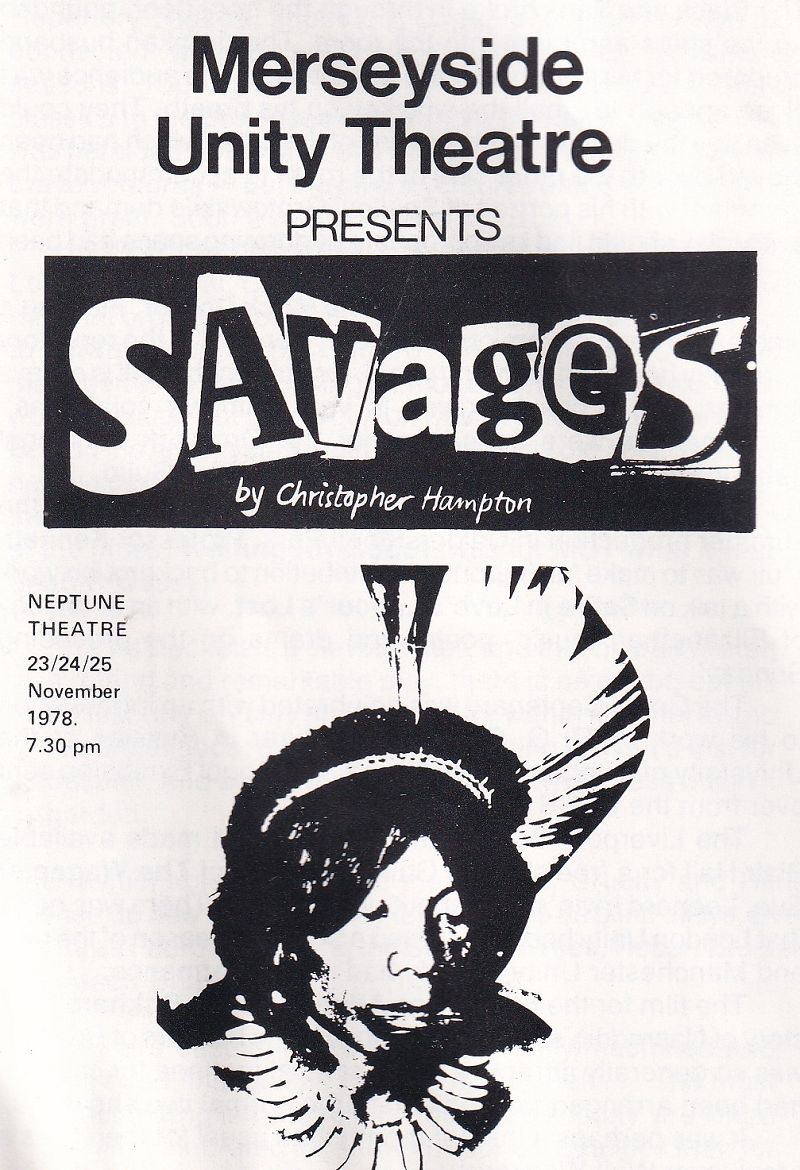
Savages, by Christopher Hampton, 1978
Timon of Athens and Filumena Marturano were followed, over 1977 to 1979, by other plays admirably within the Unity tradition — The Petty Life of the Bourgeoisie, Gorki’s picture of pre-revolution Russia; Paul Schippel, Esquire, Sternheim’s acid criticism of German middle-class snobbery; and Savages, a play written out of anger. Christopher Hampton had been deeply disturbed by an article on the genocide of an lndian tribe in Brazil. He visited the country and found that the murder of the lndians was only part of the mass exploitation of the Third World by the multi-nationals. ‘The lndian problem’, he wrote, ‘is a result of the economic policy of capitalism — a simple statement but true’. Hampton fashioned his anger and his research into a play about an English diplomat held to ransom by left-wing revolutionaries. The diplomat, a dilettante poetaster, had found in the lndians an exotic theme for his next ‘slim volume of verse’. His poems serve to introduce scenes of lndian culture — legend, craft, dance — an important part of the play (and difficult to present convincingly on the stage). The conflict between the Englishman and his Brazilian captor, the main story line, allows Hampton to present his research with the clarity of a Living Newspaper. Carlos is earnest, even priggish, but when he reads his revolutionary Manifesto it is with the authority of a man in possession of the facts:
Carlos: … the military dictatorship has transformed itself into the most regressive and repressive government anywhere in the world – West: Oh, really! Carlos: The measures it has introduced include: The suspension of all political rights and banning of all political parties except the hired lackeys of the official opposition. The imposition of blanket censorship and.the silencing of all opposition papers by intimidation … the replacement of the official Senate historian – West: Have they done that? Carlos: Yes, they have. West: Good God.
West’s facile irony can score little victories but he cannot refute the facts:
Carlos: The American public knows that their government gives aid to under-developed countries — unless they’re communist of course, in which case they prefer to ship over a few tons of napalm, but what they don’t know is that nearly all the aid has strings attached, and what they don’t know is that twice the money comes out in profit as goes in aid. Why do you think the corporations make two, three, sometimes ten times as much profit in Latin America as they do in their own countries?
The play ends with a savagely ironic picture of a world where the bombing of the Cintas Largas tribe means nothing and the murder of a minor diplomat commands newspaper headlines, radio broadcasts, TV images. Its London producer wrote:
… it was a political play, it was heavily documented, and it did say, very clearly, certain relevant things. And at the same time it was an entertaining evening in the theatre.
MUT did not need to make such a defensive apology for the play. It was admirably what they had hoped established writers would provide when the Unity Theatre movement first began.
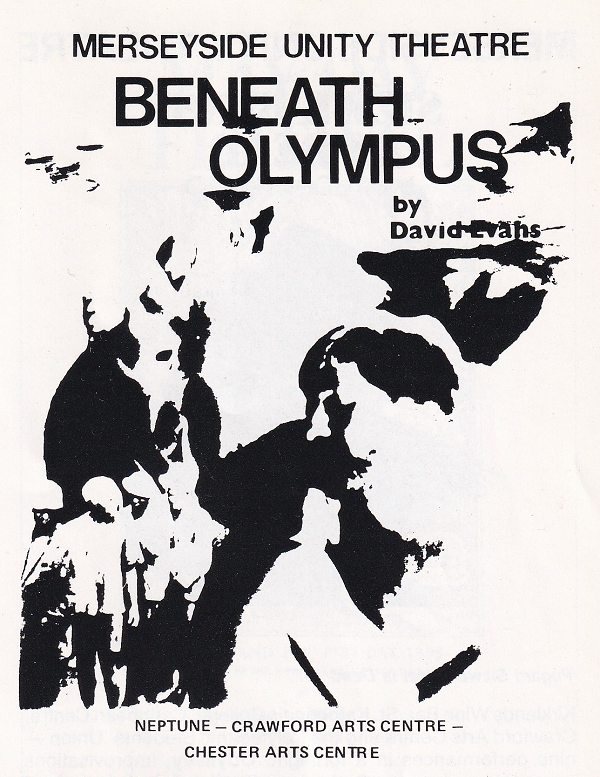
Beneath Olympus, by David Evans, 1979
The opening play of 1979 was Beneath Olympus by David Evans. The programme note gave some information about the writer:
Born in Queenstown, Cape, in 1935, David Evans began work as a journalist at seventeen … ln 1961 he joined the non-racial and socialist National Committee of Liberation, an underground group which aimed to shock the government into reform by selected sabotage and eventually armed struggle. … Arrests in 1964 led to his detention and interrogation and finally a five year prison sentence … He now works as a lecturer in the Institute of Extension Studies, University of Liverpool … Beneath Olympus is the first stage performance of his work.
The dramatist’s programme note indicated the nature of the play:
… it takes for granted the evil of apartheid and the inevitability of a militant response to it. lt is set in South Africa in the years following the Sharpeville massacre in 1960 and examines a short but crucial period in the lives of a group of white radicals and their black allies. It offers a sympathetic but critical examination of the ‘hard generation’ of South African radicals: that is, of those who initiated violent opposition to apartheid after fifty years of essentially non-violent resistance. The play is not autobiographical, or even biographical, but it draws on first hand experience of apartheid and security police tactics and is based, broadly, on actual events.
Simon Verster, the chief character, is a rebellious member of a famous Afrikaner family. His idealism ls marred by vanity and marital infidelities, though he would reasonably claim, ‘You puritans always want political saints, but having the right political views doesn’t exempt people from flaws and failings … Don’t ask too much of us’. The domestic and political tensions which develop threaten both his marriage and the black-white alliance. ln the end he faces the test of Prometheus — having stolen fire from the gods to give to men, can he endure punishment and continue to defy the Lord of Olympus?
David Evans’ next play, Reunion, was given at the Liverpool Repertory Theatre and on Yorkshire Television.
The plays of this period were firmly within Unity tradition. Even more firmly within the tradition was a vigorous return to agit-prop.
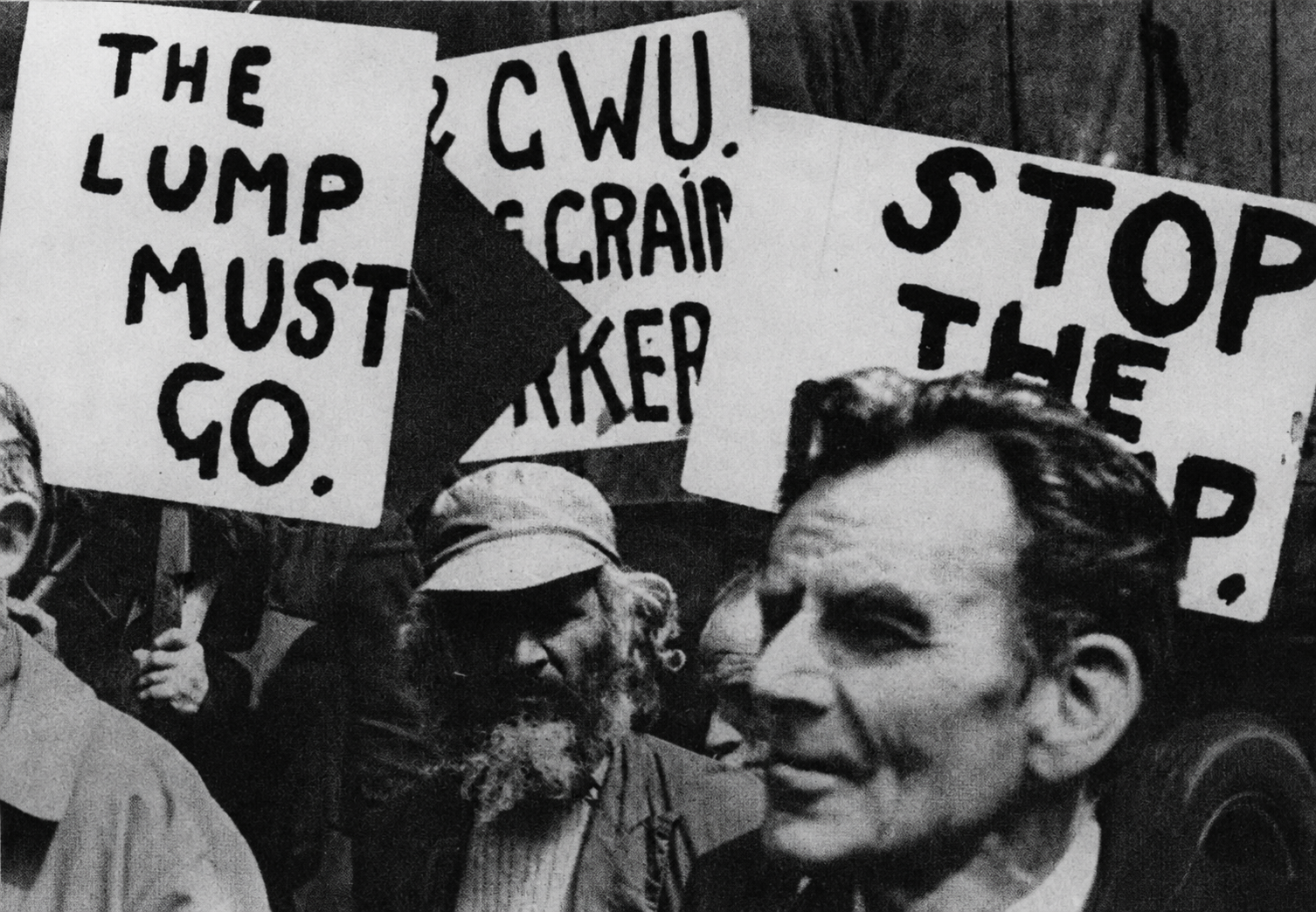
The Robert Tressell Foundation decided to erect a memorial stone over the pauper’s grave in Rice Lane Cemetery, Liverpool, where the author of The Ragged Trousered Philanthropists had been buried. Eric Heffer, MP for the Walton Constituency, and Jack Jones, secretary of the Transport and General Workers Union, spoke at the graveside ceremony. Later, in the Pirrie Labour Club, Merseyside Unity presented their version of The Great Money Trick, based on a chapter in Tressell’s novel. Owen. the central character, takes advantage of the midday break to show his fellow ‘philanthropists’ that the wealth of the rich is founded on the surplus value of the work of the poor. His fellow workers show Owen that they have been blinded to their ‘charity’ by ideas, a false consciousness, seeped into them by the rich. Shop Stewards at a later performance for a WEA Course made it clear that Owen’s lesson had still to be driven home today. An audience of Young Christian Workers, even more tellingly, accepted The Great Money Trick as a picture of conditions in the seventies.

The Ragged Trousered Philanthropists, 1972
There were other occasions which called for rough theatre. The Jubilee Celebrations of 1978 were suitably honoured with an anthology, The Cracked Crown, drawing upon republican writings by Milton, Shelley, Byron and early revue numbers. A ‘rebellion’ against the normal curriculum in a College of Education was supported by Alternative Education, with scenes from Brecht, Halliwell, Jellicoe, Hampton, Nichols and letters by Yeats and Lawrence. The painter Renzo Galleotti brought to Liverpool an exhibition in tribute to Antonio Gramsci, the Italian CP leader imprisoned by Mussolini for ten years and released only at the point of death. MUT supported the exhibition with readings from Gramsci’s Prison Letters and Prison Notebooks and an excerpt from Trevor Griffiths’ Occupations (centred on the Turin struggles of the twenties led by Gramsci).
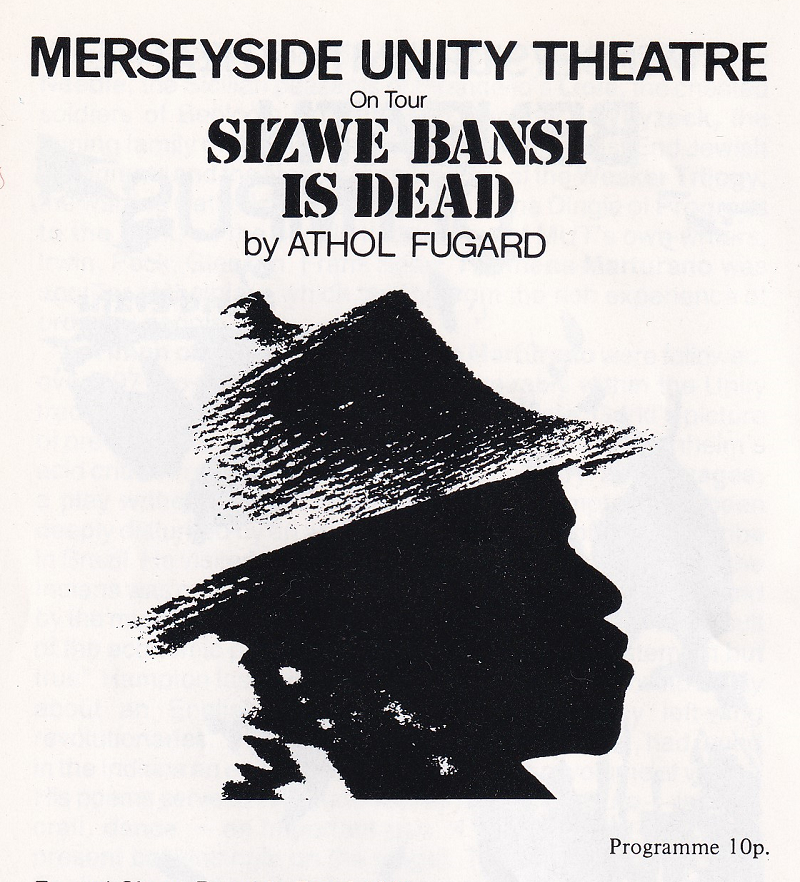
Sizwe Bansi is Dead, by Athol Fugard, 1977
There were plays designed for touring. Athol Fugard’s indictment of South African pass laws, Sizwe Bansi is Dead, based on the experiences of John Kani and Winston Ntshoni, found young black Liverpudlians who could movingly take over the parts. lt went to the Rialto Community Centre, Lark Lane Community Centre, Pirrie Ward Labour Club, AEUW Hall, Kirklands Wine Bar, St. Katherine’s College, Caribbean Centre, Crawford Arts Centre and the Polytechnic Students’ Union — nine performances in a fortnight. Odyssey, improvisations around Homer’s poem, Barbarians, Keeffe’s linked plays about young people in a corrupt society, and Liverpool ‘Ome, sketches by the Scotland Road Writers’ Group, went out on similar tours. There was a double-bill of Brecht’s The Jewish Wife, still a necessary warning about racism, and an MUT translation of Feydeau’s Condemned to Death. ln 1889 this black comedy had unmistakable references to the Dreyfus case; in 1979 the operation of ‘sus’ laws and false arrests gave it new strength. A monologue, the death-cell words of a man up from the country on a visit to his aunt in Paris, a victim of law’s inexorable machinery, it mixed the absurd with a frightening logic:
So I gets into this bus, which I heard them say was off to the Law Courts, near where my aunt lives. I heard a lot of shouting — ‘There he goes! Quick! No, it’s all right, he’sin the Black Maria!’ — and bang! they whip me straight before the Examining Magistrate and before I could open my mouth he says: ‘lt’s no use denying it. l know everything! You murdered your aunt by moonlight and cut off her left breast!’ ‘But I don’t even know the woman.’ ‘You don’t know your own aunt?’ ‘But that’s not my aunt.’ ‘How do you know it’s not your aunt if, as you say, you don’t know her?’. ‘Well, because I know my own aunt’. Then why did you just say you didn’t know her? You see how you contradict yourself? Do you also deny cutting off her left breast?’ ‘Even more so’. ‘Why even more so? Can’t you deny the rest just as much?’ ‘Certainly I do — only as far as my aunt’s breasts are concerned, I couldn’t have cut them off anyway. They’re made of horsehair. All the women have horsehair breasts in our family.’ … And then they bring in a witness who identifies me, because let’s face it there are always witnesses to identify people. He picked me out straight away. In the end the Magistrate says as long as I deny it I’ll stay in prison. So as there was no other way, I confessed, didn’t I? ‘Aha, I knew it,’ he shouted. ‘Now what did you do with your aunt’s left breast?’ Well, that did it. I lost my temper and said, ‘I ate it.’ It was those words that did for me.
Unity performed Chicago Martyrs at the May Day rally in 1978

There were two important occasions which called for special material. In 1979 Britain celebrated May Day as a workers’ public holiday, for the first time. The people had always celebrated the resurrection of life in spring. lt was easy for MUT to arrange a programme of early songs and poems, ending with a Mummers’ play. But more was needed. The organised working class had taken over an agricultural festival and moved it into the industrial world. At the Paris Conference of the International Congress of Socialist Workers the American delegate called for a General Strike for the Eight Hour Day on the First of May 1889. He wanted the day to be a tribute to the Chicago Anarchists who had been framed on a bomb charge and hanged. Here was material for rough theatre. A Liverpool bin-collector undertook the necessary research. The Paris Congress provided the dramatic framework. The American delegate made his proposal. The lights faded and came up on the Chicago Anarchists. They presented themselves directly to the audience:
Fischer: Printers’ Union. l’m German too — so they call me a foreign agitator. Well, I laugh. I tell them — in Germany I had no idea to be an agitator. ln Germany a printer is a skilled man, respected. Here, in Chicago, he’s an animal. So, I learn. The man I work for is a German. The men l work with are Poles, French, Americans. So I learn I got more in common with working-men whatever country they come from than with a boss from my own country. I learn we got to stand together or we’re nothing. I learn how to organise a union. lf they can split us into Germans, Poles, Negroes, we’re beat. lf we stand together, we win. General Strike for the Eight Hour Day on May the First.
George Engel: Carpenters and Joiners. I’ve learned a few lessons too since I came to America. But only one that is worth anything: if you don’t fight you don’t get. There is only one law for us — these (holds out his hands). Use them for work — and you get long hours, low pay and an early grave. Close them (clenches his fist) — and go on strike and we get the 8-hour day. General Strike for the 8-hour day on May the First.
Short scenes, supported by sound effects, covered the McCormick Harvester Strike, the shooting down of strikers, the Haymarket demonstration, the bomb explosion, the rigged trial, and their words from the dock:
August Spies: The Haymarket meeting wasn’t about anarchism — it was about the 8-hour day. It wasn’t called to commit murder — it was to protest against murder. But if anarchism is on trial — and that’s what the judge says the charge is — very well. Sentence me. I am an anarchist. But let the world know that in Chicago in 1886 five men were sentenced for believing in a better future.
They were taken to the death cell, then to the hanging noose. Each fastened the rope round his neck and spoke his last words.
Albert Parsons: Gentlemen, the day is coming when the silence of our graves will be louder than the voice you stifle today.
The lights came up on the Conference:
American Delegate: So now you know why we propose May the First for the 8-hour Day. We saw 10,000 workers march at the funeral of the Chicago Martyrs. We heard of protests all over the world. William Morris spoke to thousands in Trafalgar Square. And today Jim Connell has sent us a song — inspired, he says, by the ‘Devotion until death of the Chicago Martyrs’. Jim calls his song ‘The Red Flag’.
Actors and audience finished by singing The Red Flag.
The second occasion was the National Rally of the young Christian Workers in St. George’s Hall, Liverpool. Merseyside Unity presented The Two Nations. The Chairman made the usual announcement. The actors came on and placed their properties on a semi-circle of chairs in the rear. They were about to begin when the chairman returned in some confusion, had some hurried words with the cast, and announced that the performance would be held up to allow the Home Secretary, Jim Prior, to say a few words:
Prior: Rather surprised to be here, you know. When I mentioned to Mrs T that l thought of dropping in on you, casually as it were, she looked dubious, very dubious. ‘Jim’, she said, ‘Yes, she sometimes calls me Jim. I’ve got my eye on that lot. Young Christian Workers! Christians! They don’t seem to understand that the poor will always be with us! But in the end she let me come.
Again the chairman came on, followed by Mrs T who brushed past him, brusquely dismissed Prior from the stage and began:
Mrs T: As the first woman to be Prime Minister of this great land of mine, I have great pleasure in being with you in this noble hall for your great rally. Frankly, when I heard that Jim Prior was dropping in on you, I knew I just had to be here. You see, when he opens his mouth I can’t be sure what will come out. Mind you, he’s useful — to sweeten up the voters when I tell them the truth. (She picks up her notes) I’ve been called an extremist. lf it’s extreme to want to make the rich richer — then I am an extremist. If it’s extreme to cut benefits of strikers’ families — then l’m an extremist. lf it’s extreme to want more policemen to deal with pickets and niggers — then l’m an extremist. (Disturbed by audience reaction, she fumbles with her notes and can be heard muttering, ‘Must have mixed up my notes. This is tonight’s speech to the Walton Gaol Prison Officers’. She fishes out the right speech, ‘Young Christian Workers’ — that’s it. Looks at audience to make sure. Another glance at notes — ‘Kick off with St. Francis’. Begin again, gravely and sweetly). Where there is difficulty, may we bring harmony. Where there is error, may we bring truth. Where there is doubt, may we bring faith. Where there is despair, may we bring hope, (another quick look at notes — ‘Keep off policies. They may be young but they know too much. Give them Noel Coward (Cavalcade was before their time’) So, let’s couple the future of England with the past of England. The glories and the victories and the triumphs of the past — with the hopes that one day this country of ours — of MINE — which we all love so much, will find dignity and greatness and peace once again. Remember the words of Disraeli our great Empire Builder: The Tory party is the party of One Nation. All of us. Together. One nation. ONE NATION (She is interrupted by Unity actors — not before time — who show her Disraeli’s book, Sybil or The Two Nations so that they can move into their version of England’s past — the past of two nations — with excerpts from Six Men of Dorset, the Liverpool poets Clough and Mrs Hemans, etc — and the hopes for a future of one nation.)
It was a return to rough theatre. Consensus was over. The rally itself was a preparation for new confrontations. Merseyside Unity was ready to play its part.
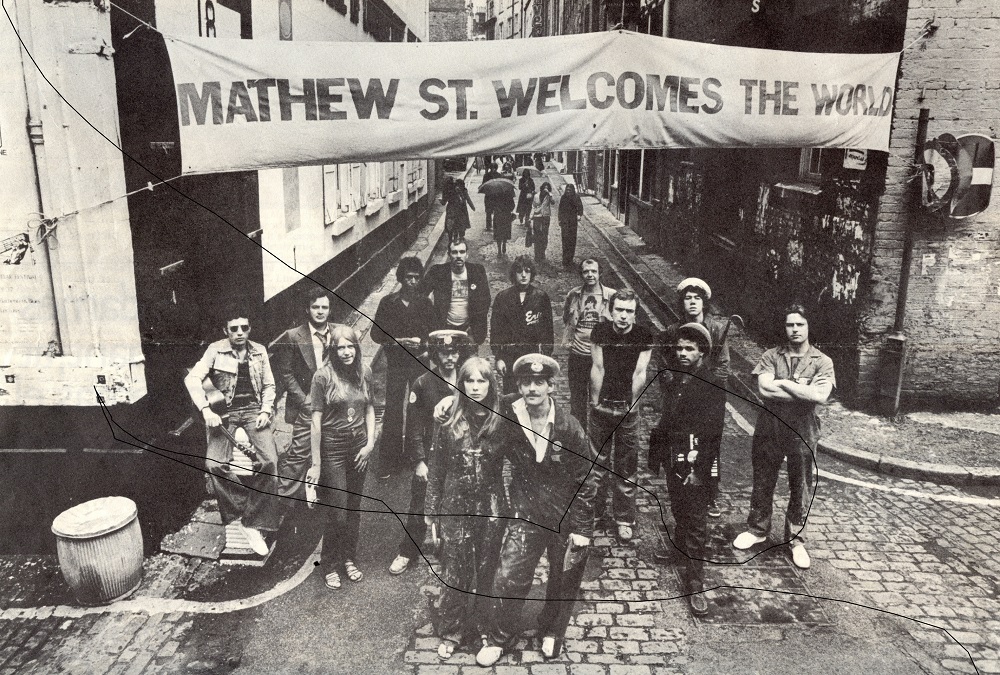
In the final years of the seventies Inner City Partnership provided grants which allowed Merseyside Unity — after years working in cold, dirty, makeshift premises — to take over a former synagogue, create a fine open space theatre and establish Hope Place Community Association and … But that is another story.
Note: This account is an extract from Left Theatre: Merseyside Unity Theatre — a Documentary Record, by Jerry Dawson, published by Merseyside Writers in 1985.
FURTHER INFORMATION
Theatre as a Weapon? The Emergence of Left Theatre on Merseyside
A paper by M Jones discussing the early history. (The Historic Society of Lancashire and Cheshire.)
Theatres of the Left 1880–1935
A history by Raphael Samuel, Ewen McCall and Stuart Cosgrove. (Routledge and Kegan Paul, 1985)
Unity Theatre archive
The business papers from 1937–1987 of the Unity Theatre, formerly the Merseyside Left Theatre, are held at the Merseyside Maritime Museum Archive. Contact maritime.archives@liverpoolmuseums.org.uk for all enquiries pertaining to these records. Other theatre collections held at LJMU SCA include the Everyman Theatre papers (EVT), the Liverpool Royal Court Theatre papers (RCT), the Fuse Theatre papers (FT), Willy Russell’s papers (WR), and the papers of the play Watching by Jim Hitchmough (WJS).
Unity Theatre
Official website







0 Comments