In 1969 a firm that owned thousands of rented properties in the Toxteth area of Liverpool offered to sell them to the council. Most were in a poor state of repair, many were scheduled for demolition and the council, wary of taking on the burden of managing them, declined the offer.
Eventually, this seemingly undesirable portfolio of 3,423 houses, which in some cases comprised entire streets, was snapped up by Hibernian Properties for £1,241,000 — an average of just £362 per house.
Hibernian was one of a string of companies run by James Standfield Wade who had ideas for turning his acquisition into a money-spinner.
Getting rid of ‘stubborn’ tenants
The biggest obstacle to making a profit was that rents paid by the tenants had not been increased since 1939. Government legislation had frozen them on the outbreak of the Second World War and they had remained frozen because of the housing shortage that followed the war. In the meantime inflation had taken its toll, with the result that the rents were no longer enough to cover maintenance costs on the properties.
However, the 1957 Rent Act offered a partial solution: if existing tenants moved out, the rent became unfrozen and landlords could bring in new tenants at a higher rent. Alternatively, the property could be re-sold at a profit, because unfreezing the rent also increased its value.
Not surprisingly, that gave landlords a strong incentive to get rid of existing tenants. Also unsurprisingly, tenants with frozen rents were often unwilling to leave.
“You would be surprised how stubborn some of the older ones are,” Wade’s PR chief Anne Mitchell told the press. “They have been there for donkeys years and refuse to move out.”
But there were ways and means …
In 1971 elderly tenants on Princes Road received a letter that sounded considerate but was actually menacing. It said:
“The company has been approached by various groups of students at the university with requests for accommodation and the company proposes making its Princes Road flats available to these students.
“We appreciate that in some cases tenants may prefer to seek alternative accommodation, in the belief that the advent of these youngsters could have a disturbing influence upon the peaceful enjoyment of their tenancies.
“Whilst every care will be made in the selection of students, it will quite obviously be impossible for the company to guarantee that all will behave in a quiet, studious manner for the entire period of their stay.
“We have been informed that there is a tendency, as examination time draws near, for the students to become strained and temperamental.
“As the company has a number of vacant properties on its register, it is felt that these should be offered to the present tenants in Princes Road at beneficial rates, or alternatively, that the company should pay to the tenants a small premium, provided the company is given the benefit of vacant possession.”
For Wade, the financial benefits of ousting the “stubborn” tenants from Princes Road were very substantial. When the students replaced them, four to each flat, Wade charged £41 per person per term — an annual total of £492 which was two or three times the previous rent.
Twenty weeks of ‘discomfort’
Another way of encouraging unwanted tenants to leave was by warning them that scheduled improvement work would cause a nuisance lasting several months. In one example reported by the Liverpool Free Press, Michael Hefferon, a prominent Toxteth landlord who was also a Liberal councillor, informed tenants they would face “quite a lot of discomfort” for 20 weeks.
Referring to one particular tenant — the mother of four children — Hefferon wrote: “We have advised her in her own interest to seek alternative accommodation as there will be quite a lot of dust and building rubble in the atmosphere due to these operations.”
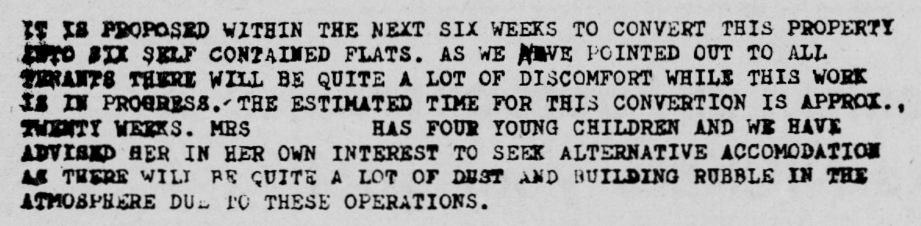
The letter from landlord Michael Hefferon
Fortunately for landlords, this work not only increased the value of their property but was mostly paid for by the public. Landlords, as well as owner-occupiers, could apply for Home Improvement Grants covering 75% of the cost. The upper limit was for work costing £2,000 — in which case the grant would be £1,500 — and landlords’ applications routinely sought the maximum amount.
Wade, however, soon found a way to maximise it bit further. The grants included £136.50 towards architects’ fees for each property but Wade was in a position to pocket the money without necessarily spending it on architects each time. In Toxteth’s terraced streets the houses were often identical, so one architect’s plan could be submitted multiple times for multiple properties.
Money from freeholds
Hibernian’s mass purchase of rented properties also included the freeholds of 4,366 owner-occupied houses. That provided income in the form of ground rents but the amounts were tiny — in some cases as little as £2 a year. However, Wade knew a way to make the freeholds more profitable.
Owners of these leasehold properties who wanted to apply for an improvement grant first needed permission from the freeholder. Most freeholders treated it as a formality but Wade began demanding £15-£20 for signing the papers.
That wasn’t all. Leaseholders asking a signature were then treated to a visit from a Wade representative suggesting they might have a long wait for approval and to avoid potential delays it would be better to buy the freehold for £45 — which, according to the Lands Tribunal, was more than twice what it was worth.
Evading the Rent Act
In 1965 a new Rent Act sought to protect residential tenants from exploitation by landlords. It introduced the concept of “fair rents”, to be determined by Rent Tribunals, and made eviction more difficult.
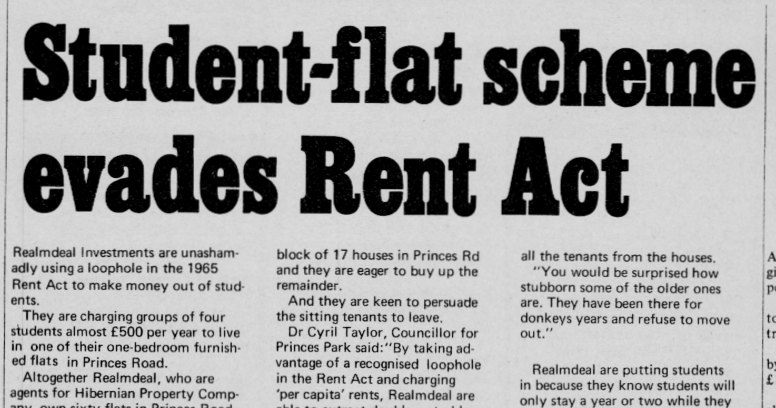
This prompted landlords to search for ways to circumvent the law by pretending that people renting their properties were not actually tenants — and therefore not protected under the Rent Act.
In the case of Wade’s student flats, there were no tenancy agreements or rent books. Instead, the company issued the students’ parents with a “licence to occupy”, allowing their son or daughter to “use” the flat.
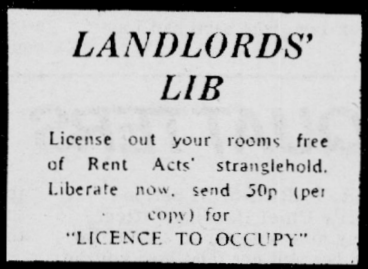
This advert appeared in a London newspaper offering landlords information on how to avoid the “stranglehold” of the law
One especially weird device — adopted by Wade and a number of other landlords on Merseyside to evade the Rent Act — was a “rental mortgage” which construed tenants as “home buyers” and rents as repayments on an imaginary loan. The effect of this was that “buyers” got all the responsibilities of home ownership without the usual benefits and also forfeited their rights under the Rent Act.

Advert from Liverpool property firm Leslie Rubin offering rental mortgages disguised as flat sales.
“Buyers” agreed to make monthly payments over a period of 15 years but the property would not become theirs until the final payment had been made. In the meantime, “buyers” were not building up a financial stake in the property: if they moved out within 15 years (which was very likely) it would revert to the “seller”.
The only sensible interpretation of this was that the “buyers” were rent-paying tenants — except that they, rather than the landlord, were now responsible for repairs and the rent they were paying could not be challenged at a tribunal. Monthly payments on a rental mortgage were higher than the “fair rent” for a comparable property but the idea of eventually owning a house made “buyers” willing to pay.
A further snag was that the houses “sold” in this way were often in a clearance area — which meant they were likely to be knocked down before the 15 years were up. In that situation, the “buyer” would become homeless and the council’s compensation for the demolishing the property would go to the “seller”, not the “buyer”.
Rental mortgages were common for a while at the seedier end of the property business but they appear to have been killed off by new regulations under the 1974 Consumer Credit Act.
Meanwhile Wade, despite all his money-making ideas, was not making enough to keep creditors at bay. He had borrowed heavily from London and County Securities, a banking firm which went bust in 1973 and was later rescued. In 1974, following its rescue, the new managers called in a receiver to three of Wade’s companies and his empire collapsed. Fortunately for his tenants, two housing associations took over the properties he left behind.
FURTHER INFORMATION
Liverpool Free Press reported frequently on the activities of Wade and his companies’ tactics …
Why the old folk are worried about Realmdeal
Aug/Sept 1971, p3
Student-flat scheme evades Rent Act
Sept/Oct 1971, p10
Warning on Realmdeal
Nov/Dec 1971, p12
Goodbye Realmdeal – Hello Standfield
Dec 1971/Jan 1972, p8
How Mr Wade will make a million
Feb/Mar 1972, p5
Poor Mister Wade!
April 1972, p5
Stanfield sell home at twice its value
Jul/Aug 1972, p3
Wade has a setback
March 1973, p10
Good riddance: big city landlord packs his bags
Sept 1974, p1
The rise and fall of James Standfield Wade
Sept 1974, pp6-7




















0 Comments