
In the 1920s and 1930s Liverpool was the home of Britain’s biggest toy manufacturer, famous for three iconic product lines: Meccano construction sets, Dinky toys and Hornby model trains.
The man who started it was Frank Hornby, born in Liverpool in 1863. Hornby worked as a bookkeeper but in 1899 he developed an interest that later made him a millionaire. He began making toys for his children from pieces of metal –which led eventually to his invention of Meccano.
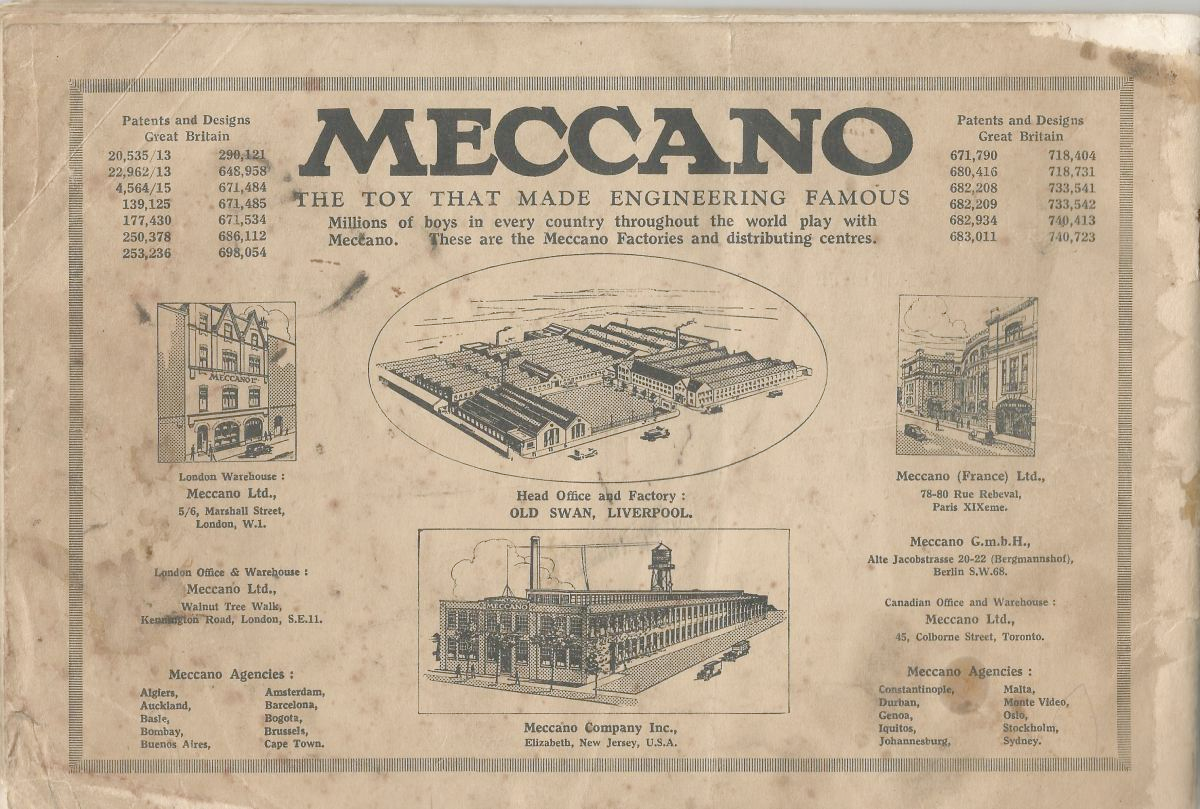
In 1908, after borrowing £5 to patent his idea, he sold his first Meccano sets. Demand grew and in 1914 his company, Meccano Ltd, moved to a purpose-built factory on Binns Road in Old Swan which remained its headquarters for the next 65 years.
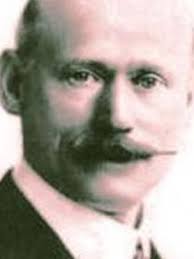
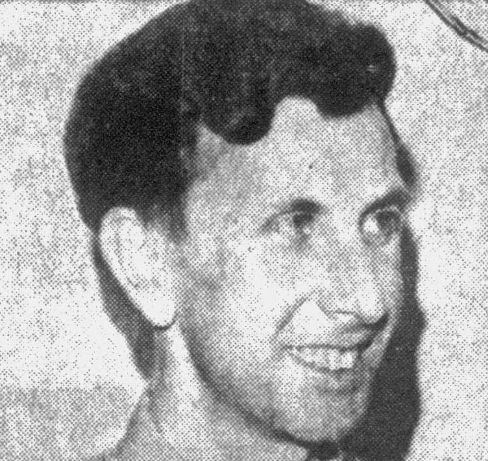
Meccano inventor and company founder Frank Hornby
By 1964, though, there were financial problems and the firm was taken over by Lines Brothers (makers of Tri-ang products). Five years later Lines Brothers went into liquidation and Meccano Ltd was then taken over by Airfix.
Airfix failed to make a success of it and in 1979 the factory closed, though not without resistance from its predominantly female workforce. They occupied the factory in a desperate effort to save their jobs and stayed there for 14 weeks.
In the article below, GREIG CAMPBELL traces the course of their campaign through the oral testimonies of participants.

‘Give us work, not dole’: fourteen weeks of resistance
IT WAS 3.45 on a Friday afternoon when the managing director of Airfix (Meccano’s parent company) summoned union representatives and told them the firm would be closing down within an hour, putting more than 900 people out of work.
“While we were sitting in the meeting management was issuing everyone on the shop floor with their redundancy notices,” one of the union reps recalled. “When we raised the question of 90 days’ notice, the managing director said ‘You’ll have to take us to court’.”
To explain the closure, executives promoted the image of a commercially viable company undermined by indolent employees — a demonstrably false narrative to divert attention away from their own failings. Under Airfix, Meccano had experienced gross mismanagement, prompting one business historian to contend:
“Meccano’s problems lay not so much in the environment as in the firm itself. New strategies, more appropriate to the increasingly competitive situation, were slow to emerge. When they did, management lacked both the ability and knowledge to implement them effectively.”
Incompetence at boardroom level manifested itself in a multitude of failings. On the commercial front, industry experts bemoaned the company’s failure to respond to new market trends:
“The weakness of Meccano is that it is essentially an Edwardian toy. It was designed for the sons of men sent out to the colonies to build bridges, and it hasn’t changed much since then.”
Likewise, the archaic nature of product development often left workers bemused:
“I lay the blame for the disastrous collapse of Meccano on the old-fashioned small-minded management. They held the rights to make Star Trek products from 1969 but chose not to make ‘space stuff’ until about 1976. They threw money into making a [model] Cinderella coach but didn’t have the naming rights. It was based on a Hollywood movie of that time, ‘The Slipper and the Rose’.
“They chose to make the coach out of die-cast metal, a very hard and sharp material. Great for Dinky cars but for a toy aimed at young girls? Totally unsuitable. The women on the assembly line laughed at the product and knew it would not sell.”
Meanwhile, a refusal to invest in plant and machinery had left the Binns Road plant in a state of total disrepair, prompting The Times to liken it to “a museum of industrial archaeology”. One ex-worker reflects on the obsolescence of the press shop:
“They were still using machines from 1910. They had presses there that were belt driven. They were 30 or 40 years old. In my recollection I can’t remember the press shop ever getting a new machine … It was the same old machines from when Hornby had it.”
Experienced engineers were forced to adopt a patch-and-mend policy in a futile attempt to fulfil vital orders:
“Machines would leak oil because the seals were so badly worn — you were plugging them all the time to make them work. You were using your engineering skills to keep them going … At the same time, you’re being criticised for not meeting your production targets.”
It was therefore operational mismanagement, rather than the workforce itself, that contributed to chronically low productivity. Airfix, meanwhile, oversaw a managerial merry-go-round that witnessed the hiring and firing of eight managing directors in as many years. The final custodian was Ray McNeice, a hatchet man who oversaw the systematic withdrawal of Meccano from Liverpool:
“He came in with one sole aim: that was to close Meccano down … to try and close it down within a time frame.”
At the same time, though, he was promising improvements to the canteen and toilet facilities (see note below).
As a faceless and absent multinational corporation, Airfix engendered an industrial relations culture that contrasted greatly with Frank Hornby’s renowned paternalism. Company officials would subsequently blame the firm’s downfall on poor industrial relations, depicting workers as industrial ogres. In truth, the Meccano worker — mostly women — were incredibly conscientious, motivated in part by a remuneration package that relied heavily on hitting production targets:
“There were no slackers, because the women supervisors wouldn’t let it slack. Winnie Bleasdale, she was one of the main women and she wouldn’t let you do anything out of order. I’m telling you, she was good …
“If you didn’t make cars, you didn’t make money. Simple as that. So, they didn’t slack in any way, shape or form. All the women were on bonuses … You had to work hard to earn your wages. You got a flat basic rate, and that was rubbish. You made it up with your bonus.”
Despite management claims, some of the most loyal employees were trade unionists. Electrical Trades Union (ETU) representative Terry Culligan would regularly work ‘off the clock’ to ensure the line was running smoothly for female co-workers. When faced with a major cashflow crisis in the mid-1970s, a team of shop-stewards co-authored a survival plan that voluntarily sacrificed hundreds of jobs:
“We’d already gone through redundancies. I had to go to my dad and tell him, ‘Sorry dad, you’re getting made redundant.’ You see, we had to make a choice … We started off with everyone over 65. My dad was over 65, so I had to go and tell him. It was soul destroying for me.”
Three years later, the same General and Municipal Workers’ Union (GMWU) official told The Socialist Challenge:
“They’ve put out in the media that we have been disruptive and have had disputes. It’s not true. We’ve cooperated with management all along the line. This is a stab in the back … They’ve definitely hoodwinked us.’’
‘Even the fellas were crying’
In the immediate aftermath of the announcement, a wave of despair descended over the women:
“People started crying … Even the fellas were crying … “Oh my god, what am I going to do? It’s nearly Christmas. This isn’t fair. This isn’t right! This is why we’ve been working so hard for the last 12 months. They’re moving! They’re going somewhere else.”
Anguish was soon replaced by a sense of outrage that sowed the seeds of mass resistance:
“We were all gobsmacked, we never even thought about it [the occupation] at first. But after, say, 15 minutes, we were getting our heads around it: ‘Right, that’s it, we need to do something about this. They’re not getting away with this. They can’t do this. We’re going to sit in’.”
The first stage of what was an entirely spontaneous plant takeover witnessed shop stewards escort indignant managers off the premises:
“Management? … They weren’t happy, let’s put it that way. Other than that, there wasn’t a lot they could do, with a load of hairy young Liverpudlians, telling them to get out … And that’s basically what happened. They were told to get out of the factory?”
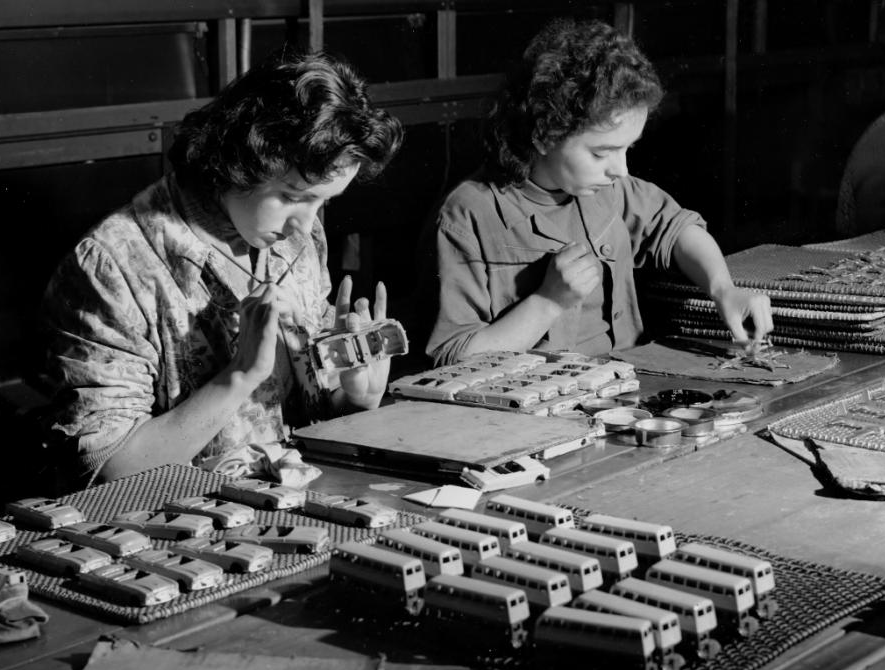
Workers putting the finishing touches to Dinky toys
The factory was now under workers’ control. That weekend, a small group maintained a nervous vigil, safeguarding the site and its contents from potential intruders. Then, after clocking-in as usual on Monday morning, a mass meeting voted to transform the takeover into a permanent occupation. Shop stewards promptly welded the factory gates shut, locking inside millions of pounds worth of stock and machinery.
On the ground, the protest was coordinated by the likes of Rosa Owens, an Italian-born GMWU stalwart and plant matriarch. Under her supervision, strict rules and a flexible five-shift rota were established. Over the ensuing 99 days, the women of Meccano became poster girls for the mainstream press, with The Times dubbing them the ‘tiny ladies of toytown’.
A wider anti-closure campaign outside the workplace was organised by a Joint Shop Stewards Committee headed by the likes of Frank Bloor, John Lynch, Dick Fitzpatrick, Rose Hanley and Anne Noon.
At this juncture, there was considerable appetite for the sit-in, with one-third of workers actively participating. A discernible camaraderie, initially prompted by a collective occupational culture forged by assembly-line work, was augmented by anger at the increasingly nefarious behaviour of management:
“I think they were extremely underhand … They didn’t respect who we were. They didn’t give a damn … We talked about how angry we were. How upset we were. We’d got to stick together … We felt that we could make a point. A point to them, to say, ‘We’re not the scum of the earth. How dare you treat us like that. We’re human beings, and we’ve worked hard.’ They had no right.”
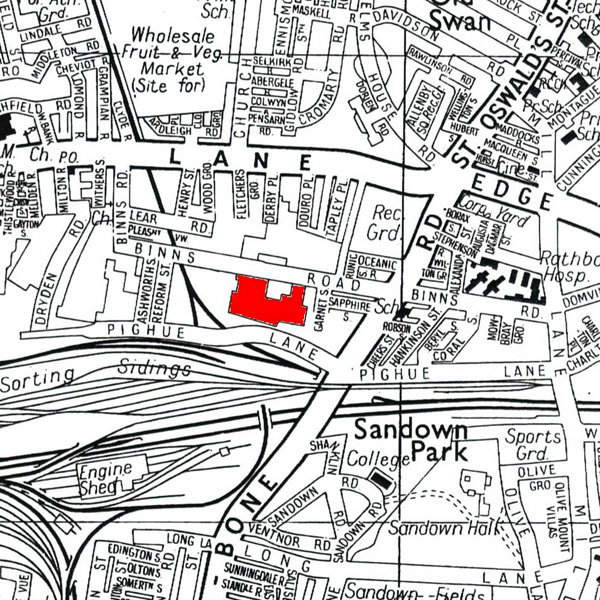
Location of the Meccano factory on Binns Road
The Committee ran a proactive defence campaign, adopting a strategic framework that drew on an extensive external support network. One important ally was GMWU district official Mike Egan, a former Meccano employee who acted as an intermediary between local shop stewards and the institutional labour movement. Another was Jack Spriggs, a principal protagonist in the 1972 Fisher Bendix work-in. Liverpool Trades Council, meanwhile, administered a fighting fund and activists from Militant and the Socialist Workers Party helped organise a series of direct actions that culminated in a huge rally against de-industrialisation at the Pier Head.
Seeking government intervention, the Committee mobilised a powerful cross-party political lobby of approximately 30 MPs, who forced a parliamentary debate on Meccano’s future. Meanwhile, workers oversaw a sophisticated PR campaign that exposed both the immorality and illegality of the closure announcement.
This prompted several industrial correspondents to write poignant articles describing the human impact of closure. In one, Ross Giles of The Times depicted a customarily moderate breed of worker forced into militant industrial action by malevolent bosses:
“Mrs Owens and Mrs Hanley seem to have no interest in arrogating management’s right to manage. They just seemed angry at not being consulted and determined from now on to have a say in their future. A banner over the entrance proclaims ‘Airfix’ll fix it. They fixed us’.”
The plight of the workforce penetrated the collective conscience of a British public that considered Meccano an integral part of the nation’s cultural heritage and, moreover, a symbol of industrial survival. A reader’s letter published in the Guardian said …
“I was utterly dismayed to read of the threatened closure of the Meccano factory in Liverpool. Quite apart from the loss of nearly 1,000 jobs in a depressed area, the demise of the model engineering system that has entertained and educated millions of boys and men all over the world for three quarters of a century can only be described as cataclysmal … There is only one Meccano: not merely the best toy ever, but part of our national heritage.”
Such messages provided a tremendous psychological boost to workers:
“It made you feel better. It made you feel a bit more positive … At the end of the day, we will have always been supported, no matter what … They just made us feel wanted. Stronger and positive.”
With the fight for jobs having been thrust into the public arena, the Tory government had little choice but to intervene. Responding to complaints in parliament from Merseyside MPs David Alton and Eric Ogden, Margaret Thatcher ordered David Mitchell, Under-Secretary for Industry, to investigate a possible breach of the Employment Protection Act. Following a meeting with workers in Whitehall, an outraged Mitchell asserted it would appear that the management had ‘behaved like a caricature of an 18th century mill owner’. After raising the prospect of a staggering £1.5m fine, he demanded an urgent explanation from company headquarters.
Airfix strikes back
Company chairman Ralph Ehrmann then scrambled into action. At private talks with Mitchell, he sought an exemption from his legal obligations as an employer, claiming management was forced to expedite closure due to huge financial losses. Mitchell rejected his assertion but offered no political solution. As acolytes of free market capitalism, the new Tory government had already aligned itself with corporate agendas. By rejecting a final plea from the unions for a cash bailout, they effectively endorsed closure.
Emboldened by Whitehall’s apathy, company bosses could now act with impunity. On Christmas Eve, they sought to freeze the occupiers out by switching-off power, gas and water. Head office then intercepted public donations and withheld statutory holiday pay in a bid to starve employees into submission.
The assault continued when Airfix hired PR consultant Nick Cowan to denigrate employees in the press. Described by the unions as ‘a paid assassin’, he sought to tap into popular misperceptions of Liverpool’s industrial relations culture:
“My argument is that Meccano had become unmanageable because of vandalism, sabotage and pilfering over many years. I told the unions, if you agree with us that there are special circumstances, our allegations of industrial anarchy will not be released to the press. If we go out in public and spread this mess around it won’t do the reputation of Merseyside any good.”
Furious Committee leaders dismissed these threats and accusations in a rebuttal published in The Sunday Times. The article included counterclaims of “excessive management perks — lobsters and curtains bought on petty cash”, and featured the testimony of former Meccano boss George Flynn:
“He told us that in times of stress he had never worked with a better workforce: ‘God knows what possessed Airfix to say the things it did about them. The stewards were more committed to getting Meccano right than some of the managers.’ He claims that disputes were few and that the company’s problems were not its workforce but wrong investment at the wrong time.”
For the remainder of the occupation, Committee leaders desperately sought third party investment. They initially turned to local Councillor Derek Hatton who sponsored a resolution calling for the City of Liverpool to finance a workers’ co-operative. The highly controversial left-wing firebrand outlined his municipal takeover proposal in The Militant:
“Under this reactionary Tory government we’re putting forward the proposal that the local authority take over the Meccano plant as a municipal enterprise, in a similar way that local authorities take on direct building work, etc. I think the city council have got to take this issue on board … to ensure that the necessary money is pumped into Meccano to enable workers to take it on, to manage it and to control it along with the trade unions concerned.”
When the proposal fell victim to Liverpool’s fragmented political landscape, Committee leaders once again turned to the institutional labour movement. Working alongside trade union officials, they undertook a feasibility study that resulted in a new survival blueprint.
Ehrmann, meanwhile, was persuaded to join a working party formed to negotiate a sale. A ‘super sell’ campaign was launched with the sole objective of finding a buyer before 28 February 1980 — the deadline for the government-enforced consultation period. With shop stewards presenting their proposals to interested parties, hopeful sit-inners cleaned the factory from top to bottom and performed vital maintenance of machinery.
However, a sale failed to materialise. Ehrmann only ever gave a cursory glance at several formal enquiries and two cash offers. The working party was just a managerial subterfuge, devised to give the impression of full and meaningful consultation as Airlix deliberately ran down the clock:
“There is a growing suspicion that he wants to take the brand names away from Liverpool and, possibly, have them manufactured in factories abroad. If that turns out to be the case, it would be tantamount to stealing names which have been developed in the City of Liverpool.”
With negotiations stalling, an irrevocable malaise took hold of a battle-weary workforce:
“It was absolutely freezing cold. You know, a cold and empty factory. You’re looking at places and saying ‘Mary used to sit there’. It was like a ghost town … We just called it a day and that was it.”
Management began targeting vulnerable employees with offers of head-turning compensation packages. As high-level talks continued, financial self-interest superseded the abstract values of fraternal solidarity, kinship and community — prompting individual workers to take voluntary redundancy:
“We were all in the fighting spirit when it first happened, and we weren’t going to give up for anybody. But the way they did things and threatened us … ‘You’re not going to get your re-dundancy’ … People were really struggling … A job came up at a solicitor’s and luckily enough I got it.
“I was still in touch with people. I’d ask, ‘How are you going?’ … They’d say, ‘There’s no-one going [to the factory] now. So we packed it in’.”
Resistance crumbled and, with the 90-day deadline having passed, the occupying force dwindled to 50.
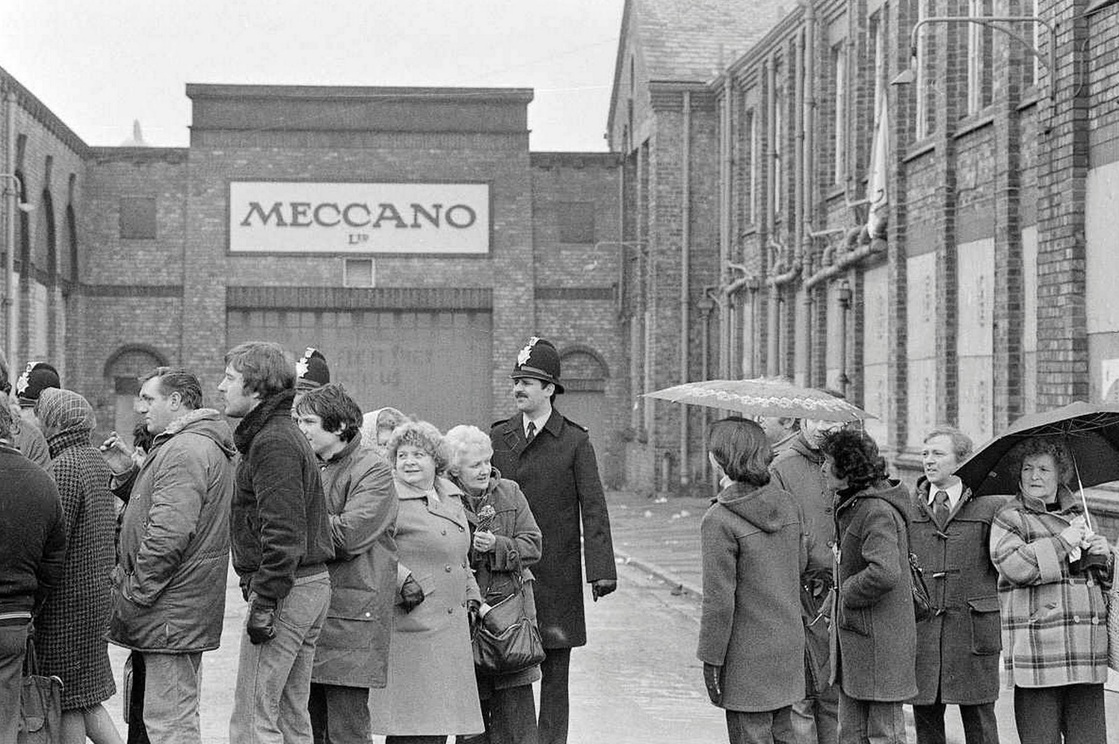
When company headquarters obtained a High Court repossession order for the plant, the remaining occupiers reinforced the barricades, with some taking vantage points on the roof.
A final showdown seemed inevitable. However, having sought legal advice, union leaders urged their members to abandon the factory. After some consideration, the Committee eventually relented — drawing up plans for a peaceful and dignified withdrawal on their own terms. But they wouldn’t be afforded such an opportunity.
At 4am on the morning of 11 March 1980, bailiffs backed by 36 police smashed through the barriers and stormed the premises. This pre-dawn raid, conducted by what shop stewards dubbed ‘the job-killer squad’, took dazed and confused workers by surprise. By the time a picket was re-established outside, locksmiths had secured the building. After 102 days, the Meccano sit-in was finally over.
The occupation in retrospect
Although the fight for jobs was halted in March 1980, the occupation united a regional labour movement that had become fragmented and demoralised by Labour’s election defeat in the 1979 general election. As a beacon of resistance that inspired a new wave of mass defiance against the evils of Thatcherism, it had a clear political afterlife.
Despite such intense symbolic significance, the battle for Meccano has been disregarded by contemporary labour historians, who have instead cast their scholarly gaze elsewhere. Mirroring this literary marginalisation, the anti-closure struggle has failed to penetrate Liverpudlians’ collective memory.
The sit-in, nevertheless, signifies a remarkable chapter in Britain’s labour history. Whilst to some, it may represent yet another glorious defeat for the trade union movement, to those who participated, it exemplifies the spirit of Liverpool — the city that dared to fight:
“We didn’t just take it on the chin and walk away … Ultimately, we were never going to win, but at least we had a go. Every single one of us — we’ve all still got pride in ourselves. At least we tried. That counts for something.”.
Dr Greig Campbell is a labour historian whose work focuses on worker responses to plant closures. The article above is an edited extract from his pamphlet, ‘Give Us Work Not Dole: an oral history of the Meccano sit-in’
Further information
Meccano factory occupation timeline
30 November 1979 — 11 March 1980
Frank Hornby Heritage Centre
“A journey that started with humble beginnings, tinkering with a toy to entertain and educate his children, to being an inventor, industrialist, businessman, politician and millionaire.”
Hansard, 5 December 1979
Parliamentary question by David Alton (MP for Liverpool Edge Hill) regarding company’s failure to give the statutory 90 days’ notice of redundancy to Meccano employees.
Hansard, 17 December 1979
Parliamentary question by David Alton (MP for Liverpool Edge Hill) regarding government grants paid to Meccano Ltd.
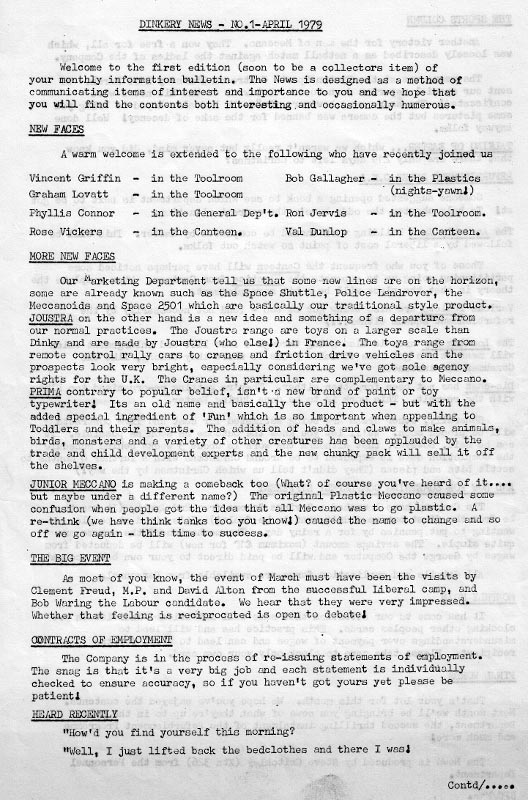
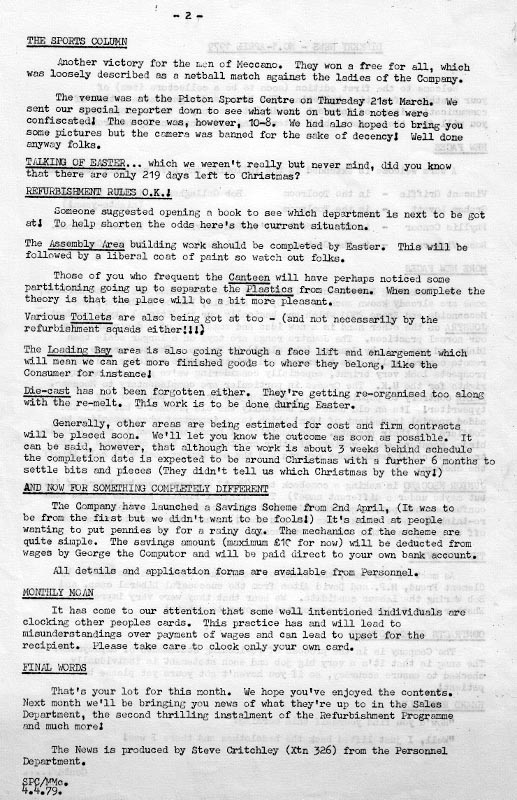
Staff newsletter, April 1979
In April 1979 – just eight months before the factory closed, management issued a cheerful staff bulletin welcoming new employees and promising improvements to the building. It also mentioned that the company was in the process of “re-issuing” employment contracts and announced the creation of a savings scheme for staff wanting to “put pennies by for a rainy day”. Source: Dinky Toys Collectors Association.





0 Comments