Liverpool People’s History

Revisiting the 1970s and 1980s

Concrete is beautiful: the Shankland master-plan

0 comments

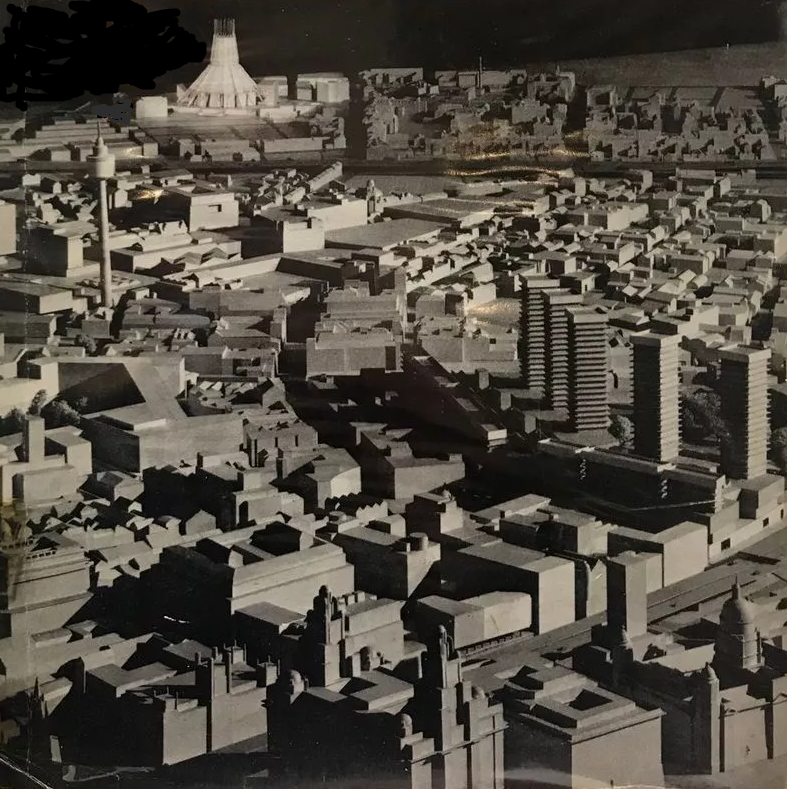
City centre model

A model showing Liverpool’s city centre, redesigned according to the Shankland plan. A photo of this model appeared on the cover of the plan.

In the early 1960s Liverpool’s council was seeking to redevelop the city— especially its centre — on more modern lines. The Planning Department was not yet established, so the council decided to hire a consultant. The man chosen for the task — by a panel of university professors — was Graeme Shankland who, in the words of the Sunday Times, came from “that fountainhead of imaginative planners, the London County Council”.

Over the next few years Shankland developed a hugely ambitious plan that has since been described as “notorious” and “a nightmare”. His vision for Liverpool was to tear down much of the centre and replace it with “robust and manly” new buildings encompassed by an inner motorway on stilts. Vast areas were designated for car parks and pedestrians would be consigned to “walkways in the sky” (foot bridges) with under-floor heating to prevent people from slipping on ice in the winter.

Fortunately for Liverpool, the economic downturn in the 1970s made Shankland’s plans unaffordable and they were abandoned bit by bit. That led to another problem, though, because the preparations had blighted much of the city. Areas scheduled for demolition became twilight zones while others — already cleared — remained empty in the absence of funds for new construction. This prompted acerbic jokes that the council was taking up the task that Hitler’s Luftwaffe had left unfinished.
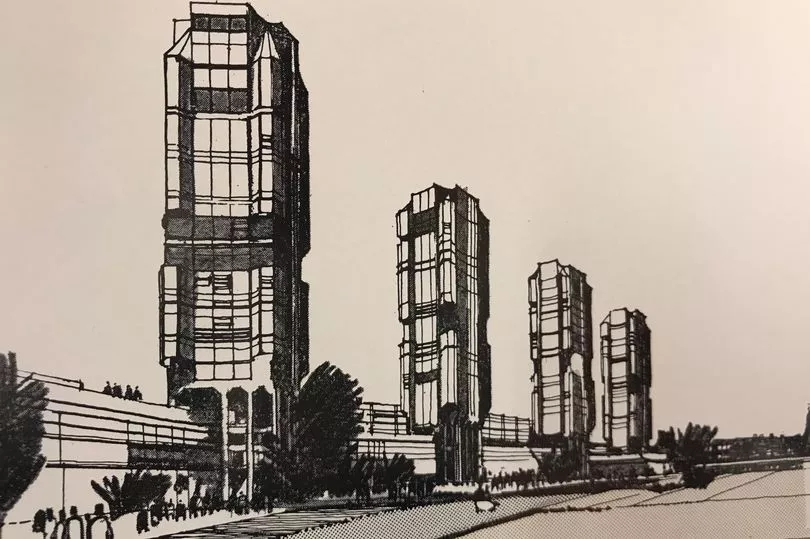
Strand/Paradise Street redevelopment

Shankland’s proposal for the Strand/Paradise Street redevelopment.

Shankland’s plan included four major construction projects: the Inner Motorway, the Civic Centre, St John’s Precinct and the Strand-Paradise Street scheme. The only one to be completed more or less according to plan was St John’s Precinct, an architecturally mundane shopping centre (though it did have a spectacular ventilation shaft in the form of St John’s Beacon, aka Radio City Tower).

The Strand/Paradise Street scheme eventually went ahead but with a different design and more realistic ambitions than in Shankland’s plan. It’s now known as Liverpool One.

The Inner Motorway and the Civic Centre, meanwhile, were both abandoned.

The Civic Centre

The idea behind the Civic Centre was to bring all council departments together under one roof — basically a massive new office block.

Objectors regarded this as both unnecessary and unaffordable but the council pressed ahead. It had spent several millions on professional fees and buying up properties that stood in the way before the government stepped in and refused planning permission on the grounds that “the proposed building, because of its alignment, overpowering bulk, scale and severe uncompromising regularity, would be oppressive”. (See separate article for a detailed account.)

Liverpool city centre map

Liverpool city centre, showing the route of the proposed Inner Motorway. The dark shaded areas were earmarked for car parking.

The Inner Motorway

Shankland’s plan was for a motorway around the city centre to relieve congestion and speed up traffic. It was intended to link directly to an extension of the trans-Pennine M62.

The most notable feature of this was that the motorway would be entirely on stilts. A detailed description of the project, including maps of its proposed route, can be found on the roads.org website.

One problem with the plan, which Shankland had warned about, was that although the motorway could be constructed in phases, none of its parts would serve a useful purpose until the whole thing was complete. There was thus no point in starting work on it unless the council could be sure money wouldn’t run out in the later stages.
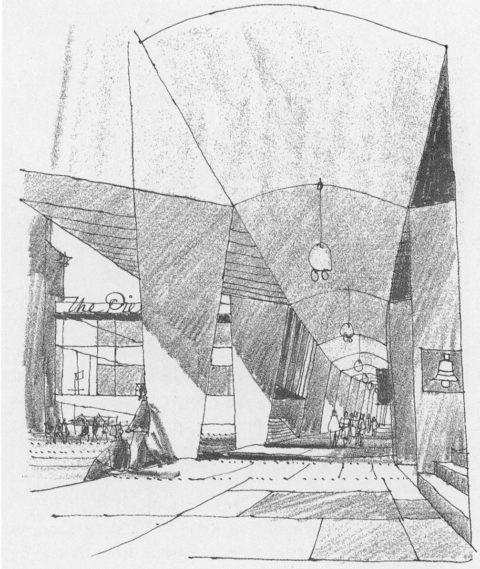
motorway underside

Shankland wanted the elevated motorway to be seen as beautiful. This drawing, by architectural draughtsman Gordon Cullen, makes its underside look attractive.

By the end of 1970 the rationale for the Inner Motorway— based on over-optimistic assumptions about economic growth — had largely disappeared and, at an expected cost of £22m a mile, the project was in jeopardy.

At this point the Daily Post and Echo began a campaign to save it, without mentioning that they had a financial interest. The Post & Echo company had long been complaining that traffic jams were hampering newspaper distribution from its building in Victoria Street. It had decided to move the offices and printing plant to a new site in Old Hall Street where, according to the plans, a slip road would provide almost instant access to the Inner Motorway.

The Post & Echo’s dream ended with a rude awakening, however. In 1976 the Inner Motorway project was formally cancelled, with £8m wasted on development costs.
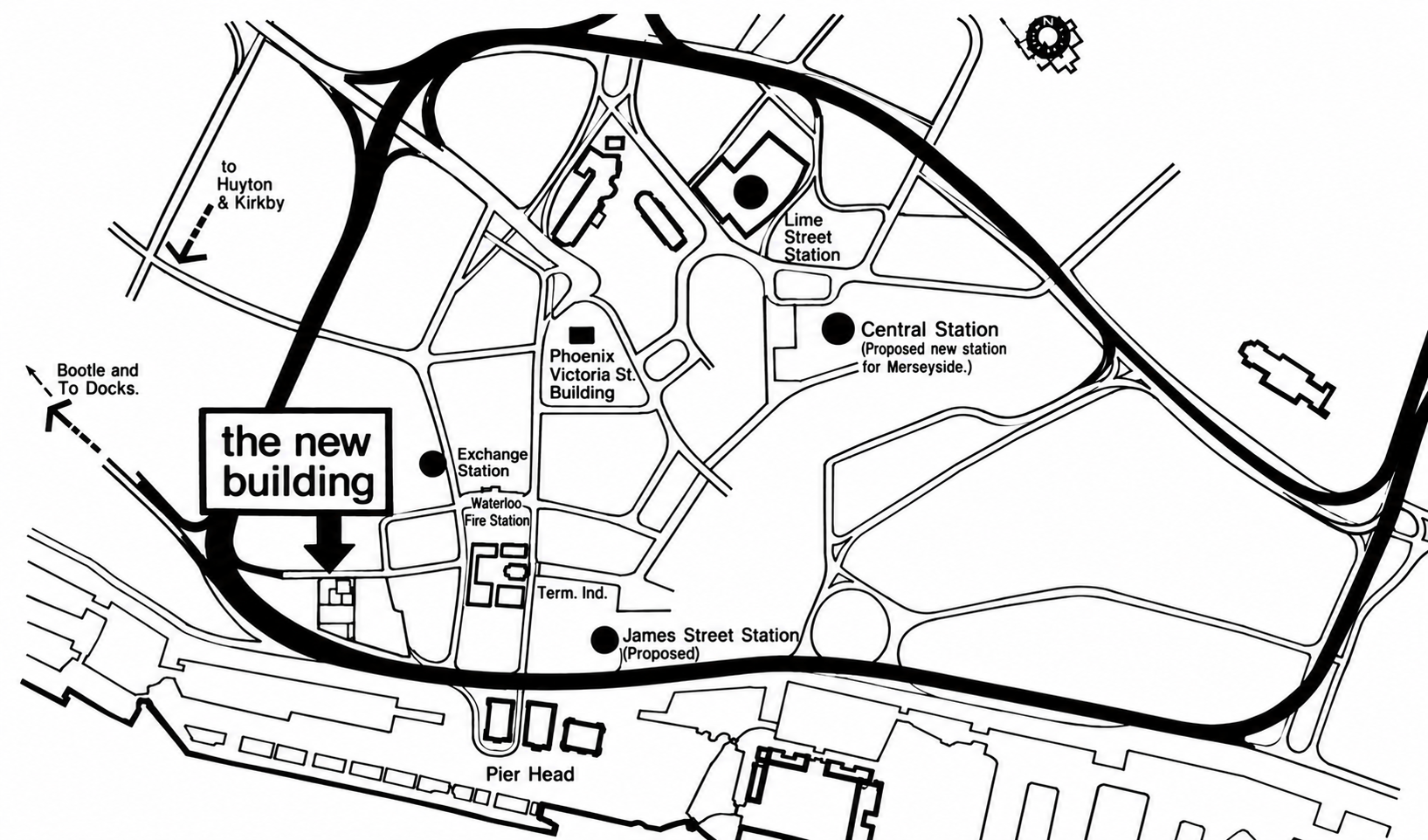
Map of the city centre

Map of the city centre showing how vans from the Post & Echo’s new building would have easy access to the motorway.

Liverpool was not the only city with ambitious road plans at the time. Britain’s urban areas had not been designed for “the age of the car” — which made traffic management a pressing issue for planners. In that connection a report compiled by Colin Buchanan, Professor of Transport at Imperial College, titled “Traffic in Towns” and published in 1963, proved especially influential. One effect of the report was to encourage experiments in separating vehicles from pedestrians — which in Liverpool’s case is where the elevated walkways came into the picture.
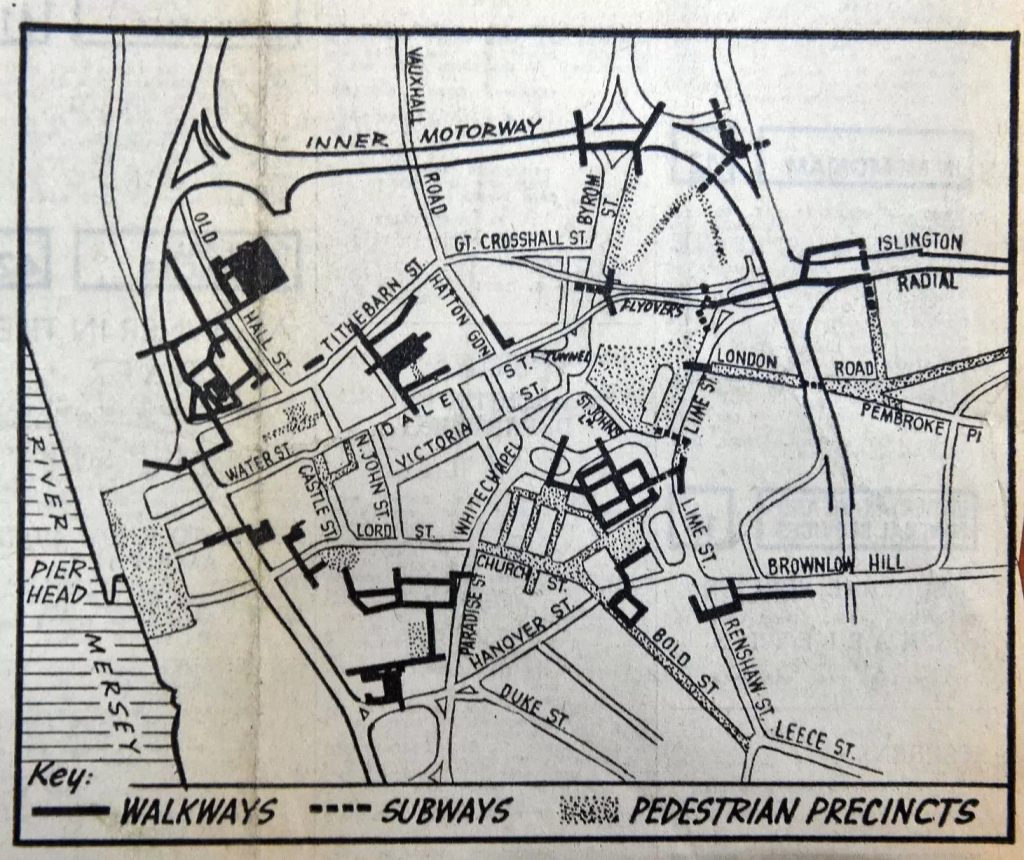
Map showing the proposed network of elevated walkways for pedestrians.

Map showing the proposed network of elevated walkways for pedestrians.

Shankland envisaged two miles of walkways criss-crossing the city centre. Some of them were built, only to be removed a few years later. Pedestrians didn’t like them and one had become known as “Muggers’ Alley”.

Today there are still a few traces of the walkway system. The entrance to Moorfields station, for example, is at the level of a non-existent walkway. To catch a train, passengers must first go up stairs or a ramp to the ticket hall and then go down escalators to the underground platforms.

Another ill-fated project from Shankland’s plan was the Churchill Way flyovers, intended to carry traffic over an especially congested area around the Queensway tunnel entrance. They were a concrete-lover’s dream and the Concrete Society gave them an award. The award plaque (made of concrete, obviously) was displayed along with graffiti on one of the flyovers’ concrete pillars.

In the years that followed, the flyovers became something of a local curiosity because despite their enormous presence hardly anyone used them. A few months after their completion the new Kingsway tunnel opened and the original problem at the Queensway tunnel — which the flyovers had been meant to relieve — disappeared.

In 2019 both flyovers were removed after being declared unsafe because of flaws in their award-winning concrete.

Disputes with the council

While Shankland was developing the master plan Liverpool paid his firm, Shankland Cox and Associates, £60,000 a year. By 1966 the plan was complete and the city’s new Planning Department was ready to take charge but the council decided to keep him as consultant for the next five years on an annual retainer of £4,000. This included attendance at quarterly meetings with officials (at £500 a time) and £2,000 for answering letters and phone calls from the planning department.

The arrangement ended rather bitterly following a series of disputes about money (reported by Liverpool Free Press) which soured his relations with council officials. On receiving news of his termination, Shankland sent an indignant letter to the Town Clerk. “I do not accept that I and my team have no useful further contribution to the central area plan and its realisation,” he wrote, adding: “I will be at the Adelphi by 6pm on Monday and can be telephoned there.”

Archetype of a rampant planner

Today Shankland is often seen as the archetype of a rampant planner — a megalomaniac who set out to butcher the city. His efforts to reshape Liverpool are treated as a cautionary tale and the most complimentary thing said about them is that they were “well-meaning”.

Behind these crude characterisations, though, there’s a more complex picture. Surprisingly, perhaps, Shankland had a soft spot for the rustic medievalism of William Morris. He was the founding secretary of the William Morris Society and wrote for its journal. The walls of his London home were decorated with Morris wallpaper and, allegedly, “posters of a Communist nature”.

Shankland was born on Merseyside in 1917 but shortly moved to London where, in 1926, his father became Chief Harbour Master at the Port of London. Graeme was educated at Stowe, an expensive public school, and later graduated from Cambridge with a degree in architecture.

During the second world war he served in the Royal Engineers and also joined the Communist Party. He resigned from the party in 1956, in protest at the Soviet invasion of Hungary.

People now look back with horror at Shankland’s plans for Liverpool but in the early 1960s they were very much in line with the mood of the time — an exciting time when bold new buildings with concrete roadways “curving sensuously” around them heralded a brighter tomorrow. It was a time, in the words of Robin Brown, when “brutalism was beautiful”.

FURTHER INFORMATION

Graeme Shankland: a Sixties Architect-Planner and the Political Culture of the British Left
Otto Saumarez Smith
Architectural History, vol 7, 2014, pp 393-422

The Liverpool City Plan
Victoria Lawson
Urban Design Group, 1 April 2020

Walkways in the Sky and the Liverpool ‘masterplan’ that was never built
Alistair Houghton
Liverpool Echo, 20 June 2020

Liverpool’s lost streets in the sky were torn down
Alistair Houghton and Charlotte Hadfield
Liverpool Echo, 2 June 2024

Come fly with me – the brave new world of Liverpool’s flyovers
Robin Brown
National Museums Liverpool

Liverpool Churchill Way Flyovers – Deconstruction (video)

Churchill away
Bryn Buck
roads.org.uk, 18 September 2020

0 Comments

Submit a Comment

Your email address will not be published. Required fields are marked *

LATEST POSTS

Friends of the Earth and the war against waste

In the 1970s, amid an ever-growing volume of rubbish dumped into landfill sites, environmental activists began a campaign to promote recycling.

Something nasty in the air: residents’ battles against noxious chemicals

Accidental emissions and hazardous waste from Merseyside’s chemical industries caused much alarm in the early 1970s. The government responded with two important pieces of legislation: the Control of Pollution Act and the Health & Safety at Work Act.

From riots to regeneration: Michael Heseltine and the great Mersey clean-up

How the Thatcher government’s environment minister inspired a campaign against pollution – and laid the foundations for Liverpool’s economic revival.

George Melly

George Melly was a multi-talented musician, writer and entertainer – a larger-than-life character noted for his exuberant sartorial style.

How working on ‘the Lump’ angered trade unions and caused a taxing problem for the government

The ‘Lump’ was a controversial practice in the construction industry where workers received a lump sum for each completed job, instead of a weekly wage. ‘Lump’ workers could earn more than regular employees but since they were supposedly self-employed they had no job security and were not covered by health and safety regulations.

Bob Dylan in Liverpool: 1966 and all that

When pop music came of age Liverpool was at its heart. Not only the Beatles and Merseybeat. Bob Dylan was part of it too. PHIL OATES explores the singer-poet’s connections with the city and how, on the sidelines of a controversial concert in 1966, it became a place of pilgrimage where he paid tribute to some of his literary and musical heroes.

How male prejudice toppled Britain’s highest-ranking police woman

In 1983 Alison Halford achieved what no woman had done before: she became an Assistant Chief Constable in Merseyside police – which also made her the highest-ranking officer anywhere in Britain. Nine years later, though, her police career lay in ruins. In an acrimonious legal battle she accused the police of sex discrimination and the police retaliated by accusing her of misconduct.

Mathew Street and the ‘Pool of Life’

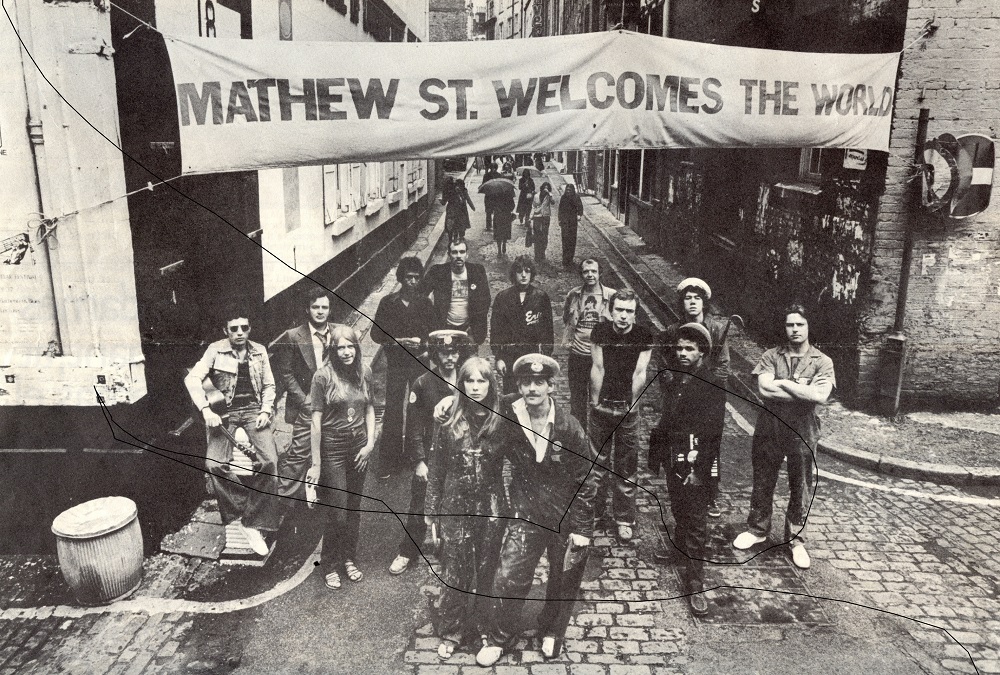
The Beatles were gone but in the 1970s Mathew Street lived on as the epicentre of Liverpool creativity, drawing its energy from Eric’s Club, the Liverpool School of Language, Music, Dream and Pun, the Probe record shop and, according to some, the magical power of ley lines.

The acid factory that made St Helens fume

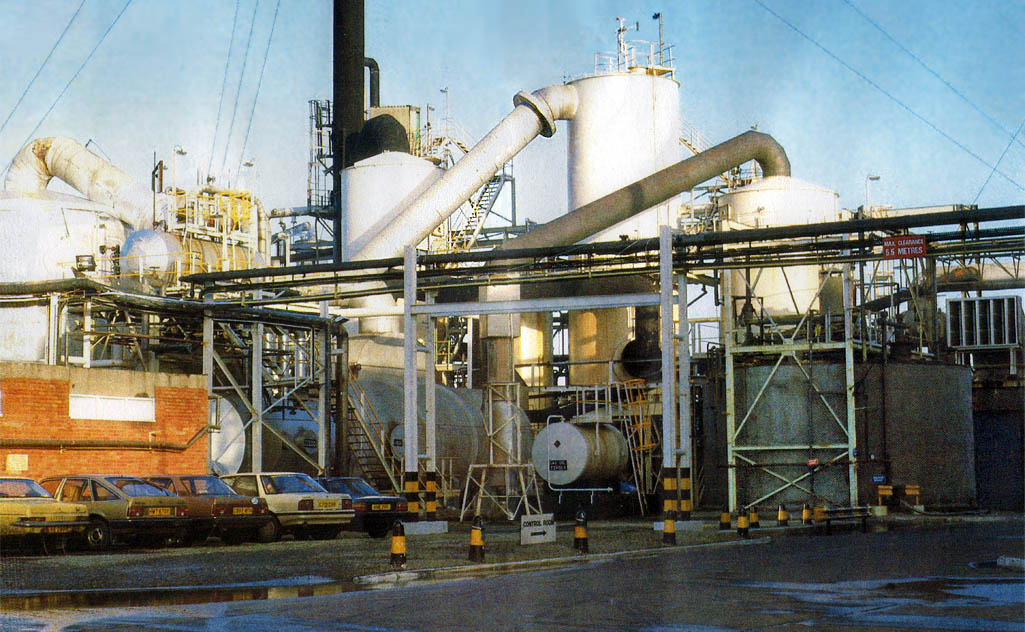
Leaks and emissions from a sulphuric acid factory brought constant complaints from local residents. Despite three public inquiries and several prosecutions, the problem continued for years and the council was powerless to stop it.

Pushing the boundaries of education

The City of Liverpool Community College aimed to provide qualifications for people who had left school without a certificate.
It also worked closely with local communities, providing literacy and numeracy classses for adults with poor basic skills. Later, though, the word “community” was dropped from its name.

Reclaim the Night

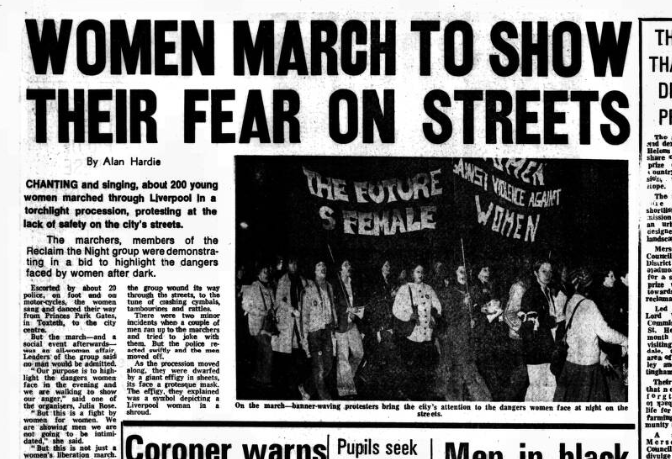
Women’s campaign against male violence

Trouble in toytown

When the Meccano factory suddenly closed down in 1979, workers fought back by occupying the premises.

How the Campaign for Homosexual Equality brought gay Liverpool out of the shadows

Despite relaxation of the law against homosexuality in 1967, gay people faced a continuing struggle for social acceptance during the 1970s.

The ghost cinemas of Liverpool

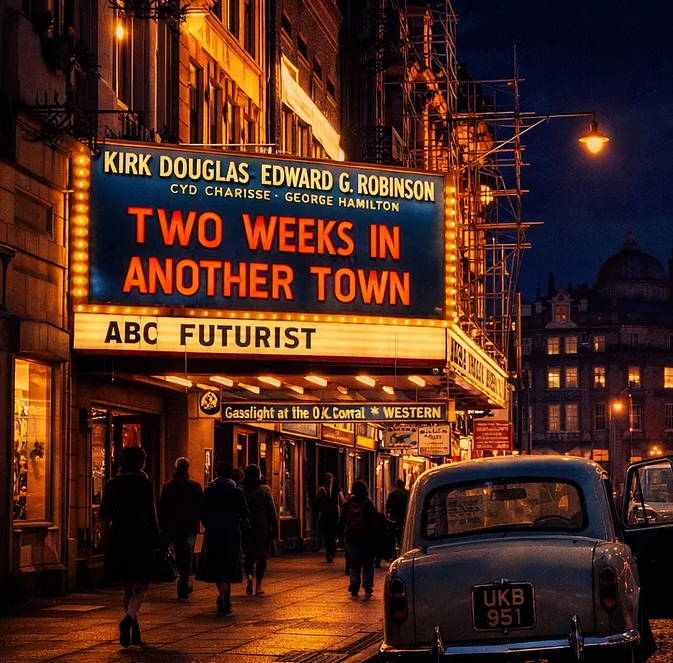
With the closure of cinemas Liverpool didn’t just lose buildings. It lost communal dreaming. Cinemas were places where you sat alongside strangers and felt the same fear, laughter, romance, and hope. In a city shaped by migration, war, poverty, and labour, cinemas offered shared narratives that crossed boundaries.

Creating jobs for the jobless

The Job Creation Programme was one of several government initiatives in the 1970s aimed at reducing unemployment, especially among school leavers. Local authorities, businesses and voluntary organisations were all urged to sponsor employment projects, with the government covering wages and other costs from a £75m fund. But what did it achieve?

The privatisation of intelligence gathering

In the political and industrial turmoil of the 1970s, left-wing militants  –  especially among the trade unions  –  were treated as a threat to national security. Monitoring their activity was a task officially assigned to the police Special Branch but the police faced competition in the form of unofficial intelligence networks run by shadowy right-wing organisations. This article looks at the controversy generated by two of them: the Economic League and the Unison Committee for Action.

Rehousing Liverpool (1): From slum clearance to rehabilitation

Slum clearance in the 1960s and 1970s separated people from friends and neighbours they had known for years. Tens of thousands were “decanted” to new estates on the edges of Liverpool. But demolition and displacement weren’t the only options and in Toxteth the Shelter Neighbourhood Action Project initiated a new approach.

Rehousing Liverpool (2): Grassroots initiatives

Housing cooperatives began with the idealistic goal of giving residents control over their own homes. They were voluntary organisations that focused on rehabilitating run-down terraces (and, later, building new estates) with the aid of loans and government grants. Decision-making was in the hands of co-op members rather than the council or private landlords, but the members often had no previous experience working with architects and other professionals – which led to them making some surprising choices.

Rehousing Liverpool (3): Liberal compromises

The Liberals took charge of Liverpool City Council in 1973, though without an overall majority. They abandoned the construction of new council homes in favour of new-build co-ops. Thus what had started out as a radical and marginal movement for residents’ control was watered down as the new mainstream. However, the initial success of these co-ops created a demand for more that was impossible to meet because of government spending restrictions.

Rehousing Liverpool (4): Militant and ‘bourgeois’ housing

For several years in the 1980s Liverpool city council was dominated by members of Labour’s Militant Tendency which promised to build a thousand new council homes every year. Elsewhere in the country, municipal housebuilding was almost at a standstill and the cost of Liverpool’s ambitious plans brought a confrontation with the Thatcher government.

Militant also had ideological objections to housing co-ops which it saw as a backdoor form of privatisation benefiting the bourgeoisie rather than the working class.

Fun in the dismal days of Thatcherism: the story of ‘The End’ magazine

‘The End’ magazine was produced by the young and read by the young. It talked mainly about football, music, beer and made jokes about life without a job. The End had plenty of attitude and was often outrageous. It published witty poems that didn’t always scan and letters from readers who it then insulted in print. But that didn’t matter because it gave people a laugh – and built up a cult following.

Hounded out of town: the caravan dwellers with nowhere to stay

In the 1970s gypsies and other itinerant caravan dwellers faced constant battles with the authorities due to a lack of places where they could legally camp. After eviction from one patch of waste land they would move to another, where the process to evict them would begin again.

Neighbouring local authorities engaged in a sort of ping-pong game, batting the problem of unwelcome caravans back and forth across each other’s administrative boundaries.

A drink in the most dangerous pub … and a riotous night in Kirkby

The Eagle & Child pub in Huyton had a city-wide reputation as a clearing-house for stolen goods. Fights broke out almost every night and police officers who went to take a look would be pelted with eggs and beer. Former Post & Echo journalist John Toker recalls a visit.

Photographing football – with rollickings from Bill Shankly

Stephen Shakeshaft spent four decades chronicling life on Merseyside as a photographer and later as picture editor of the Daily Post & Echo. He describes his experiences photographing football during the Shankly era – and some strange encounters with the boss himself.

Queer-bashed in James Street: the story of a Scout leader who vanished

John Gick disappeared in 1969 during a weekend visit to Liverpool from the Isle of Man. Despite extensive searches and enquiries, the police found no trace of him, alive or dead. The reason for his disappearance is still unknown but delving into the mystery opens a window on the secretive lives of men who struggled with their sexuality in the 1960s and 1970s.

Policing Liverpool: the road to the riots

When Bert Balmer took over as Acting Chief Constable of Liverpool in 1964, tackling high levels of crime in the city centre was his top priority. Determined to take drastic action, he created a special task force with a glamorous-sounding name that was sure to cause a stir in the media and  –  he hoped  –  strike fear into would-be lawbreakers. He called it the Commando Squad.

What no one foresaw was that the battle against street crime initiated by Balmer would lead over time to a breakdown in police-community relations and ultimately to the riots of 1981.

Upping the rent: a landlord’s tricks of the trade

How private landlords drove out tenants whose rents were frozen by law and replaced them with new tenants at higher rents … and how they evaded the Rent Act by pretending tenants were “buyers” or simply “users” of the property.

A pioneer in the struggle for racial justice

The name is Bond … Comrade Bond

In 1984 Sampson Bond, a 26-year-old Londoner, became head of Liverpool city council’s new Race Relations Unit following a rigged selection process. Bond was the least qualified of six applicants for the post but he got the job because his views on race relations matched those of Militant, the Trotskyist group which dominated the city council at the time and believed racial problems would be solved by the defeat of capitalism. His appointment infuriated black and anti-racism groups in the city. They refused to cooperate with him and demanded his dismissal.

The bleak council estate of Netherley was nicknamed Alcatraz because people living there often felt like prisoners. In 1976, though, a group of women took the first step towards building a sense of community – and organised a carnival. Maria O’Reilly describes how they did it and what it achieved.

Colonialism in the classroom: books for children in the 1970s

Amid concern that Liverpool’s schools were not preparing youngsters for life in a multi-racial society, the Community Relations Council carried out a study of racist attitudes in books written for children.

The NHS watchdogs that were allowed to bark but not bite

In 1974 the government established Community Health Councils throughout the country to monitor NHS performance and represent the views of patients and the public. In Liverpool, Sylvia Hikins chaired one of them for nine years, but her hopes of improving health services were constantly battered by spending cuts and closures.

Scotland Road Free School: a devastating report from government inspectors
A highly confidential report by education inspectors in 1973 gave a blistering account of the Free School in its death throes, Liverpool People’s History has discovered.

News from Nowhere: the story of a radical bookshop 
An insider’s view of the shop’s history – by Mandy Vere who worked there for 45 years.

The early years of Women’s Liberation
How the movement evolved on Merseyside in the 1970s and 1980s.

The Bridewell and the Boys from the Blackstuff
Much of Alan Bleasdale’s acclaimed TV drama was filmed at a former police station on Prescot Street.

Police, drugs and ‘agriculture’ in Toxteth
In 1971 there were two notable court cases where black men accused of possessing cannabis were acquitted after claiming police had planted it.

The Liverpool Scene – and beyond
In the 1970s and 1980s Merseyside poets dared to be popular – challenging the idea poems can’t be ʽgood’ unless they are elitist.

International Garden Festival: a treat for ʽcomfortable Britain’
The Garden Festival in 1984 attracted more than three million visitors and helped to regenerate Liverpool. But what benefit did the visitors get from it?

Arthur Dooley, sculptor
The former shipyard welder who turned scrap metal into art.

Merseyside Unity Theatre
Drama and agitprop in the 1970s: an account by one of the theatre’s founders

From word games to Dial-a-Poem
How the Windows Project spread new forms of creativity among children and adults.

Concrete is beautiful: the Shankland master-plan
Graeme Shankland was a planner hired by the council. His vision for Liverpool was to tear down much of the centre and replace it with “robust and manly” new buildings encompassed by an inner motorway on stilts. His plan has since been described as “notorious” and “a nightmare”, and fortunately most of it was eventually abandoned.

The Civic Centre fiasco
In the 1960s Liverpool council embarked on a plan to bring all corporation offices under one roof in a massive city-centre building to be known as the Civic Centre. They spent years buying up properties that stood on the site but the new building became unaffordable and a public inquiry condemned its design as “oppressive” and “overpowering”.

Filming the community: Old Swan festival, 1976
Old Swan was a rather drab part of Liverpool but for a few days in 1976 it became an extraordinary place where residents held a community festival described as “an explosion of colour and noise”. In the midst of that, though, it wasn’t always clear where reality ended and the entertainment began — which in a way added to the fun.

Radio Free Liverpool
On Merseyside in the 1970s clandestine broadcasters played a cat-and-mouse game with the authorities who were seeking to confiscate their transmitters.

‘Seducing’ soldiers
Activists campaigning against Britain’s military presence in Northern Ireland faced surveillance and prosecution during the 1970s.

Liberty Hall
A club “for people who are interested in politics but don’t wish to belong to a political party”.

The battle to save Fisher Bendix
The Fisher Bendix factory in Kirkby had been built with government help to ease unemployment in the area. It wasn’t a success and in 1972 when the owners tried to shut it down workers occupied the factory in an effort to save their jobs. Three years later they began running it themselves.

Trade unions? No thanks! We’re Marks & Spencer
M&S, in its own estimation, was such a good employer that unions were unnecessary. In theory, staff were free to join one if they wished, but the company had ways of making sure that unions didn’t gain a foothold.

Where women ‘never had time to get bored’
Litttlewoods football pools once provided jobs for thousands of Liverpool women. Former employees describe what it was like to work there.

Revolting students: the Liverpool University sit-in, 1970
Students accused the university of ignoring its responsibilities by trying to isolate itself from the social and political consequences of its policy decisions. They occupied the university’s Senate House building for ten days and nights. One participant was expelled and nine others were suspended.

Democracy in the classroom: Scotland Road Free School
Come to school when you want and do what you like. An experiment in classroom democracy that didn’t work out.

GET INVOLVED
Since this is a “people’s history” website, it’s intended as a collaborative effort. Click here to find out the various ways you can take part.