.
When Bert Balmer took over as Acting Chief Constable of Liverpool in 1964, tackling high levels of crime in the city centre was his top priority. Determined to take drastic action, he created a special task force with a glamorous-sounding name that was sure to cause a stir in the media and — he hoped — strike fear into would-be lawbreakers. He called it the Commando Squad.
What no one foresaw was that the battle against street crime initiated by Balmer would lead over time to a breakdown in police-community relations and ultimately to the riots of 1981.
.
The Commando Squad was a pioneering development at a time when rival police chiefs in several cities were competing to be first with new ways of combating crime — and it put Liverpool in the forefront. Soon, officers from other forces in Britain and abroad were flocking to find out more, and most were said to be impressed.
“We were the first force to set up a squad like this, also to use a camera, in the fight against crime on the streets,” Eric Hyams, a former sergeant in the squad recalled. “The city centre was being overrun by groups of young and not-so-young criminals who rampaged through the city streets, running into the large stores, grabbing anything they wished and running off with their stolen property.” Thefts of vehicles or their contents were also prevalent, together with shop-breaking, criminal damage and “general disorder”.
‘Blasting’ city-centre crime
The Commando Squad comprised 58 male and 10 female officers — some uniformed, others in plain clothes — reassigned from other parts of the force and largely chosen on merit (though some divisional chiefs took the opportunity to rid themselves of officers who were difficult to manage).
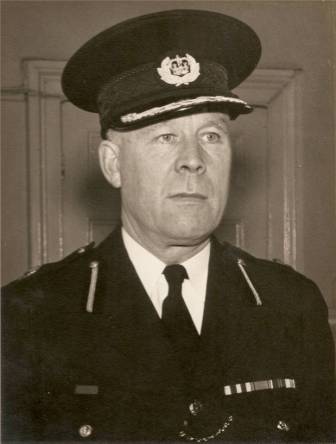
Bert Balmer: exaggerated claims
On the first day of operation, Balmer summoned his commandos to the Hardman Street headquarters for a briefing to which journalists were also invited. The squad’s task, he said, was to “blast” city centre crime with zero tolerance. They would be supported with the most modern equipment — including surveillance cameras which he said had been “installed around the city”.
Balmer, as Hyams noted, “could tell a good tale and spin it out”. He was also media-savvy and, presumably in an effort to enhance the squad’s deterrent effect, he spread wildly exaggerated claims about its capabilities.
On one occasion Balmer regaled journalists with tales of the ruses Commando Squad officers were supposedly using. Some of the men were disguised as road sweepers, he said, while female officers sometimes patrolled the streets pushing a pram. It wasn’t true but it helped spread the idea that criminals could never know when they were being watched, either by incognito members of the Commando Squad or by hidden cameras.
Rooftop surveillance
Liverpool City Police was one of the earliest forces in the country to use CCTV (some say it was the first) but Balmer’s talk of multiple cameras “installed around the city” was more aspiration than reality. At the time, there was only one camera.
It had been secretly placed on the roof of Lewis’s department store along with a cabin for the operator, giving a 180-degree view across the road — mainly of an area between the Adelphi Hotel and the bottom of Mount Pleasant. One limitation was that the police could only access it between 9am and 5pm when Lewis’s was open, and the rooftop surveillance led to few arrests.
The rest of the squad’s equipment was more Dad’s Army than commando. Officers, who usually patrolled in pairs, carried a baton and a whistle, and the squad as a whole had the shared use of a car and two personal radios. They were also supplied with one typewriter and a clerk to type up their reports. This was clearly inadequate and according to Hyams it was supplemented by some of the officers providing their own car or their own typewriter.
For the first few months of the squad’s operation (and the last few months of Balmer’s tenure) crime in the city centre dropped — though it’s unclear how much of the fall was due to more effective policing and how much to the mystique built up around the Commando Squad. Either way, Balmer was pleased and other forces copied some of his ideas, but he was about to step aside.
Balmer had grown up in Cairns Street, Toxteth. In 1926, after a spell in the Merchant Navy he had joined Liverpool City Police — and remained there ever since. He was popular with the local Watch Committee and when the previous Chief Constable retired they wanted to give him the job. He was disqualified, though, because of a Home Office rule that Chief Constables must have served in at least two forces — and Balmer had served in only one. Consequently, after a year as Acting Chief Constable, he was replaced by James Haughton who had plans to reshape the Commando Squad.
From ‘Commando Squad’ to ‘Task Force’
In a private dinner conversation with two colleagues a few months after his arrival, Haughton said he had been giving a lot of thought to the squad’s future and had decided to make it mobile. It would continue operating in ‘A’ Division (the city centre) but would also be ready to swoop into other divisions if, for example, disturbances broke out. For its new role the Commando Squad was renamed as the “Task Force” and provided with two Land Rovers, plus officers from ‘T’ Division to drive them.
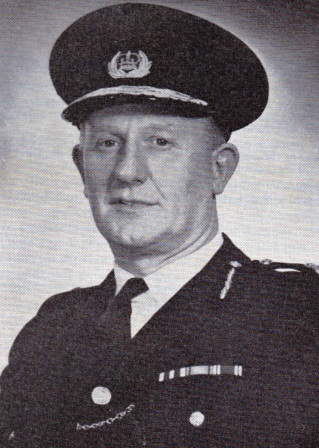
James “Sunny JIm” Haughton, also known as the “Silent Assassin”
Born in Oldham in 1914, Haughton had joined the Birmingham police in 1935 after two failed attempts to join other forces. Oldham and Rochdale both rejected him for being half an inch below the regulation height of five feet eleven inches. In Birmingham, he eventually became head of CID and at the time of his appointment as Liverpool’s Chief Constable in 1965 he was an assistant chief constable with Staffordshire Police.
During his time in Liverpool, Haughton oversaw an expansion and transformation of the city force, first to incorporate Bootle, then into the newly-created Merseyside Police as part of a nationwide restructuring.
Earlier in his career Haughton had been instrumental in establishing Regional Crime Squads — specialised units focusing on serious and organised crime that crossed the boundaries of different forces. His plan for the Task Force in Liverpool applied a similar principle, but at a more local level: it would work across divisional boundaries. Writing about the Task Force, former Assistant Chief Constable Ian MacDonald says:
“They patrolled crime and disorder hotspots … in what could most kindly be described as an enthusiastic and robust manner … The sight of one or more clearly marked long wheelbase Land Rovers roaring down the street was a clear signal that it was time to stop whatever you were doing and go home. Their crews were not given to negotiation.
“Team spirit was excellent and in an early form of community engagement they engaged with grateful licensees and club owners who plied them with trays of ale when it was quiet.”
Crime and disorder fell — which led to talk of reassigning Task Force officers to strengthen short-staffed divisions. The Task Force was a popular place to work, though, and the threat of disbandment made its members even more determined to prove their worth. MacDonald writes: “Arrests for assault, disorder, going equipped for theft, offensive weapon and ‘suspected person loitering’ (known in Liverpool and Bootle as ‘SPL’, and elsewhere as the ‘Sus Law’) increased. So did complaints.”
Stop-and-search
In Liverpool, use of Sus Law powers became a key tactic for combating inner city crime and disorder. “Indeed,” MacDonald adds, “they may have been the only one.” Sus Law normally required evidence of two “suspicious acts” witnessed by two people. Since officers usually patrolled in pairs this meant they could intervene if, for example, both claimed to have seen a suspect trying car door handles twice.
Suspects could be charged with going equipped for theft if found in possession of “implements” — usually filed-down car keys or single scissor-blades which at the time could open most vehicle locks. Given that the police tended to measure their success by the number of arrests rather than the overall crime rate, it was not unknown for less-scrupulous officers to cut corners during a search. MacDonald recalls:
“A story circulated about two officers, one with a reputation for ruthlessness, the other for naivety. They stopped and searched two suspected youths, and found nothing. They then swapped over, and each searched each the other’s suspect. The naive officer found, to his delight and his prisoner’s apparent astonishment a scissor blade, which his colleague appeared to have missed. He boasted of his newly discovered searching prowess for weeks to come. His ruthless colleague smiled enigmatically.”
Allegations of drug-planting
Drug searches presented similar opportunities. How often drugs were actually planted is unclear but the practice was common enough to be known euphemistically in the force as “agriculture”. There were two notable court cases in 1971 where black men accused of possessing cannabis were acquitted after claiming the drug was planted by police.
Chief Constable Haughton’s official position was that he “would welcome complaints from anyone who thought the police had behaved in an unauthorised manner” but that usually resulted, a year or so later, in a letter to the complainer saying no further action would be taken.
This is not to say that Haughton completely ignored the problem. One Vice Squad member told the Free Press that surprise searches of officers’ desks and drawers had been introduced — looking for drugs that might be used for “agricultural” purposes:
“Every member of the Vice Squad used to have samples of every kind of drug in their drawer. Just by comparing drugs which we seized with our samples we knew exactly what kind they were … long before the analyst gave us his report.
“But since all this fuss our desks have been searched frequently and completely out of the blue. Now we’re not supposed to keep any drugs, though of course, some still do.”
Crime figures for Liverpool in the mid-1970s showed high numbers of assaults on the police — many of which appeared to result from the way officers behaved when making arrests. Suspects could be difficult to deal with, especially if they had been drinking, and those wrongly accused of breaking the law could be uncooperative and argumentative.
The police were allowed to use “reasonable” force when making an arrest but there were plenty of cases where a suspect ended up with injuries pointing to excessive force.
A sergeant with bruised knuckles
In 1973, after a night at the Tudor Club in Upper Parliament Street, 29-year-old Alan Sutcliffe was arrested on suspicion of stealing a car. He appeared in court a few hours later with a broken nose, a black eye, blood on his right ear, grazes on the right of his neck and eight severe bruises on his shins.
At that point he was no longer suspected of car theft and instead faced two charges of causing grievous bodily harm to Detective Sergeant Lawrence Moore, plus two charges of assault — one against Moore, the other against Mervyn Davies, the detective constable accompanying him.
The officers’ injuries, though, were relatively light. A police surgeon reported that Constable Davies had suffered “a moderate nervous upset” and sustained a bruise over his left eye. Sergeant Moore suffered “mild shock”, had a bruise on his lower lip, grazes on the back of his left hand and a big bruise around the third, fourth and fifth knuckles of his right hand. A small bone in his little finger, the fifth metacarpal, was later found to be broken and this formed the basis of the “grievous bodily harm” charge.
Sutcliffe maintained that those injuries were caused accidentally by his attempts to dodge blows from the detectives and when his case went to the Crown Court it took a jury only 35 minutes to decide — unanimously — that he was innocent on all charges.
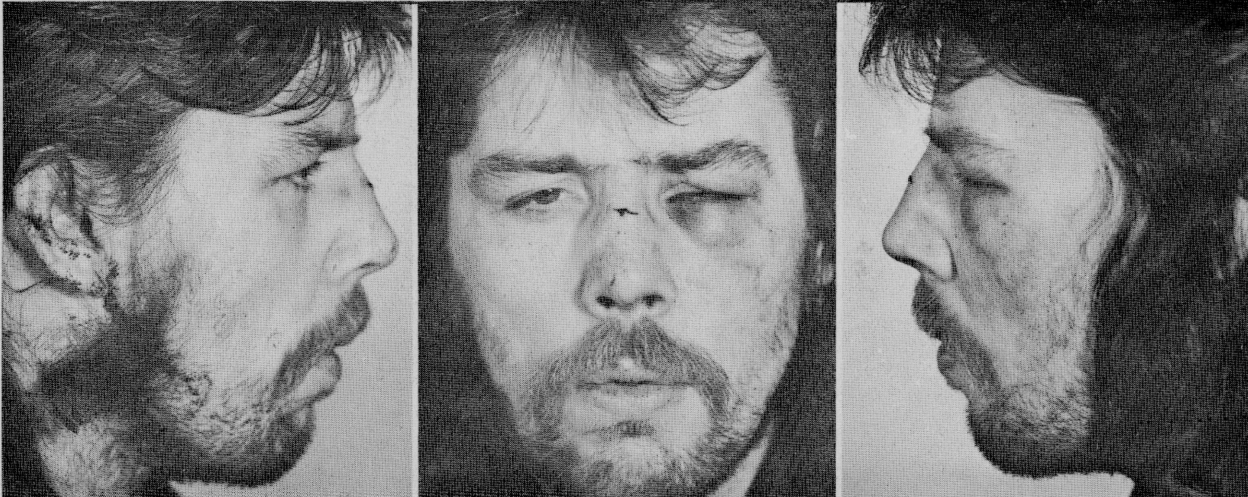
Alan Sutcliffe after his release
Death followed ‘beating in a Land Rover’
Injuries inflicted by the police were widely believed to have led to the death of Kenny Williams, a 27-year-old father of four. On a Friday night in 1974 Williams went to a club in the city centre then stole a car intending to drive it back home to Kirkby — but he didn’t get far. The police arrested him and bundled him into a Land Rover.
Doctors who examined him later found two deep cuts on the top of his head requiring stitches, two black eyes, a suspected broken nose and a large bruise on his stomach. While on remand he was given medicine for “wind” after complaining of vomiting and stomach pains. He was eventually diagnosed with acute pancreatitis — which could have been caused by a blow to the stomach — and, four weeks after his arrest, he died.
Before his death, Williams had told three people — his wife, his brother and a solicitor’s clerk — that he was severely beaten in the back of the Land Rover. He said he had been kicked, punched, and hit on the head with a metal police radio.
The police held a disciplinary inquiry but the Director of Public Prosecutions advised that no charges could be brought against any officer. One factor in this was that Williams was now dead and unable to repeat the allegations himself. What he had told others about his beating amounted to hearsay. A subsequent inquest returned a verdict of misadventure.
Multiple witnesses
A lack of independent witnesses was a common problem with allegations of police brutality but the arrest of John Lannon shortly before dawn one August morning in 1975 was a notable exception. The noise awoke much of the neighbourhood.
Lannon, 34 and living in Kirkby, was well known to the police. By all accounts he was extremely drunk when he left his parents’ home in Kirkby. Around 4.30 am two shirt-sleeved officers arrested him at the back of the Peacock pub, a few minutes’ walk away.
He was then viciously attacked — kicked and beaten by four officers — and dragged to a waiting police car at the front of the pub. The Peacock (since demolished) stood in an open space surrounded by flats and houses. Residents awakened by the disturbance were shocked by what they saw.
At least two families were so concerned they phoned the local police station. Others who complained by shouting from their windows were told to “Get to bed” and “Come down here and you’ll get the same.” The Free Press later published interviews with seven of the witnesses.
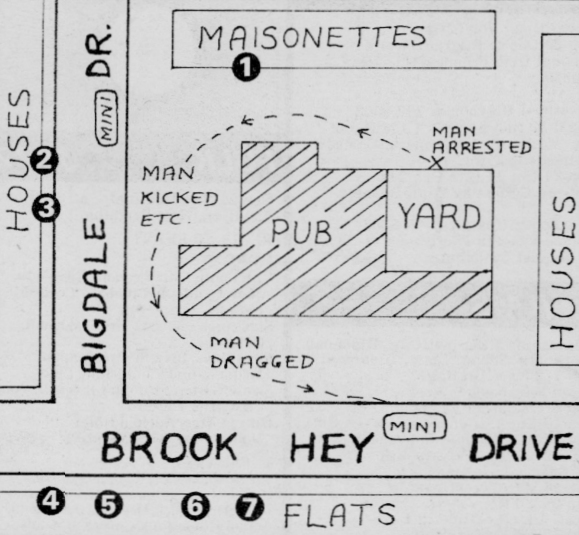
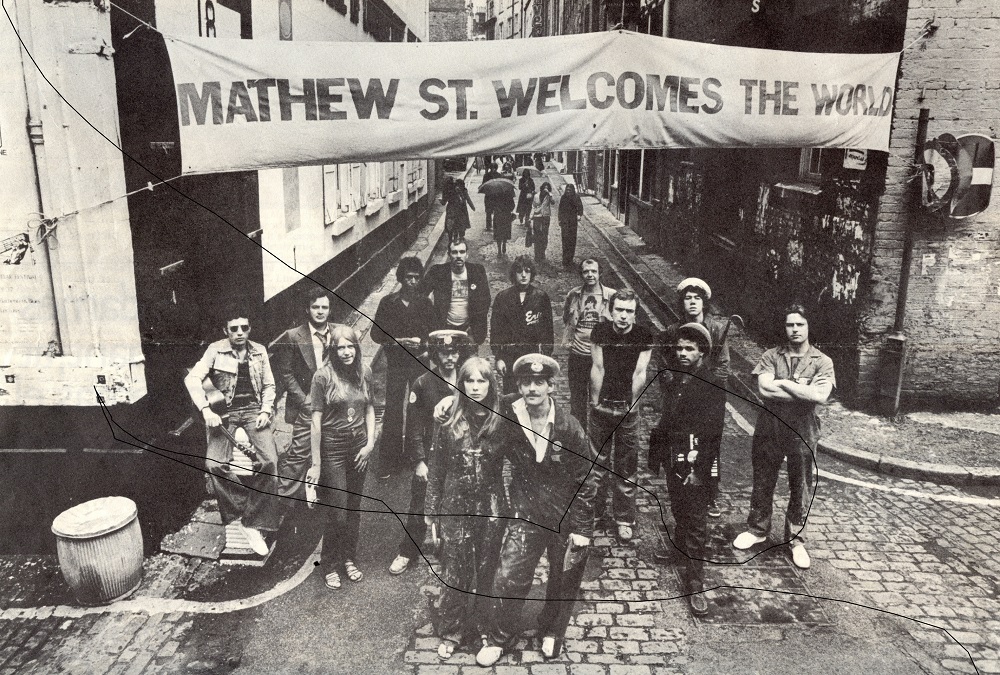
Sketch map showing position of witnesses interviewed by Liverpool Free Press
After 11 hours in custody without medical attention, Lannon began coughing blood and was transferred to Walton Hospital where he spent the next six days recovering from a punctured lung, a broken rib, facial injuries, severe bruising and grazes.
Lannon faced a host of charges: theft of four dozen tins of dog food, trespassing with intent to steal, criminal damage to a car, plus three charges of assaulting the police and three of damaging officers’ shirts.
Fortunately for the police, though, evidence of Lannon’s beating was never heard in open court. A few days before his trial prosecutors offered to drop the most serious charges if he would plead guilty to lesser charges of common assault, attempted burglary and damaging the car. Lannon agreed and was sentenced to 200 hours community service and ordered to pay £18.90 towards damage to the car.
‘Unscrupulous’ complaints
In a lengthy report to the police committee in 1975, Chief Constable Haughton grumbled that people were using the complaints procedure “in an unscrupulous manner”. He appeared to be referring to the case of Tommy Satchell and Rita Lindsay whose allegations of police brutality had been publicised on TV but were later discredited by an internal investigation that consumed 228 hours of police time.
The couple — both in their twenties —had been arrested for being drunk and disorderly in the back of a taxi. According to the driver they were “punching each other and pulling hair and scratching and shoving”. Satchell, the driver added, had blood on his face, neck and shirt.
The couple insisted they had just been kissing and cuddling, and claimed their injuries had been inflicted in a police Land Rover after their arrest. They made a formal complaint and also appeared in a Granada TV programme (broadcast shortly after the Kenny Williams inquest) that was critical of the Merseyside police. It included a four-minute interview with Lindsay.
In an unusual move, apparently intended to discourage similar complaints, Satchell and Lindsay were charged with wasting police time. They were convicted on majority verdicts and given suspended prison sentences of six months each.
Racial tensions
Use of Sus Law powers to stop and search people in the street wasn’t confined to any particular part of the city but in Liverpool 8 — Toxteth — the racial dimension made it especially contentious. The long-established but alienated black community saw stop-checks as a form of harassment motivated by racism.
One typical example, reported by the Free Press, began with a street search that revealed nothing incriminating but ended with three police cars plus a Task Force Land Rover on the scene and two mixed-race youths under arrest.
At 7.50 one morning George Carpenter was walking along Upper Warwick Street together with 14-year-old Hilton Adams, intending to catch a bus. A police panda car pulled up and two officers got out to search Carpenter’s bag which turned out to contain nothing more sinister than his lunch.
It was by no means the first time Carpenter had been stopped like this and according to Adams he said to the police: “Why are you always pulling me up? You wouldn’t if I was white.”
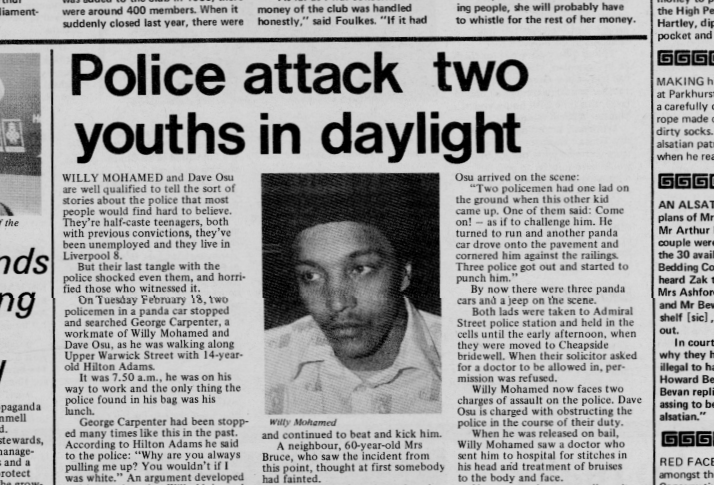
Liverpool Free Press, March 1976, p 3.
An argument ensued and Willy Mohamed, a workmate of Carpenter, came over to see what was happening. At this point a bus arrived. Carpenter and Adams ran to catch it. Mohamed was about to do the same but the police called him back.
When Mrs Bruce, a 60-year-old resident, saw Mohamed shortly afterwards he was lying moaning on the pavement after being kicked and beaten. One officer slapped him across the face with the words “Shut your fucking mouth”.
Mrs Bruce came out of her front door in a dressing gown to remonstrate with the police: “What do you think you’re doing? Leave him alone.” An officer shouted back: “Fucking get in” — to which she replied: “You can’t make me, I live here.”
Meanwhile, Mrs Shawcross, who was watching from her bedroom window, described what happened when Dave Osu, another mixed-race youth, arrived on the scene: “Two policemen had one lad on the ground when this other kid came up. One of them said: ‘Come on!’ — as if to challenge him. He turned to run and another panda car drove onto the pavement and cornered him against the railings. Three police got out and started to punch him.”
Osu was then arrested and charged with obstructing the police in the course of their duty. Mohamed — later treated in hospital for his injuries — was charged with assaulting the police.
Offensive language
There were numerous cases where witnesses described officers making provocative remarks, together with liberal use of the F-word, in their encounters with the public. But that wasn’t all.
One night in 1973 two black men passing the open door of Hope Street police station were shocked by words they heard coming from inside. According to both of them a uniformed officer had said in a loud voice: “That’s all you can expect from niggers.”
They then made the mistake of going inside to complain. The officer denied making the remark but one of the complainers, Paul Ambrosius, ended up with a summons for “using obscene language” and was fined £5.
Chief Constable Haughton was known in the force by two nicknames — “Sunny Jim” and “the Smiling Assassin” — and both could be seen in his dealings with the black community. He gave the impression of listening sympathetically to complaints from community leaders and their warnings of widespread disorder if relations with the police did not improve but, according to McDonald, once they had left “he would turn to his staff officer and instruct him to ‘get the vans out’… Confrontational stop checks and arrests for minor infractions intensified.”
A new broom
Haughton’s successor, Kenneth Oxford, had worked for the Metropolitan Police and Northumbria Police and was noted for his role in two high-profile arrests: James Hanratty (hanged for the A6 Murder) and Christine Keeler (the model at the centre of the Profumo Affair).
On joining the newly-formed Merseyside Police as Deputy Chief Constable in 1974, Oxford was seen as a future candidate for the top job and some of the senior officers set about courting him.
“Oxford was wined and dined in after-hours drinking and gambling houses by a small and extremely powerful clique of senior police officers,” MacDonald writes. “They thought that they were about increase their already considerable influence through their new accomplice, who clearly liked a drink or seven. They were mistaken.” He immediately stopped drinking with them on his promotion to Chief Constable in 1976.
Use of nicknames, especially for senior officers, seems to have been prevalent at the time. In contrast to Haughton’s nicknames — Sunny Jim and the Smiling Assassin — which had alluded to different sides of his character, Oxford’s was unpleasant and unimaginative. He became known as Lumpy Head because of a lump on his forehead. It wasn’t by any means the most offensive sobriquet in the force. One officer noted for incompetence was known as Aberfan — because he was Welsh and “a disaster”.
Cleaning up the Task Force
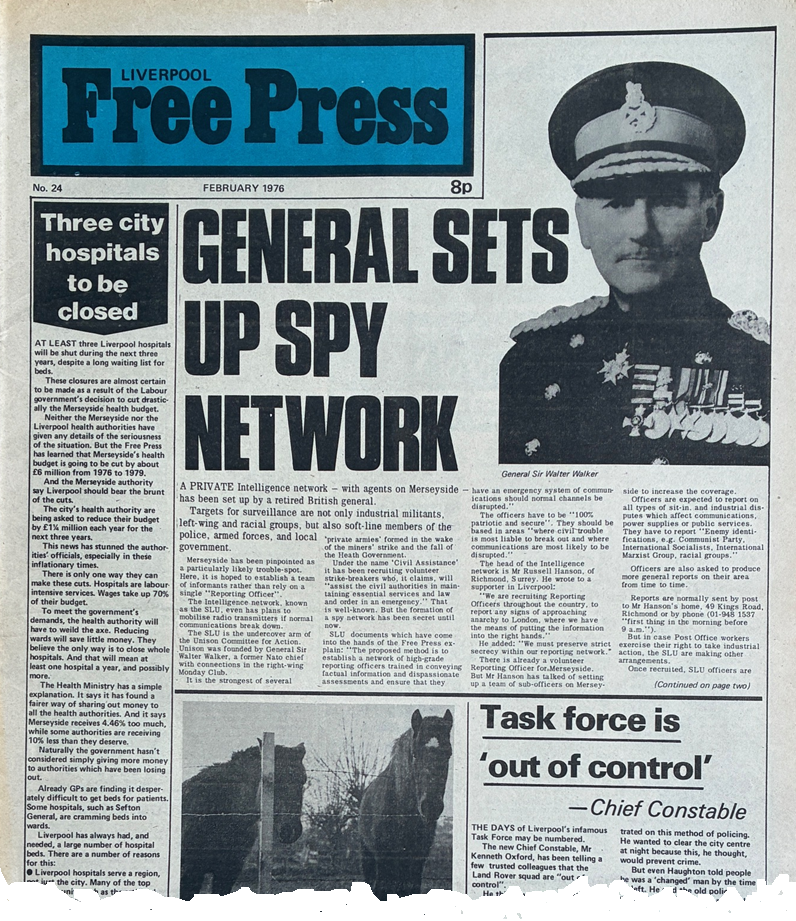
Within weeks of taking charge, Oxford told trusted colleagues that the Task Force was “out of control” and its superintendent, Bob Moores, was promptly bundled off to run the CID at Lower Lane police station in Fazakerley. He left the force shortly afterwards.
This was part of a wider clear-out during Oxford’s first year and the Free Press noted a series of early retirements:
Liverpool night-life won’t be the same without the “Jack of Clubs”– alias Sgt Bill Wain. For twelve years he was in charge of licensing administration and claims to know every pub, club and betting shop in the city. He told the Echo he had never mixed business with pleasure — “it was all strictly business.” Bill, still only 55, is off to a newly-built bungalow in the Isle of Wight.
The Ace of Clubs has also gone. Supt Arthur (“call me Otto”) Schmuhle’s job was to organise raids on clubs. Naturally the owners turned out in force for his farewell party. Otto told the Daily Post there were some bad club owners, but “others were likeable people who happened to exceed the law I had to enforce. They will be at my party, having a drink with me.”
Yet another victim is Sgt Doug Corlett, still only 50 and retiring after five years as Houghton’s personal dogsbody. He was known in the Force as “Dr Kissinger”. Then the former head of the Regional Crime Squad, Supt Eddie Washbourne also went early — though he won’t be forgotten.
And finally it’s goodbye to former Acting Deputy Chief Constable Ron Lancaster. Mind how you go!
Under Oxford, the Task Force formerly known as the Commando Squad began its third incarnation, this time as the Operational Support Division (OSD) — a thoroughly unexciting name that reflected Oxford’s intention to tone down its excesses. A chief inspector, a superintendent and a chief superintendent were sent to impose discipline and according to MacDonald “officers who sailed to close to the wind soon found themselves ‘binned’ and sent back to their divisions”.
MacDonald recalls attending a meeting chaired by Oxford on juvenile crime — and being favourably impressed by the way he chaired it: “His grasp of the facts, chairmanship and handling of a diverse and potentially difficult group were exemplary.”
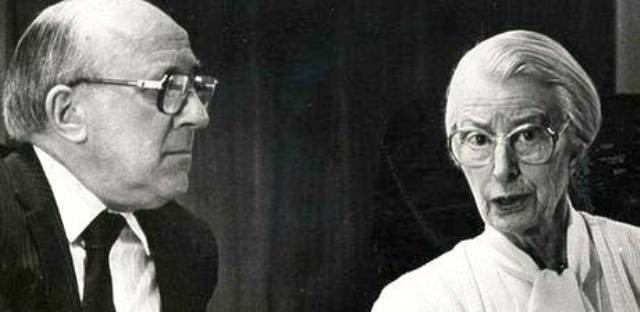
Chief Constable Oxford clashed with Margaret Simey, chair of the Police Authority
He had a ferocious temper, though, and in the later years famously quarrelled with two formidable women: Margaret Simey, chair of the Police Authority, and Alison Halford, the force’s first female assistant chief constable. At her first meeting with Oxford after taking up the post Halford found him “charming, attentive and almost deferential” but it wasn’t long before she saw one of his outbursts — directed against his own deputy, John Burrow. In her book, No Way Up the Greasy Pole, Halford writes:
“We were sitting casually in the coffee lounge one morning when the door burst open and in stormed the chief. Without any warning or preamble he launched into a humiliating tirade against poor Burrow as if he were a naughty schoolboy. I have long since forgotten what had prompted the Oxford temper but it seemed out of all proportion to the offence.”
Her shock at Oxford’s behaviour was matched only by her surprise that Burrow “sat there meekly and took the humiliation without protest”.
Oxford’s temper was said to be at its worst in the mornings and one senior officer told Halford that whenever he had to meet the chief he would try to arrange it for as late in the day as possible.
Oxford travelled to London from time to time for meetings at the Home Office and on returning to Liverpool he would entertain staff with tales of the officials he had supposedly floored with his caustic tongue. He was especially proud of having described junior Home Office minister Douglas Hogg — to his face — as a “jumped-up little smarty boots”.
Liverpool-Manchester rivalry
Another notable feature of Oxford’s reign was his rivalry with James Anderton, the controversial Chief Constable of Greater Manchester. This led to jokes about their oneupmanship which portrayed Anderton as always managing to stay a step or two ahead of Oxford.
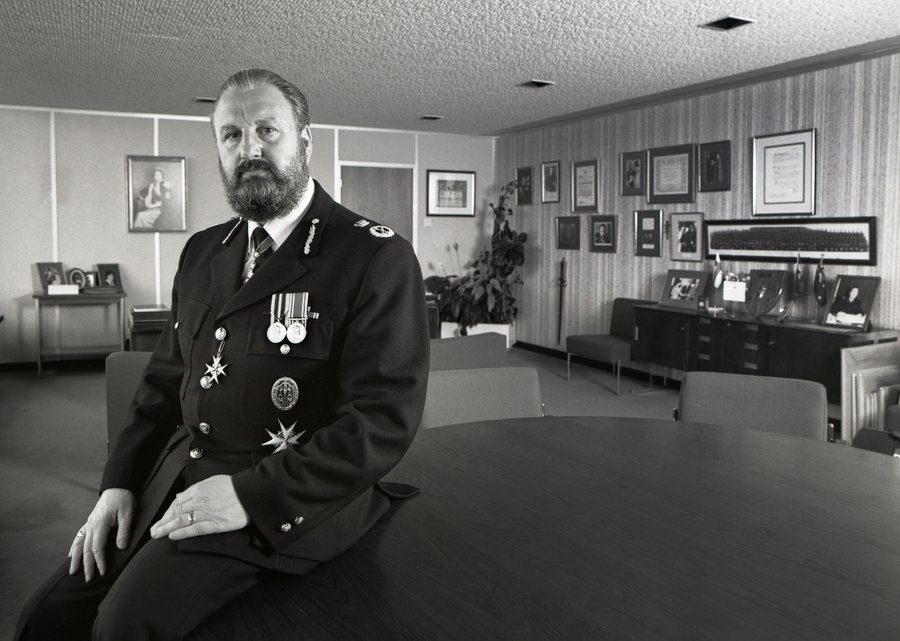
Manchester’s police chief, James Anderton (aka “God’s Cop” because of his controversial views on religion and morality) was seen as upstaging Merseyside’s Kenneth Oxford.
One story circulating at the time began with Anderton acquiring the latest status symbol for important people: a car phone. According to the tale, Anderton let Oxford know about his new acquisition with a message, relayed via his driver, asking Oxford to phone him in his car. Not to be out-done, Oxford was said to have immediately got a phone for his own car then ordered his driver to call Anderton’s driver:
Oxford’s driver: “Mr Oxford wants to speak to Mr Anderton on his car phone.”
Anderton’s driver: “Mr Anderton is on the other line.”
The story was almost certainly apocryphal but it’s an interesting reflection on how the Oxford-Anderson relationship was perceived within the police.
Less amusingly, during the 1981 Toxteth riots Anderton sent reinforcements to Liverpool which — embarrassingly for Oxford — turned out to have better equipment than the Merseyside force.
Oxford had a reputation for being unwilling to listen to advice or criticism but he listened enough to recognise the need for a conciliatory gesture towards Toxteth. He banned the OSD from patrolling in the area and sent them to focus once again on “harvesting shoplifters” in the city centre.
The problem, though, was that this left the policing of Toxteth split geographically between two divisions under different commanders and operating on separate communication channels. A further complication was that Upper Parliament Street — where numerous nightclubs frequented by black people were located — straddled the boundary between two divisions.
“There was no strategy for policing the area,” MacDonald writes. “Mobile patrols responded to incidents then drove away. When officers were deployed on foot they were often looking for criminals, and indiscriminate and inflammatory stop checks were a standard tactic.”
To some extent these searches compensated for a lack of effective intelligence-gathering which at the time was rudimentary and included stationing officers at the top of the cathedral tower to observe the area with binoculars.
Bricks thrown at patrols
Officers patrolling the streets of Toxteth complained that bricks were often thrown at them and when they tried to make an arrest neighbours and passers-by would object and try to intervene. Joe Squires, the chief superintendent of a division covering one half of Liverpool 8 “got to hear very little of what we would now call ‘Tension Indicators’, in part because his staff were scared to tell him,” MacDonald writes. “Even if they had there was not much that he could have done.”
The OSD were not totally excluded from the area, however. They still lurked around the edges, and were allowed to enter in hot pursuit of suspects — an exception that provided the trigger for the 1981 riots. A couple of youths on a motorbike are said to have provoked the OSD into a chase and then lured its vehicle into Liverpool 8 where attackers were waiting.
Despite elaborate practice drills, Merseyside Police found themselves ill-prepared for the events that followed. New guidance on tactics and equipment for dealing with riots had been developed in the late 1970s by Sir Kenneth Newman, Her Majesty’s Inspector of Constabulary.
Much of Newman’s planning focused on police tactics during the 1968 Grosvenor Square riot, and ways of improving them. The Toxteth riots were not a re-run of Grosvenor Square, though: they were more widespread and a lot more violent. Grosvenor Square had been a single-issue protest against the Vietnam War but in Toxteth the grievances were deeper and more complex— rooted in the social and economic problems of a long-marginalised community. The way Liverpool had been policed undoubtedly contributed to that and when the crunch came the police were the ones expected to deal with the consequences.
“Poverty and crime and disorder go hand in hand … Police officers are often the victims of the failings of others,” MacDonald writes, adding: “This is not to say that the force was an innocent victim.”
FURTHER INFORMATION
This article is based mainly on accounts by former police officers on the unofficial Liverpool City Police website, an autobiographical book by a former Assistant Chief Constable and media reports from the time (mostly Liverpool Free Press).
Accounts by former police officers:
Herbert Balmer, Acting Chief Constable, 1964-1965
Chris Kelly, Liverpool City Police website
James Haughton, Chief Constable, 1965-1974
Brian Starkey, Liverpool City Police website
Kenneth Oxford, Chief Constable, 1976-1989
Brian Starkey, Liverpool City Police website
Commando Squad
Eric Hyams, Liverpool City Police website
Stop and Search
Ian MacDonald, Liverpool City Police website
Authority and Insurrection
Ian MacDonald, Liverpool City Police website
No Way Up the Greasy Pole
Book by Alison Halford, former Assistant Chief Constable
Allegations of drug planting:
Police, drugs and ‘agriculture’ in Toxteth
Liverpool People’s History
Did the police plant drugs?
Mersey People, issue 5, May 1971, p 1
Arrested but innocent
Mersey People issue 5, May 1971, pp 4-5
Whiter than white
Liverpool Free Press, Nov/Dec 1971, p 12
Drugs and the police
Liverpool Free Press, July 1971, p 3
Police inquiry: the same old story
Liverpool Free Press, July/August 1973, p 4
Police accuse man who dared to complain
Liverpool Free Press, May 1974, p 3
Arrest of Alan Sutcliffe:
The night the sergeant hurt his knuckles
Liverpool Free Press, June/July 1973, p 6
Death of Kenny Williams
How did this man die?
Liverpool Free Press, November 1974, p 1 (continued on p 4)
Death case PC ‘was in earlier attack’
Liverpool Free Press, February/March 1975, p 1
Williams inquest: the cover-up goes on
Liverpool Free Press, February/March 1975, pp 6-7
Arrest death: new moves
Liverpool Free Press, Dec 1976/Jan 1977, p 12
The beating of John Lannon:
Many witness police attack
Liverpool Free Press, September 1975, p 1
Kirkby man kicked by police, say witnesses
Liverpool Free Press, September 1975, p 10
Man goes for trial
Liverpool Free Press, December 1975, p3
Police get off the hook in pub arrest case
Liverpool Free Press, March 1976, p 8
Police assault victim dies
Liverpool Free Press, April 1977, p 9
Other press reports
Task force is ‘out of control’– Chief Constable
Liverpool Free Press, February 1976, p 1 (continued on p 12)
Deserting the forcе
Liverpool Free Press, Dec 1976/Jan 1977, p 5
Your complaints will be taken down and used against you
Liverpool Free Press, May/June, 1975, p 10
The night the police beat up the wrong man
Liverpool Free Press, Sept/Oct 1976, p 8
Appeal likely over police case damages
Liverpool Free Press, April 1976, p 9
Judges order retrial of £1 damages case
Liverpool Echo, 16 Feb 1977, p 3
Police harass critic
Liverpool Free Press, Feb/Mar 1975, p 4
Fire-bomb threat to family – police refuse protection
Liverpool Free Press, May 1974, p 1 (continued on p 10)
Police harassed black taxi-driver
Liverpool Free Press, April 1977, p 8
Police hit back at couple who complained
Liverpool Free Press, September 1975, p 3
Mystery of blood in police jeep
Liverpool Free Press, November 1975, p 8
Two found guilty of time wasting
Liverpool Echo, 24 March 1976, p 7
Police attack two youths in daylight
Liverpool Free Press, March 1976, p 3









0 Comments