
Shortly after a new factory started making sulphuric acid in St Helens, women working nearby began complaining about holes in their tights. More than 20 office staff were said to have been affected, and they blamed it on having to run the gauntlet through chemical clouds from the acid factory in order to reach their workplace.
In the words of one woman, 22-year-old Helen Marsh, the emissions were “like a sea of champagne bubbles coming towards me … When the bubbles landed on my tights they just disintegrated.”
Another woman, 20-year-old Margaret Gaskell , said it had happened to her multiple times. “My tights have had great holes in them when I have got into work. We try and dodge the bubbles but there are so many of them, it’s a losing battle.”
The affair of the dissolving tights signalled the start of a decades-long saga over the acid factory on Lancots Lane. Chemical leaks were frequent — as were the complaints from local residents. Despite three public inquiries and several court cases, the problem continued and St Helens council was powerless to stop it.
A detailed account of the wrangling can be found in Stephen Wainwright’s online history of industries in the Sutton area of St Helens. The article below draws on Wainwright’s research, plus various press reports from the time.
Claims of environmental benefits
The story began in 1968 when British Sidac, which made cellulose film for packaging, sought planning permission for a £1.3 million sulphuric acid factory to be built next to their plant.
Sidac, which had itself been in trouble over emissions, claimed this would benefit the environment. The Sidac cellulose factory would use surplus steam from the acid factory, thereby reducing the levels of sulphur dioxide released into the atmosphere. Meanwhile, sulphurous waste from Sidac would be used in the acid-making process rather than simply dumping it in Sutton Brook (known locally as Stinky Brook).
Aside from the irony of using environmentalist arguments to support establishing an acid factory, these proposals also determined its location. To reap the alleged benefits of exchanging steam for sulphurous waste it would need to be close to Sidac on Lancots Lane. However, there were plenty of other reasons why this was not a suitable spot. Residential areas, plus St Helens Hospital, several schools and a reservoir all lay within 600 yards of the site and some of the homes were as close as 200 yards.
A surprise letter
Ten days after the council granted planning permission it received a letter from Sidac saying they did not intend to operate the acid factory themselves: the operator would be Leathers Chemicals, a subsidiary of Occidental Petroleum.
This immediately rang alarm bells because an earlier Leathers acid factory in Bradford had been forced out of the city, leaving behind a notorious reputation. The council had eventually got rid of it through a compulsory purchase order to clear the way for a new road.
Looking for an alternative site, Leathers tried Widnes and Warrington. Both turned them down, but then St Helens council let them in. Bradford council greeted the news with a note in its minutes recording the Medical Officer’s pleasure at seeing the firm go over the Yorkshire border “to a site in Lancashire”.
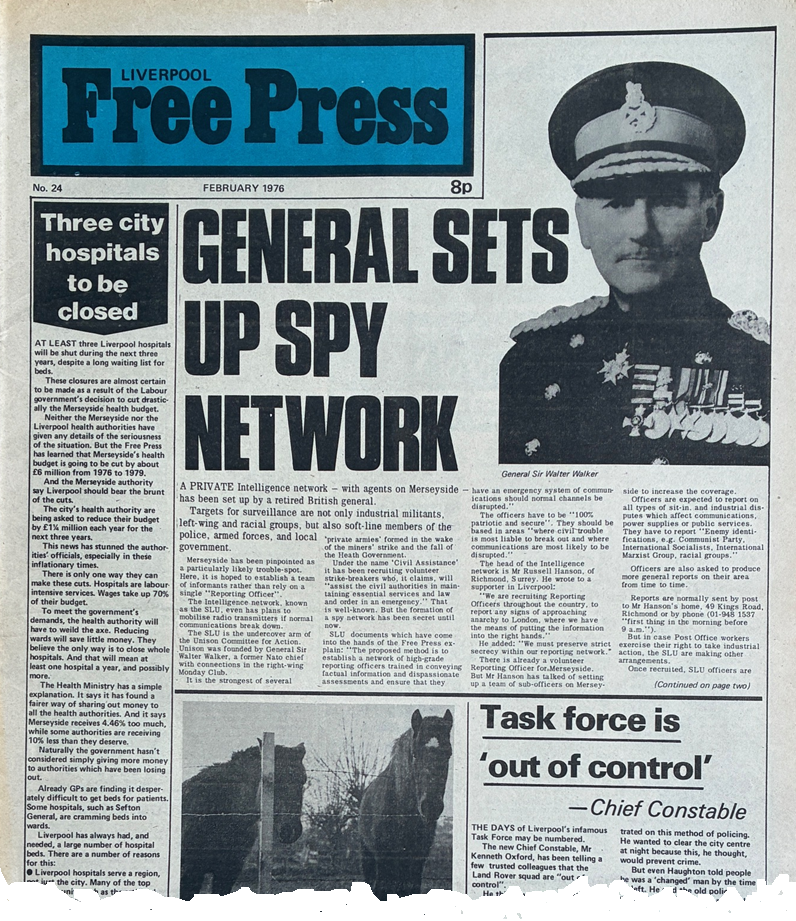
The new Leathers factory in St Helens — said to be one of the most up-to-date in Britain — opened in 1970, initially employing about 20 people. An article from the Liverpool Free Press published in 1974 takes up the story …
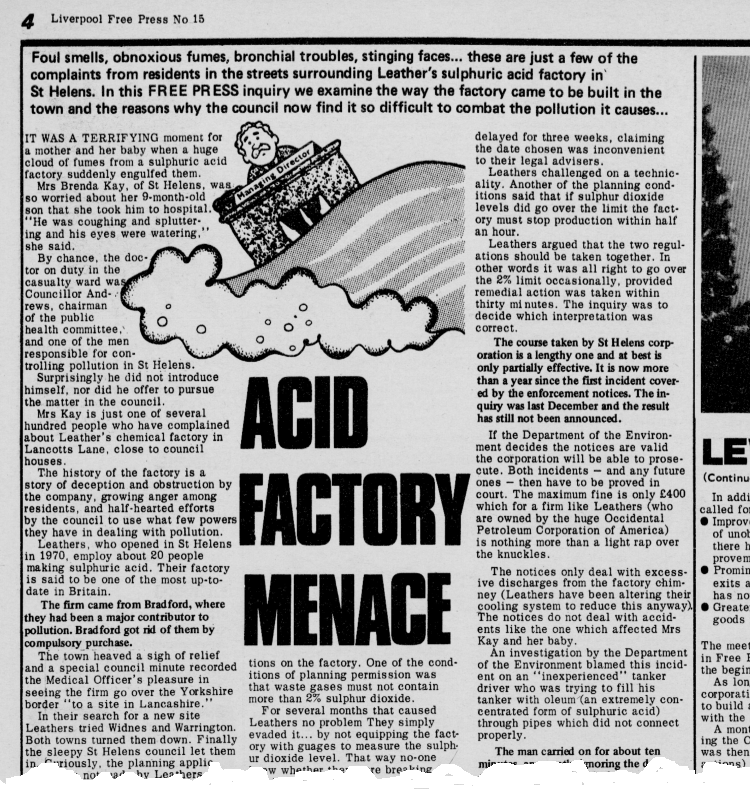
Extract from the Free Press article:
The history of the factory is a story of deception and obstruction by the company, growing anger among residents, and half-hearted efforts by the council to use what few powers they have in dealing with pollution.
But overall, the effect has been very different. The smell and fumes are obnoxious. At times some people have been left gasping for breath, while others have complained of sickness, smarting eyes and stinging faces. And four head teachers in the area say there has been more asthma and bronchial trouble amongst pupils since Leathers came.
The council did place some restrictions on the factory. One of the conditions of planning permission was that waste gases must not contain more than 2% sulphur dioxide. For several months that caused Leathers no problem. They simply evaded it… by not equipping the factory with gauges to measure the sulphur dioxide level. That way no-one knew whether they were breaking the regulation or not. However, the pollution was so obvious that eventually the council served an enforcement order and monitoring gauges were installed.
From Leather’s point of view the gauges could not have been better designed. For they only give readings below 2%. So when Leathers go over the limit no-one knows by how much. On two days last year there were serious discharges from the factory. In the first case fumes from Leathers travelled more than a mile to another factory and made workers ill. In the second, discharges of sulphur dioxide enveloped shoppers in Sutton three times in one day.
St Helens council sent Leathers two enforcement orders claiming the firm had broken the regulations. The notices would have allowed the council to take Leathers to court, and at last it looked as though they had Leathers cornered. But Leathers appealed and a public inquiry was called. Although Leathers were given two months’ notice of the inquiry, they got it delayed for three weeks, claiming the date chosen was inconvenient to their legal advisers.
Leathers challenged on a technicality. Another of the planning conditions said that if sulphur dioxide levels did go over the limit the factory must stop production within half an hour. Leathers argued that the two regulations should be taken together. In other words it was all right to go over the 2% limit occasionally, provided remedial action was taken within thirty minutes. The inquiry was to decide which interpretation was correct.
The course taken by St Helens corporation is a lengthy one and at best is only partially effective. It is now more than a year since the first incident covered by the enforcement notices. The inquiry was last December and the result has still not been announced. If the Department of the Environment decides the notices are valid the corporation will be able to prosecute. Both incidents — and any future ones — then have to be proved in court. The maximum fine is only £400 which for a firm like Leathers (who are owned by the huge Occidental Petroleum Corporation of America) is nothing more than a light rap over the knuckles.
The notices only deal with excessive discharges from the factory chimney… The notices do not deal with accidents like the one which affected Mrs Kay and her baby. An investigation by the Department of the Environment blamed this incident on an “inexperienced” tanker driver who was trying to fill his tanker with oleum (an extremely concentrated form of sulphuric acid) through pipes which did not connect properly.
The man carried on for about ten minutes, apparently ignoring the dense cloud of sulphur trioxide fumes which belched out into the surrounding streets. There have been several other accidents. So far this year, residents have reported cases of a passer-by and a car being sprayed with acid.
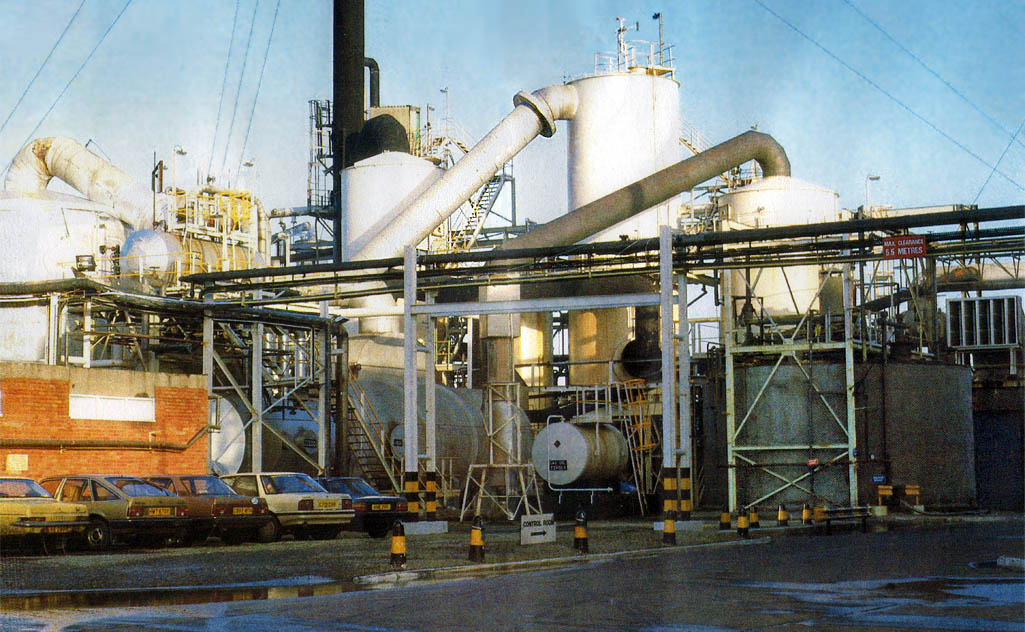
The factory when operated by Hays Chemicals. Source: St Helens Library archives
Council’s move to close the factory
A few days after the Free Press article appeared there was bad news for St Helens council: the inquiry had found in favour of Leathers Chemicals.
This left the council with two possible further actions. One was to prosecute for “nuisance” under the public health laws, though that needed approval from the Attorney General, who appeared uncooperative. It seems that Leathers was not causing enough of a nuisance to be worth prosecuting.
The other possible action was to issue a “discontinuance notice” forcing the factory to close, with the loss of 60 jobs. This was a very drastic procedure, rarely used, and it also meant the council would have to find £10 million or more to compensate Leathers. In other words, the cost of ending the pollution would not be borne by those who caused it but by those who suffered its effects.
Sutton councillor Jim Bond was quoted as saying: “The people of the area are so heartily sick of Leathers that they are more than willing to pay the price”. He added that their acid tankers were cleaned out with steam every night with “the fumes choking those living nearby”.
The acid factory was by no means the only source of pollution in St Helens but such was its reputation that people in the town tended to blame Leathers for any illnesses or nasty smells. One side-effect of this was that the factory’s presence on Lancots Lane blighted the immediate area. Companies became relucant to establish new factories on vacant land nearby and in the 1980s the Health & Safety Executive advised St Helens Council to drop plans to build housing for the elderly near Leathers, on the grounds that an accident at the acid factory would endanger people within a one mile radius.
Another public inquiry
Responding to public sentiment, the council duly issued its discontinuance notice, the company appealed and the result was another public inquiry, held in January 1976.
In support of its case, the council provided a list of 45 incidents at Leathers, two of which had been serious. Leathers countered by arguing that closure of the factory would damage both the environment and Britain’s economy.
Commercial director Dennis Matthewman told the inquiry the UK market for sulphuric acid was about 800,000 tons a year and the St Helens plant provided more than a quarter of that.
“Should the capacity at St Helens cease for any reason it would effectively close down a very important section of British industry geared to the manufacture of a wide range of detergents, rubber, oil refining chemical manufacture, ceramics, plastics and petro-chemical products.” he said.
“The net effect of the closure of the St Helens plant and its effects on the British industrial scene and indeed our economy would be immense.”
He added that in addition to sulphuric acid the St Helens plant was an important producer of oleum and “I would emphasise it would be impossible to obtain supplies of oleum to cover this capacity anywhere in the United Kingdom.”
On the environmental front, closure would deprive the British Sidac of the surplus steam from Leathers, resulting in an additional 1.86 tons of sulphur dioxide to be disposed of every day.
A shop steward from Leathers also testified at the inquiry saying he had been an acid loader at the factory for six years and “so far as I am aware the process at Leathers Chemicals does not expose myself or other employees to undue risk of injury.”
As before, this second public inquiry found in Leathers’ favour and the acid factory continued production. (There was a third public inquiry in 1988 which overruled the council’s rejection of plans to add a sulphur-grinding plant on the site.)
Oleum tank ruptured
A major incident occurred one morning in 1986 when a tank containing 110 tonnes of oleum ruptured, causing what one resident described as “a thick fog” of poisonous gas. Wainwright describes what happened next:
“Roads were closed for a radius of a quarter of a mile and police toured the streets with loudspeakers telling people to stay indoors, shut all their doors and windows and drink plenty of milk. Residents were also advised to wash immediately if they came into contact with acid fumes.
“Ten appliances and fifty firemen quickly arrived at the scene and they sprayed the defective tank with water. Despite this a further emission of the acid gas took place at 2:50pm and it took six more hours before the situation was brought under control.
“Morrisons supermarket in Baxters Lane evacuated shoppers for the day and a major golf tournament in Sherdley Park was called off … Even trains on the Liverpool to Manchester line were re-routed and St Helens Hospital sealed all doors and windows and turned off its ventilation system.”
Fortunately, no one was seriously injured.
At the time of the leak Leathers was no longer in charge of the factory and the new operator — Hays Chemicals — was later fined £3,000 for failing to maintain a vent pipe on the oleum tank. Hays did, however, spend £150,000 on improvements that included replacing the large oleum tank with four smaller ones which had additional safety features.
Charm offensive
Hays also told a local paper it wanted to be a good neighbour and embarked on a charm offensive which included splashing out £6,000 in sponsorship money for the town’s Amateur Rugby League and its Mid-Week Cricket League. Hays also circulated 6,000 “Getting to know us” information packs along with “action cards” advising people what to do in the event of an emergency at the factory and held two open days where the public were invited to tour the plant.
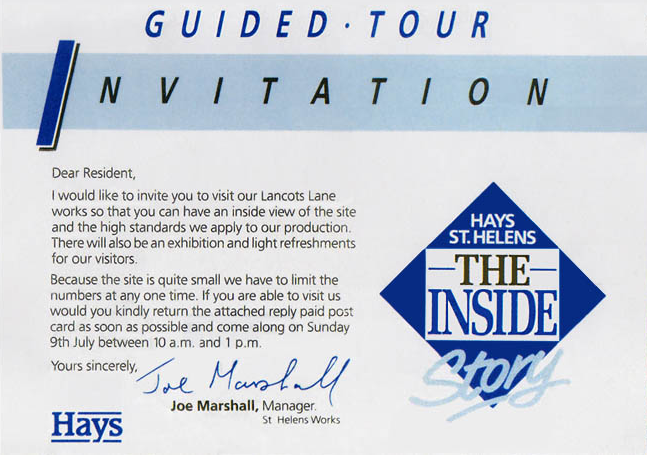
While this served an obvious PR purpose, it was also a disguised way of complying with the Control of Industrial Major Accident Hazards (CIMAH) regulations, introduced in 1984, which said “persons liable to be affected by a major accident” had to be given information about the nature of the hazard and the recommended steps to take if accident occurred.
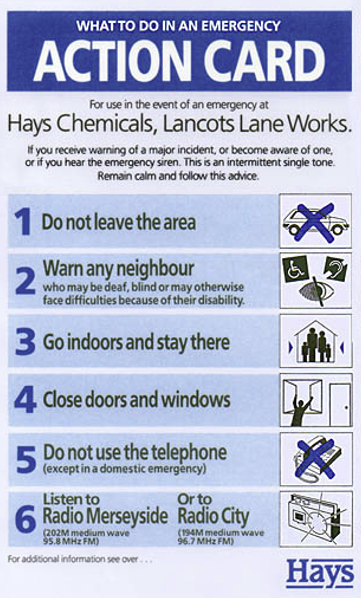
Another requirement of the CIMAH regulations was that manufacturers and local authorities must develop plans for dealing with emergencies, and in St Helens the result of this was Operation Cloudburst — a two-hour practice exercise in 1988 involving the fire brigade, the ambulance service and the police, based on an imaginary scenario where a drum of sulphur trioxide had been punctured by a forklift truck.
The exercise was pronounced a success, though it started late and was ridiculed by some residents. Fortunately, the plans don’t seem to have been put to the test in a real emergency, though in 1989 there was a further oleum leak for which Hays was again fined £3,000
Despite all the council’s efforts to shut down the acid factory, when the end came in 2022 it wasn’t the result of action by the council. Hays had been taken over by Albion Chemicals in 2001 and a few months later the new owners decided it could no longer be profitable — and shut it down themselves.
FURTHER INFORMATION
The History of Industry in Sutton
Stephen Wainright, Sutton Beauty and Heritage website, 2020
Sulphuric acid production
A five-minute video by the Royal Society of Chemistry in association with
NEWSPAPER REPORTS
(with links to the British Newspaper Archive)
Women’s threat to factory
Liverpool Echo, 8 Sept 1972, p7
Factory row: no-go threat
Daily Post, 9 Sept 1972, p7
Chemical fumes ‘leave people gasping’ — MP
Daily Post,19 Dec 1973, p9
Factory fumes ‘scare mums’
Daily Post, 20 Dec 1973, p3
Acid factory menace
Liverpool Free Press, issue 15, May 1974, p4
St Helens firm wins appeal
Daily Post, 14 May 1974, p3
Protests as judge opens new courts
Daily Post, 30 May 1974, p9
Tankers turned away by pickets
Liverpool Echo, 2 July 1974, p3
Call for new rule on fumes firms
Liverpool Echo, 20 July 1974, p8
Acid plant decision deferred
Daily Post, 4 Sept 1974, p3
Residents protests over ‘fumes’
Liverpool Echo, 2 Nov 1974, p1
Residents fight on to shut chemical plant
Daily Post, 12 December 1974
MP is to probe fumes leak at acid plant
Liverpool Echo, 18 April 1975, p4
Closure of plant ‘would hit industry’
Liverpool Echo, 10 January 1976, p7
MPs call for action over chemical leak
Daily Post, 1 July 1986, p12
Acid factory ‘must close’
Liverpool Echo, 3 July 1986, p2
Sirens will sound for safety drill
Daily Post, 3 October 1991, p17
Council bid to shut down chemical plant
Daily Post, 5 July 1986, p10














0 Comments