The Job Creation Programme was one of several government initiatives in the 1970s aimed at reducing unemployment. Based on a similar scheme in Canada, it sought to provide temporary work for people without jobs, especially school leavers.
Local authorities, businesses, charities, voluntary organisations and community groups were all urged to sponsor employment projects. Over a two-year period the Labour government made £75 million available to cover wages and other costs – £13 million of it allocated to Merseyside.
The newly-created Manpower Services Commission took charge of the programme and set up ten “action committees” around the country to decide which projects qualified. The Commission was deliberately vague about the types of projects it was looking for, saying it wanted people to “use their initiative and imagination”.
The chair of the Merseyside action committee – Fred Ridley, Professor of Political Theory and Institutions at Liverpool University – echoed this, saying: “We are open minded. In a sense we are saying ‘surprise us and suggest something original’. But we want sponsors who will manage the projects themselves and who have the facilities to run them.”
The government was wanting quick results but, as Ridley noted, even simple projects needed a lot of preparatory work. Also, the people most likely to come up with imaginative ideas for projects – such as community groups – were often not well-placed to run them. Local authorities, on the other hand, had the organisational capability to do so and ended up with the lion’s share of the funding.
To allay fears that job creation projects might take work away from people who were already employed, Manpower Services stipulated that projects must only take on work that would not otherwise be done by anyone else.
One consequence of this was that the projects offered by local councils generally involved low-priority tasks such as tidying up parks and open spaces or removing graffiti – things they couldn’t afford to pay for out of their normal budgets.
* * *
Did you work for a Job Creation project in the 1970s?
If so, Liverpool People’s History would like to hear from you.
Tell us what you did – and what it did for you.
* * *
The first schemes to get under way on Merseyside were in Ellesmere Port, sponsored by the local council. In November 1975, six teenage girls joined the council’s Horticulture Unit and a group of boys began work at the same time on an adventure playground project.
The value of some of these projects was questionable and they gave the impression of creating work just for the sake of it. The Liverpool Echo reported:
A squad of six unemployed people will soon be walking around Liverpool’s district shopping areas, surveying neighbourhood parking problems …
During the working day, they will survey the numbers and types of vehicles and monitor the length of stay. But a council official today emphasised the six would not be duplicating work done by the city traffic wardens. “We have had a history of complaints from residents living close to shopping centres concerning parking in their roads and outside their homes,” he said.
Proposals rejected
Manpower Services also stipulated that job creation projects must not be used as a backdoor way of restoring previous local authority spending cuts and Liverpool’s education department ran into trouble on that account.
Seven of the department’s nine job creation proposals were rejected, including one to repair vandalised desks and chairs in the city’s schools. However, another project – to discourage thefts by employing three people to mark the department’s name on portable equipment – appears to have been approved.
The Job Creation Programme made only a small dent in the overall unemployment figures and, given the nature of the work, there was little chance that projects could become self-financing and provide continuing employment once the government funding dried up.
According to the government, though, there were other – less tangible – benefits. Harold Walker, minister of state in the Department of Employment, told MPs the Job Creation Programme could provide “a realistic introduction to the constraints and satisfactions” of having a job:
“It can help young people acquire skills of either a specific or non-specific nature; it can help young people gain a better knowledge of their own capacities, help them gain in maturity, self-reliance and self-esteem, and help widen their communication skills and abilities to cope with adults or peers.”
It didn’t go quite so well in Ellesmere Port where Don Porter, the parks superintendent, complained of a disruptive element among Job Creation youngsters who engaged in “mud-throwing matches, water fights and general larking about”. One lad had been sacked and Porter told the Echo “I am picking out the ringleaders and will sack them on the spot if they don’t learn to behave.”
‘Artificially high’ wages
A prominent critic of the Job Creation Programme was Anthony Steen, the Conservative MP for Liverpool Wavertree. Speaking in parliament in June 1976, he claimed the schemes were paying “artificially high” wages and suggested halving their pay would allow for twice as many people to be employed.
Steen said some were being paid as much as £56 a week when the average wage for a 21-year-old outside the programme was around £40 a week. Such high rates may have been exceptional, however, and according to the Echo youngsters on the Ellesmere Port schemes were paid between £23 and £26 a week.
Replying for the government, employment minister Walker said the Job Creation Programme did not want to be a scheme offering second-class work:
“Sponsors are reimbursed wage costs and pay the rate for the job. A local authority sponsoring a scheme pays the rate it would normally pay for broadly comparable work. Other sponsors pay their normal wage rates. It is a simple way of deciding the rates which should apply.”
He added that the programme was also more cost-effective than it might appear:
“Job creation also makes economic sense, as the net costs of the scheme, taking into account income tax deductions and savings in benefits which would otherwise have to be paid, are considerably less than apparent costs and some valuable work will be done.”
Nationally, 90% of the sponsors of job creation schemes were local authorities, but on Merseyside schemes run by voluntary organisations played a much bigger role and accounted for about 40% of the total.
The following article, published by Liverpool Free Press in 1976, looks in detail at some of the schemes run by voluntary groups …
Making work
by JIM CARMICHAEL
Liverpool Free Press, July/August 1976
Tony Byrne runs two job creation schemes employing 38 people. He is aware that the programme is a political con trick, the result of “a cocked-up compromise between the government and the trade unions”. Despite this, he thinks it a good idea – “a new possibility for youth employment” – and would like it to become permanent, not only for kids but all the unemployed. “There has never been a time when this area has had full employment. Traditional industry has failed to meet the needs of the working people,” he said.
Tony Byrne is a community worker based at HANDS (Help and Neighbourhood Development Scheme) on Smithdown Road. The people helped by HANDS are mainly the elderly and the homeless in that area.
The job creation scheme has enabled them to extend the practical help offered to these people. The first scheme employs four skilled supervisors and 15 school leavers to decorate the homes of the elderly and the poor. They not only decorate but do any number of tasks which are the responsibility of the tenant.
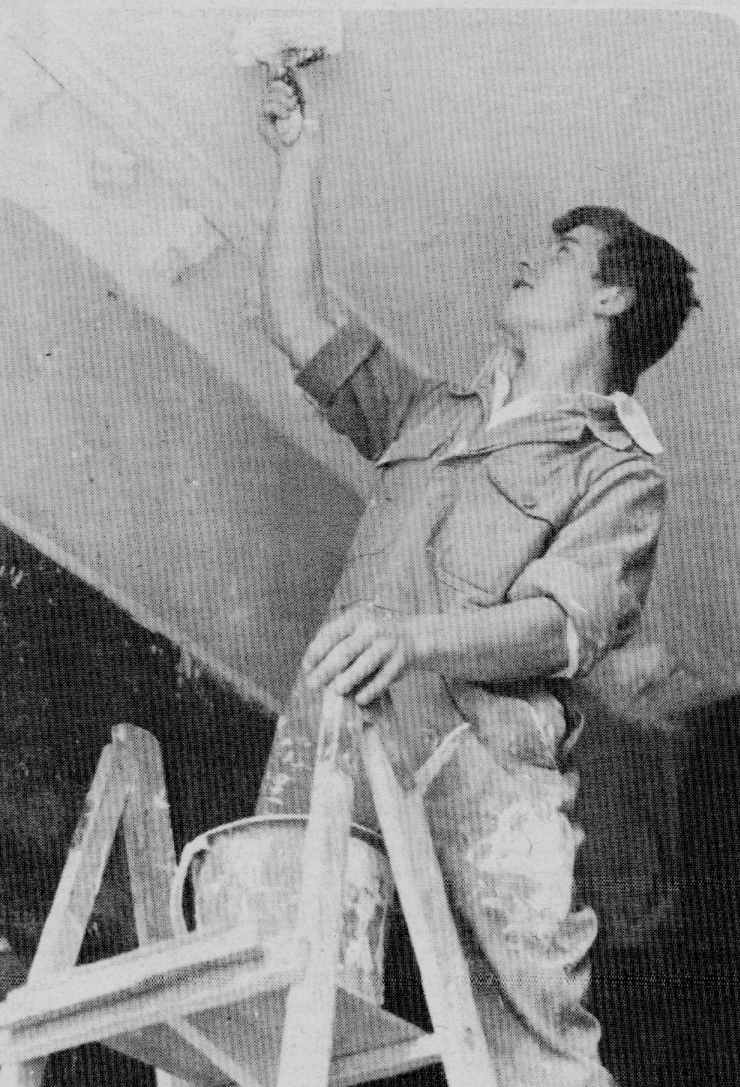
Painting the parts pensioners couldn’t reach.
The second scheme also employs four skilled supervisors and 15 school leavers and provides a moving-in service for the homeless. This often means making a house habitable by cleaning, decorating and making minor repairs as well as removals.
The ratio of boys to girls in these schemes is 50–50. This is a feature of many job creation schemes: girls are given genuine equality of opportunity..
The kids attend the Mabel Fletcher College once a week and pursue courses of general education, woodwork, maths, English and social studies. Six of them are to start O-Level courses in September.
They are paid local authority rates and have normal working conditions (i.e. they book on and off and have to produce sick notes if they miss a day). In this sense there is not a new form of employment here. Tony Byrne argues that these are the conditions working people expect and that only “middle class divvies” would try to change this system of working. “The terms on which we sell our labour is our problem,” he said.
However, they do have regular meetings where the kids and supervisors get together to discuss the work and offer criticism. Allan Blackhall, aged 17, said this about one of these meetings: “They said they didn’t like us to go to the pub at dinner time because if we have an accident and people smell beer they will blame that. We agreed with them and we don’t go.”
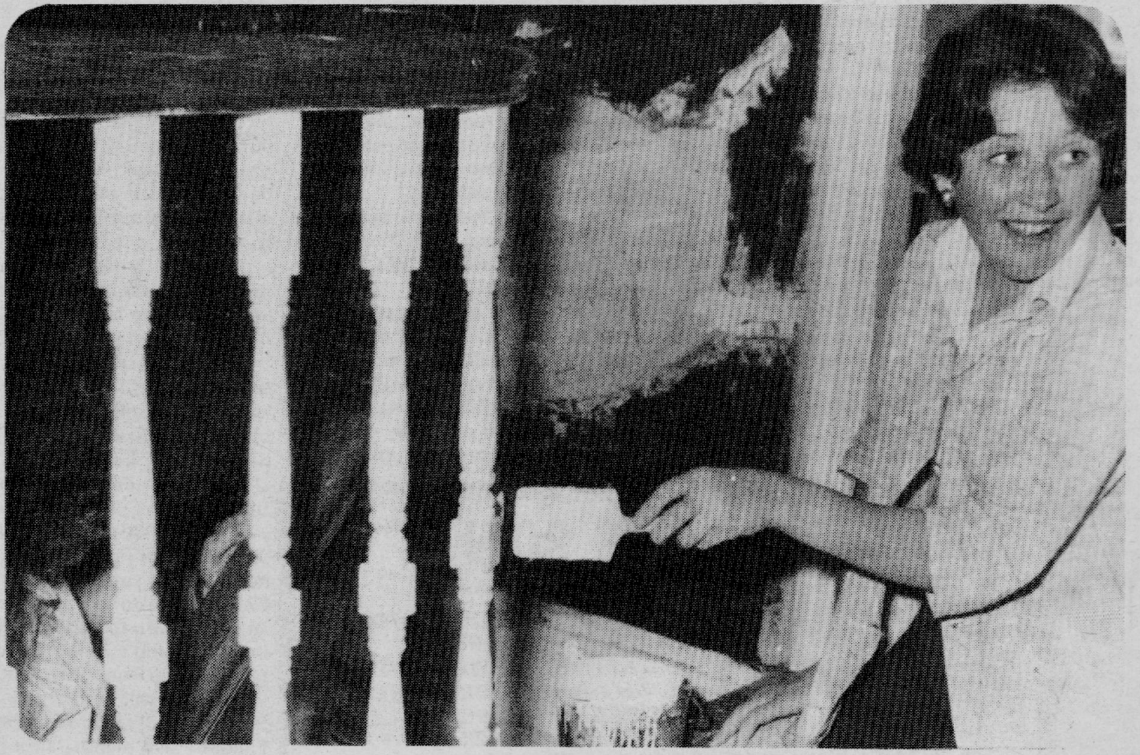
Half of the HANDS team were girl school leavers.
New ways of working
The Sefton Employment Action Group is an ad-hoc group whose role is to set up job creation schemes in the Bootle area. The group itself has received a job creation grant.
Jeff Hill and Nigel Godfrey; two members of this group, agree with Tony Byrne’s ideas but go further and see job creation as “widening the whole spectrum of what is meant by work … there will be new types of work and new ways of working”.
Nevertheless, at the moment their employees are expected to conform to the old ways of working.
They are planning two adventure playgrounds, a toy workshop and a decorating co-op. All their supervisors are going on Training Service Agency courses to learn to be instructors.
One of the chief drawbacks of the job creation programme is its shortness: maximum length of any scheme is one year. Jeff Hill: “We ought to be talking about three-year schemes. If the thing is to be serious they have to be longer.”
The Sefton group, HANDS and others have made three proposals for the long-term development of Job Creation:
- That it should have a long-term development and become permanent.
- That it should be related to Special Development status for areas such as Merseyside.
- Day release funds need to be available as part of the job creation scheme to pay for training.
A chance in life
The continuation of many schemes depends on the whole programme continuing. The alternative is to create a commercially viable business which is able to continue when the Job Creation funds dry up. This is one alternative considered by the Lifechance Construction Co Ltd. They hope that they will be able to continue as a co-op when the scheme comes to an end (though they would prefer the programme to continue indefinitely).
Lifechance were one of the first schemes on Merseyside to be approved. They have received a lot of attention and publicity. Their visitors include the Sunday Times, the Under-Secretary of State for Industry and a professor of economics from the LSE.
Lifechance is run by Andy Churchill, Bill Murphy and Andy Cordell. The first two were involved with the Scotland Road Free School, and all of them with Community Transport.
Andy Cordell says Job Creation has “made possible a lot of things that wouldn’t have been possible, but only because we had the ideas”.
Their schemes employ 70 people (30 adults and 40 young people). They work in a huge ramshackle warehouse and one of the schemes employs people to renovate this building. They are also making glass fibre canoes, converting old vans into caravanettes and have plans for building boats.
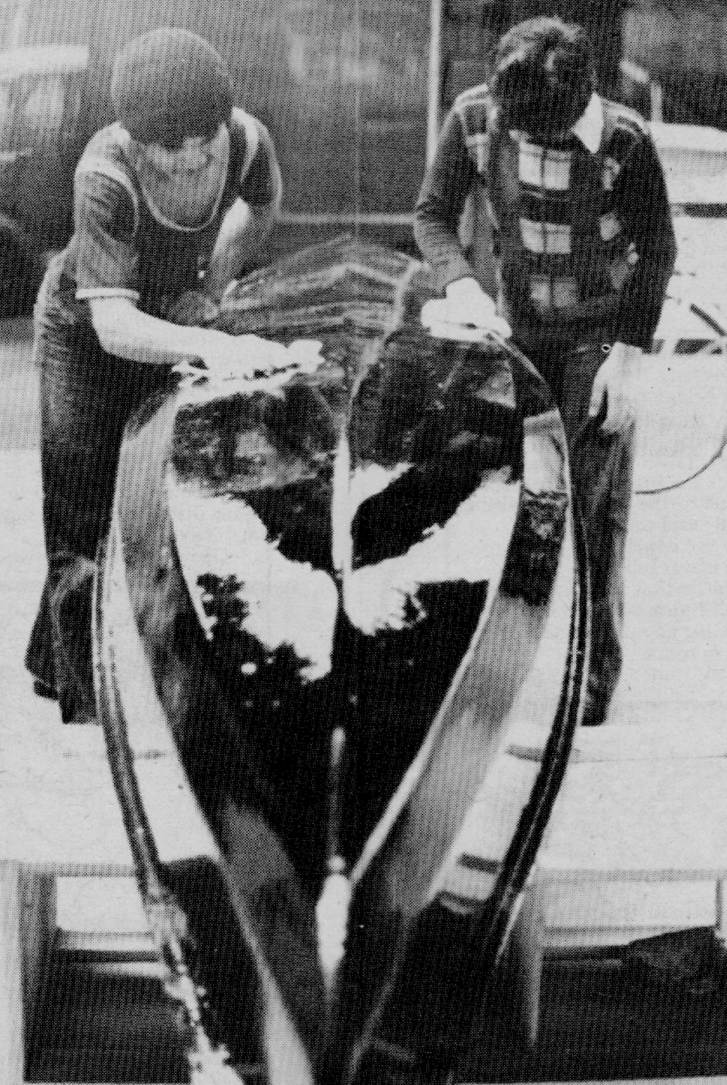
Final polish for a fibre glass canoe at Lifechance.
All the young people employed here are given the chance to do joinery, glass fibre laminating and car mechanics. Those that are interested in one of these skills are encouraged and helped to continue their training.
Shirley Wood is 17 and she used to work in an office. Soon she is going to college to train to be a car mechanic. “I’ve always wanted to be a mechanic but when I was at school they told me I’d like to work in an office,” she said.
Emmanuel Owolaby is 17 and was unemployed for six months after leaving school. He is also going to go to college: “I’m doing mechanics which I always wanted to do and I’ll get into college because of Lifechance.”
These are only two of the many that arc being trained through Lifechance. Also, many of the skilled men have become very involved in this side of the scheme. Bill Eccleston, a joiner and shopfitter, has this to say: “I’ve been waiting all my life for a job like this. My reward is seeing the kids dragged off the street.”
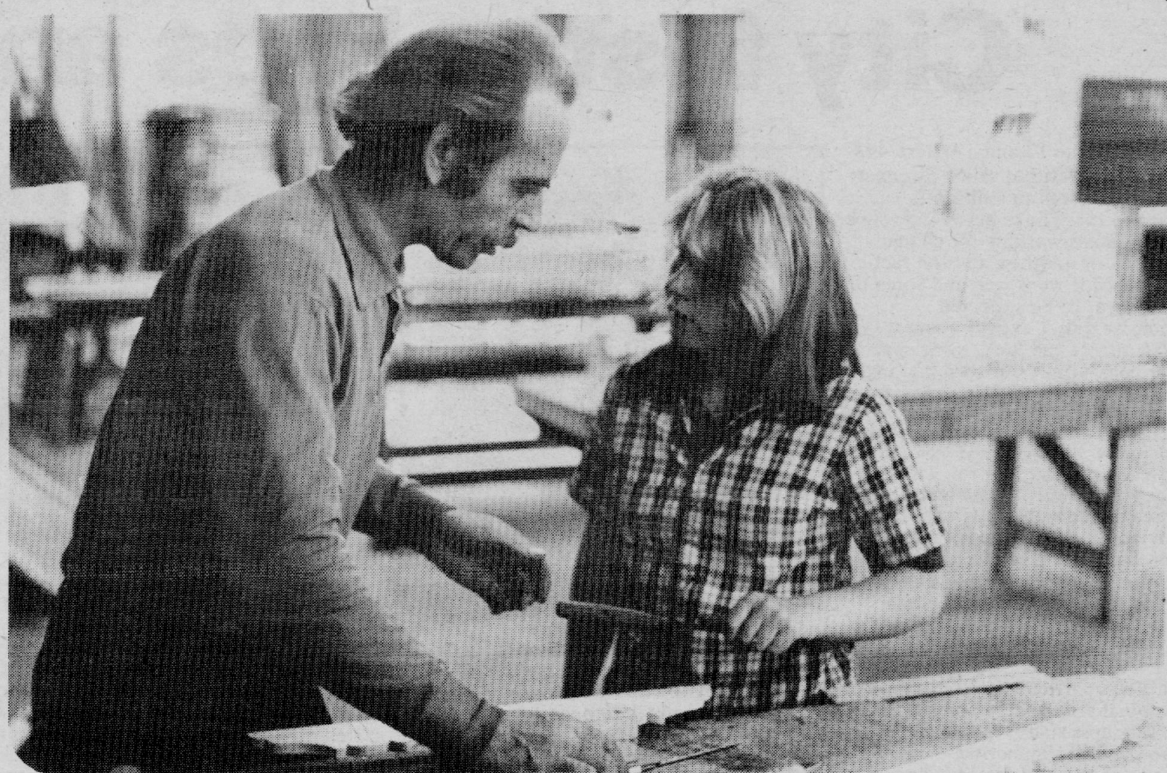
Helping hand for a carpenter at Lifechance.
Keeping it going …
But the Lifechance schemes finish this month and about three-quarters of their workforce will be back on the dole. The other quarter are to be members of Liverpool Training Co-op Number One. A group of 12 tradesmen have become founder members of this co-op. It has four main aims:
- To try and make saleable products.
- To gain management skills.
- To gain technical skills.
- To gain contacts.
The aim is to help other groups form their own co-ops. This idea has emerged from Lifechance and will initially need Job Creation funds. These have been applied for and a decision is expected at the end of the month. There are 102 jobs to be created.
The co-op will have a Friendly Society constitution. There are no shareholders in a Friendly Society, only members. In the co-op all members will be employees and all employees members. General policy will be decided at general meetings and only a 75% majority of a 75% quorum will be effective. A Friendly Society is like a limited company in that the members only have a limited liability for the society’s debts.
Problems which have already emerged are similar to those experienced at the KME workers’ co-op in Kirkby. There is a difficulty in finding people willing to take responsibility for day-to-day management decisions. It was hoped that the co-op would arise from the unions but this did not happen.
Andy Cordell said: “The trade unions were not aware of the wider implications and remained more interested with the individual welfare of their members.”
The problem is essentially one of responsibility. In the usual industrial situation there is a hierarchy of power and responsibility. The worker on the shop floor is responsible only for his own work. A co-op is an attempt at workers’ management: the individual workers have equal responsibility for the success or failure of the co-op.
As we have already seen, general policy is decided by a general meeting. But it is obviously not practical to call a general meeting to make middle level decisions. For example, the office staff at Lifechance need more space and there is an old caravan which could be used for this purpose. But the factory staff have taken it for their own use.
The shop floor worker has little awareness of the problems of those in the office (and vice versa) which means that a decision is taken based on a partial perspective. Although Lifechance is not yet a fully-fledged co-operative, this example does illustrate the difficulty.
Andy Cordell described it thus: “We are trying to sort out the minimum structures necessary to make things happen”, and he went on: “These problems cannot be sorted out in theory”. It is not a problem unique to Lifechance and it can be solved through their long-term development.
There are worse problems when it comes to trying to make a saleable product. All job creation schemes are fundamentally labour intensive: the schemes are allowed an extra 10% of labour costs for administration and materials. There is no money for capital investment.
When Job Creation funding ends the co-op will be faced with huge labour costs. If they continue to produce caravanettes, canoes and boats they will be in an enormously uncompetitive position. In this type of economic system that is a formula for disaster. But I’m sure some members of Lifechance have their imaginations working on this problem too.
The vast majority of schemes are not as ambitious or imaginative as Lifechance. Nor are they seen as “a new form of employment”. They are merely a stop gap and for those employed on them the best that can be said is that they are better than the dole.
Of the 186 schemes on Merseyside, 45 involve landscaping, site clearing and other similar tasks. The majority of these have no provision for training. Thirty-nine schemes involve painting and decorating and it is hoped that young people will be trained in this craft.
Yet Jack Rogers, the area organiser of UCATT, says that the job creation schemes “cannot offer a genuine training in any way whatsoever”. The Construction Industry Training Board is, he said, the only body that can give a proper training. So no matter how much the job creation kids learn about painting, they will not be qualified.
Thirty-one schemes involve boring types of clerical work such as indexing, filing and bringing records up to date. Only 13 schemes offer day release provisions.
Jack Rogers gave his reaction as a trade unionist to the programme. He described it as “an aspirin for a cancer” and said the government was only scratching at the problem of unemployment. There are 700 painters unemployed on Merseyside, yet he is not opposed to some of the schemes.
According to figures released by the Job Creation Board, it costs only £11 per week to employ someone through the programme. This figure is an average which is arrived at by deducting tax, insurance and the supplementary benefit that would have been paid, from an individual’s wages. £11 a week is not very much for the government to pay for the political benefits of holding down the unemployment figures.
Opening for bright ideas …
The Job Creation Programme got off the ground very rapidly. Voluntary groups sponsoring schemes say they have never known civil servants to move so fast. On the left, whilst there is a general disapproval of the government’s motivation, responses to the programme are varied and often ambiguous.
It is obvious that the Job Creation Programme will not solve unemployment. And despite the Manpower Services Commission wishing it otherwise, most of the schemes are of the ‘hole in the road’ variety.
But one thing in Job Creation’s favour is the ease with which community groups have been able to get money. Urban Aid on Merseyside has been under local authority control and hence difficult to get. But with Job Creation, community groups have to be trusted, otherwise some of the funds will remain unspent. The responsibility and imagination necessary to create jobs does not lie with the bureaucracy – they can only wait for other people to suggest schemes.
It is unlikely that many of the schemes will succeed in existing without Job Creation funds. Those that do will be making a profit – and what will happen to any profit is an interesting question.
The development of the programme will be the result of experience and debate. Some schemes are training people in various crafts and skills. If the trade unions integrated these schemes with their existing training schemes this would preserve standards and prevent the young people trained under Job Creation from becoming second-class workers. But resistance to this is only to be expected when there are so many trained people already out of work.
The intention of the government is to be seen to be doing something without seriously tackling unemployment. Some people have called their bluff and the result is imaginative and genuinely useful schemes. As the programme develops they can only get better.
FURTHER INFORMATION
Parliament
Adjournment debate on the Job Creation Programme
Hansard, 21 June 1976
Speakers: Anthony Steen, Leon Brittan, Harold Walker
Liverpool Echo
(with links to British Newspaper Archive)
Pledge on wages in boost for jobs
9 Oct 1975, p1
Surprise us, say jobs men
13 Oct 1975, p1
Girls start the spadework on jobs project
4 Nov 1975, p8
More projects on way to aid jobless
5 Nov 1975, p7
21pc of teenagers still jobless
17 Nov 1975, p7
Skylarking jobs scheme lads face threat of sack
5 Dec 1975, p5
Petty snags disqualify good ideas in job creation
6 Jan 1976, p5
Jobless are to take on parking survey
16 Mar 1975, p7
Comment: Dangers of the dole
22 Sep 1976, p10
















0 Comments