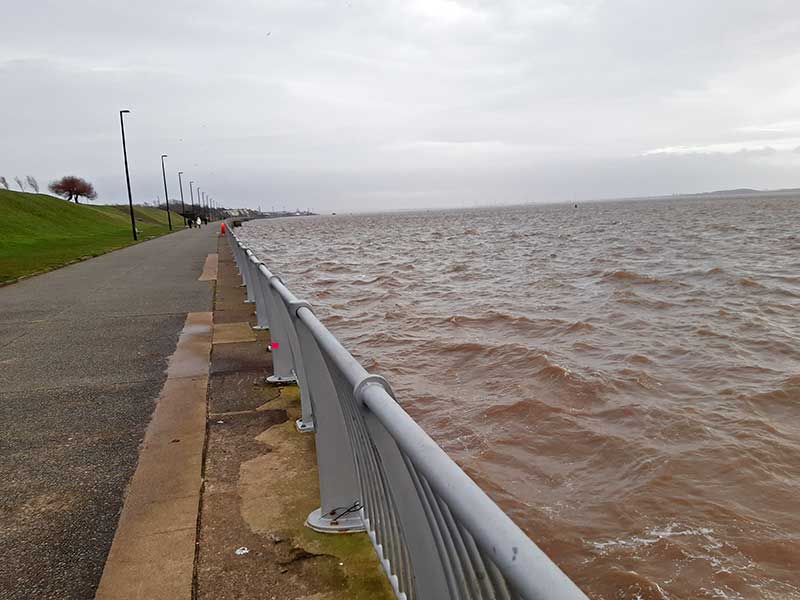
High tide at Otterspool

by Paul Unger
Making his home in the Atlantic Tower Hotel, and his temporary office in the Royal Liver Building, Michael Heseltine overlooked the River Mersey in the summer of 1981. “Alone, every night, when the meetings were over and the pressure was off,” Heseltine remembered “I would stand with a glass of wine, looking out at the magnificent view over the river and ask myself what had gone wrong for this great English city … In truth, everything had gone wrong.”
Then Secretary of State for the Environment, Heseltine had headed north to Liverpool in the smouldering aftermath of the Toxteth riots. Two weeks of rioting, looting and arson by some of the poorest people in the city left one young man dead, hundreds of police and unknown numbers of civilians injured, and caused great damage to the neighbourhood’s public buildings, homes and shops.
Heseltine was uneasy about the short-term social effects of the policies being pursued by the Treasury: “I was alarmed by the suddenness and extent of these manifestations of arson and violence. Besides, I felt that I bore much of the responsibility. I had been Secretary of State for two years. I had chosen to take a particular interest in Liverpool. I asked Mrs Thatcher to allow me to spend some two to three weeks away from day-to-day departmental duties while I concentrated on Merseyside … I intended to find out what had gone wrong.”
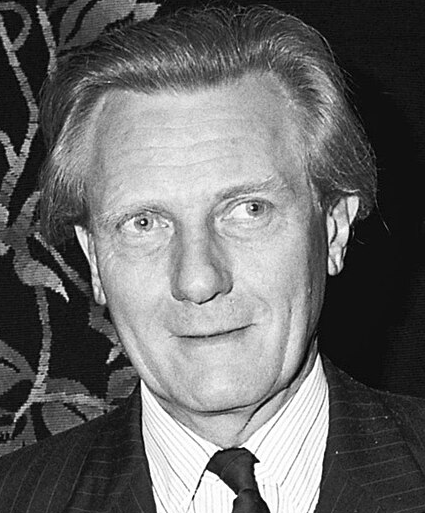
Heseltine: “Everything had gone wrong”
Liverpool certainly needed something. The post-war population of 800,000 had shrunk to 450,000 and was continuing to fall by 10,000 per year. Between 1966 and 1977, 350 factories closed or transferred production elsewhere with the loss of 40,000 jobs. At the same time, the port continued its decline. Its share of total UK imports and exports almost halved from 15 to 8% and its workforce fell from 25,000 in 1945 to 3,000 by the mid-1980s.
The Mersey was a filthy joke. For more than 100 years raw sewage had been dumped unchecked into its waters, from its source to its estuary. There were nearly 50 sewage outfalls in the lower estuary alone. Upstream heavy pollution entered the river from Warrington, Runcorn, Widnes and Ellesmere Port. The Manchester Ship Canal, little more than a stagnant strip of oil, caught fire in the dry summer months as the river beside it sweated and stank, hardly inviting for any would-be waterside property developer. The narrow, slow, shallow estuary between Liverpool and the Wirral peninsula took 30 days to clear itself of pollution from up river. It was not until the water authorities were set up in 1974 that a body even existed with the powers to make and execute a plan for improvement in water quality.
Neither Labour nor Conservative governments had faced the costly second part of the Control of Pollution Act 1974, calling for massive water improvement investment. After more than two weeks of meetings, and listening to as many local people as he could, Heseltine held a press conference in Liverpool. He announced 13 initiatives aimed at solving Merseyside’s problems: a range of quick-fix steps to tackle immediate and severe problems. To see the list through to fruition, a Merseyside Task Force was set up, headed by one of his brightest civil servants, Eric Sorenson. Heseltine visited Liverpool fortnightly to check on progress.
A month after the riots, Heseltine presented to Thatcher and her cabinet a paper named from the most familiar phrase heard during those days in Liverpool; “It took a riot.” His paper, leaked to The Times, suggested a single regional office in Liverpool comprising the main government departments concerned with economic development and a reassessment of urban policies for training, enterprise and redevelopment. It was ignored by Thatcher.
Peter Walton was a civil servant among Heseltine’s task force, and remembers the issue of the river gaining in prominence. “Early in 1982 the question of the river kept coming up. He was asking: what about this water, this magnificent river?”
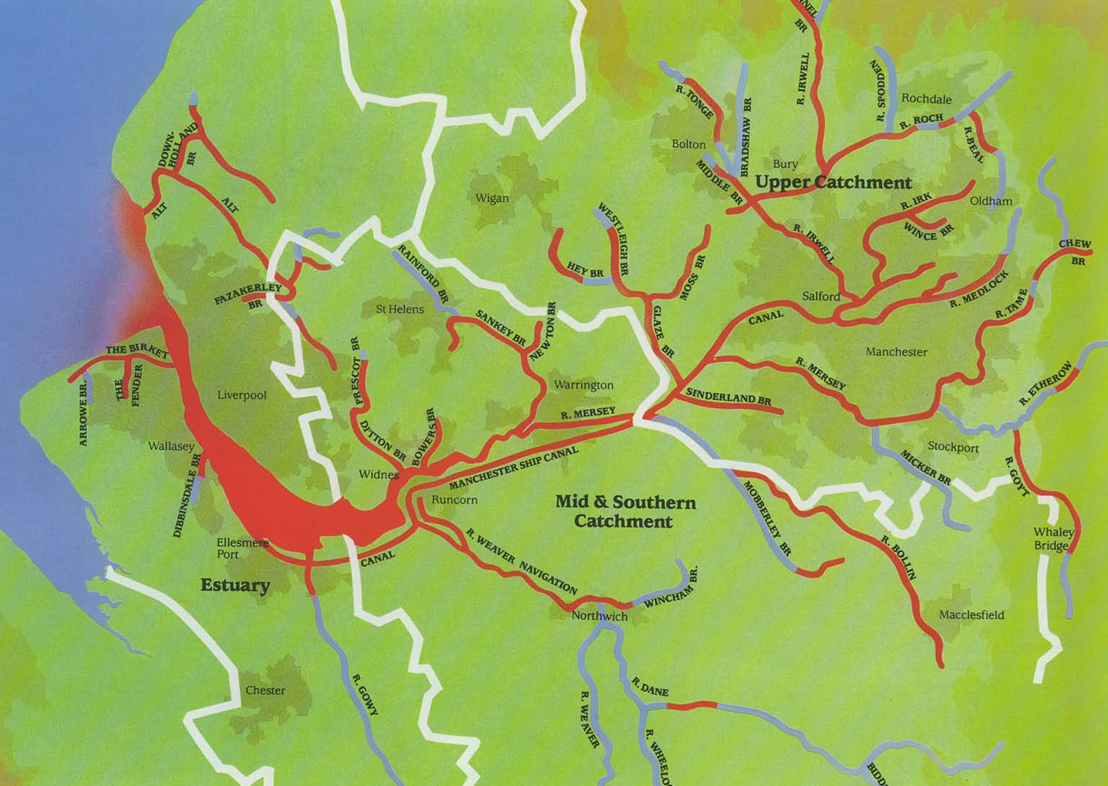
The Mersey’s catchment area (right-click for larger version in a new tab)
Heseltine brought forward the estuary part of the water authority’s expenditure faster but was repeatedly told that he could not clean up simply the bottom end of a river system because there was still pollution coming in at the top. He had started at the wrong end. On one of his regular Thursday visits, Heseltine asked how much it would cost to clean up the entire Mersey basin system and how long it would take. The answer came back that it was going to cost £2,000m and take 25 years. This was a vast amount of money for having a clean drain, and was not value for money. Heseltine wanted a more tangible benefit development on land next to the river. The sum needed became £4,000m over 25 years.
In February 1982, Heseltine announced the go-ahead for the costly second part of the Control of Pollution Act 1974. A four-year programme in the Northwest would begin in July 1983, focusing on intercepting Liverpool’s 28 raw sewage outfalls. The North West Water Authority’s longterm objective was to raise all rivers to class 2, fair quality, capable of supporting fish.
By the summer of 1982, handling Heseltine’s requests for information about cleaning up the Mersey and the benefits that would bring had become a full-time job for Walton, who remembers: “The Secretary of State kept bouncing back this request and that request, saying can you put a figure on this, where would it happen?”
“There came a point around the autumn of 1982, when it became such a diffuse, big request that it turned into a consultation paper and I effectively became its editor.” Walton began to gather the relevant information on the state of the Mersey into what would be the seminal document needed for the recovery of the great river system. A now-famous covering letter from Heseltine invited responses from the public, private and voluntary communities.
Clearing the ravages of the past
“The haunting grandeur of the Mersey creates its own unforgettable impressions,” he opened. “To earlier generations the Mersey and its tributaries were the essence, the life-spring of Liverpool and of a whole host of towns in the textile and industrial belt of the Northwest … But today the river is an affront to the standards a civilised society should demand of its environment … To rebuild the urban areas of the Northwest we need to clean and clear the ravages of the past, to recreate the opportunities and attributes that attracted earlier generations to come and live there and invest there.”
Heseltine nailed the landward objectives in no uncertain terms: “From its source well to the east of Manchester to the sea beyond Liverpool we must aim for much cleaner water. It encourages the restoration to full use and beauty of the many waterside places neglected over the years … A Mersey basin restored to a quality of environmental standards fit for the end of this century will be of incalculable significance in the creation of new employment … I can think of no more exciting challenge for the decades ahead.” And then he was gone, promoted to Defence Secretary in January 1982.
Heseltine’s successor, Tom King, chaired a conference on the paper on March 18 1983 at Daresbury. The response was positive and strong.
“After that there was no going back,” Walton says. “The instinct normally in the civil service is to try and lose it to the local authorities if it’s getting too big for us, but I just hung on by my nails and thought ‘this is wonderful’.”
By the time the final approval from London was called for, there had been another change in command and Patrick Jenkin was Secretary of State for the Environment. Jenkin agreed there should be an organisation, although the question of resources was left a bit vague.
By May 1983, politics in Liverpool was dominating national debate. The Liverpool Labour Party took control of Liverpool City Council, and the infamous ideological battle between Labour’s Militant Tendency and the Conservative government began in earnest. The following year, the city’s ruling Labour party, under the de facto leadership of Derek Hatton and Tony Byrne, refused to set a budget for rates unless further funding was handed down by London.
In July 1984, a settlement was reached between the Conservative government and Liverpool’s rebellious rulers following concessions on both sides, although the defeated minister Jenkin, who had been slow and clumsy in reaching a deal, would not repeat his mistakes when challenged again in 1985. Liverpool capitulated and Hatton’s militant ‘republic’ crumbled by 1987 when the leadership was replaced.
European funding
Meanwhile, funding revolutions were occurring on an even higher stage, one that would benefit work on the Mersey. So-called European structural funds were becoming widely used for schemes on the landward side. But as the volume of European-funded projects grew, organising them on an individual case-by-case basis began to overwhelm the European Commission. It wanted to move towards a programme structure, where Brussels could manage from a higher level of involvement.
When EC commissioners came to the UK looking for pilot programmes on which to test its new thinking, it found a ready-made prototype in the Mersey basin initiative. The Mersey programme received £60m for three years, which would then be repeated on a rolling basis all being well. Two-thirds was to be spent on water and the remaining one-third on land.
By the mid 1980s, the country was beginning to get used to Thatcher’s penchant for privatisation and water was being touted as the next likely candidate. Yet the more money the North West Water Authority’s projects received via Heseltine’s new initiative for the Mersey basin, the more opponents to privatisation smelled a rat. There were lengthy and heated rows inside the Commission that this was a fix to soften up North West Water with a huge influx of money, to prepare it for privatisation.
The money certainly came in handy at the North West Water Authority, which began work in 1984 on a huge capital investment in cleaning up the river. At last the 28 raw domestic sewage pipes discharging from the Liverpool banks of the Mersey would be intercepted by a major new pipe and diverted to a purpose-built wastewater treatment works at Sandon Dock in north Liverpool.
The project would take five years and cost £300m to build, with funds coming from specially raised water rates as well as EC grants and a favourable European Investment Bank loan. Sandon Dock was operational by 1989, capable of dealing with up to 950m litres of wastewater per day. Discharge levels in the Mersey were starting to fall, by 30% when Sandon Dock started and nearer 50% by the time it finished.
Grand projects
Indeed, 1984 was a year for grand projects. Two of Heseltine’s best-known ‘babies’ were born that year. Under the supervision of his Merseyside Development Corporation, set up by Heseltine in 1981, the Albert Dock, a wonderful complex designed in the 1840s by a great architect of the Industrial Revolution, Jesse Hartley, was restored and put back into use as bars, restaurants, museums, shops, and the Tate Liverpool art gallery.
The other great scheme of the year had even wider, if shorter-lived, prominence. The idea for garden festivals was simple, as Heseltine remembers: “Use public money to eliminate dereliction, and green the area to produce a high-quality environment. Stage a festival of attractions for six months and then sell the much improved site for redevelopment.”
Liverpool was not an automatic choice. There was a national competition held and the best bids were from Liverpool and Stoke. Liverpool would get the first international garden festival and Stoke the second two years later.
A former rubbish dump at Otterspool beyond Liverpool’s south docks was the target for the grand makeover. With the full weight of central government money and machine behind the festival the transformation was amazing.
The first part of the plan was superbly executed and for nine months from the summer of 1984 crowds travelled from all over to explore the themed international gardens, lakes, pagodas and space-age silver tubular exhibition hall.
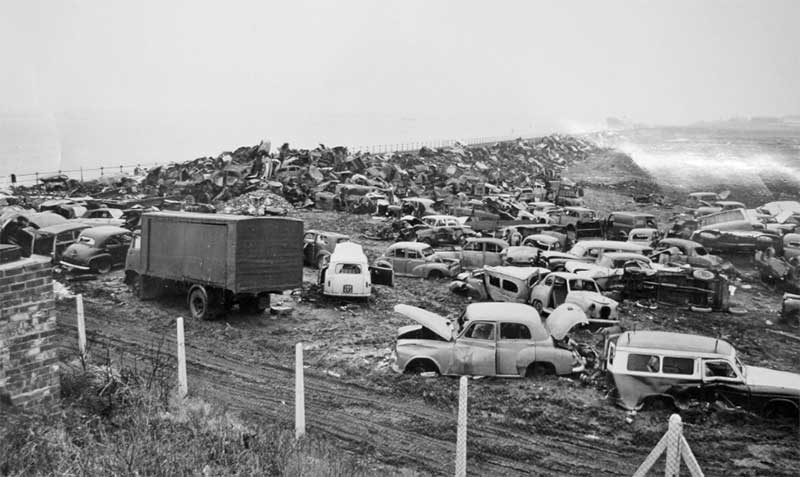
The rubbish tip became the site for the International Garden Festival. Photo-Strawberry Fields Art
By 1985 the foundations were set for the official launch of the Mersey Basin Campaign. An inaugural chairman had been found in John Tavare, a successful businessman about to retire from his small manufacturing conglomerate based in Cheshire, and a former chairman of the Northwest branch of the CBI. Excited, inspirational, as mercurial as Heseltine in many ways, Tavare (capably succeeded later by Brian Alexander, Joe Dwek and Peter Batey) followed his pattern of leadership through charisma, charm and cajoling.
While the consultation paper in 1982 was the intellectual birth, 1985 was the formal birth of the campaign. The clock started counting down 25 years from here. The £4bn cost (£2.5bn on water, £1.5bn on land) would mount up from here. The campaign had a focal point, the river. All the partners had to do was stop polluting. If they stopped abusing the river it would naturally recover, as rain fell and flowed out.
Local people could see the clean banks and enjoy the new country parks but not the hidden treatment works. If the local sewerage works were no longer dumping straight into the river then a virtuous cycle would start. The property developers would cease to be put off by debris, stench and oil and communities may turn and face the water again. Otherwise it would be back to Heseltine’s question at the outset: what’s the benefit of clean water? There is no point having a clean river if development does not come with it.
Reclaiming derelict land
That landward progress could run ahead of water improvement was shown in Salford Quays in 1985, with the publication of a plan to redevelop hundreds of acres of derelict dockland on the Manchester Ship Canal. Salford was among several Greater Manchester authorities which had used the government’s Derelict Land Grant to great effect and decided to have one almighty push at Salford Quays. Offices, retail, cinemas, hotels, housing, all would help build a new urban community over the course of a generation.
For once the property interest acted as a pressure to plead for better quality water in Salford Quays. The polluted water from the Ship Canal was separated off by bunds across the docks and a mixing system was installed to improve the water quality. Fish stocking took place. Two new canals and a lock entrance were constructed for boats to navigate. New roads and pedestrian bridges were constructed, along with promenades and low jetties for smaller boats.
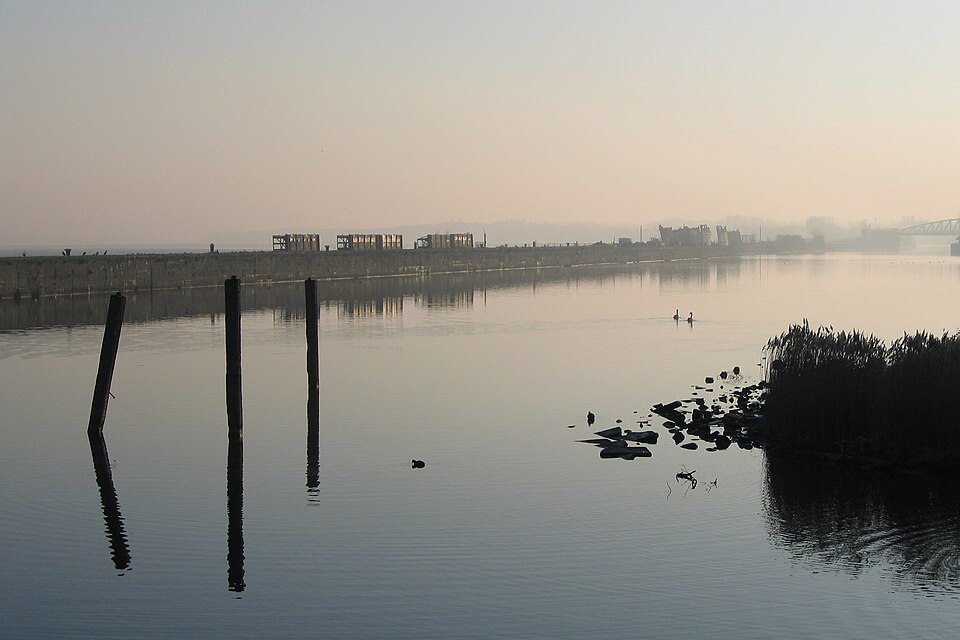
A frosty morning on the Manchester ship canal at Runcorn. Photo: Wikimedia Commons
After a long and controversial fight, the publicly listed Manchester Ship Canal Company was bought in 1987 by John Whittaker and his family. Whittaker’s Peel Holdings, a property firm set up a decade earlier, became a major player in both the landward and water sides of the story of the reborn Mersey.
Whittaker’s deal in 1987 saw him take control of a port, a canal and 3,000 acres of land including large parts of Salford Quays and the area where he would build the shopping behemoth of the Trafford Centre ten years later. Peel would became crucial to joining up the assets of the Mersey and realising their potential.
Privatisation of the water industry was finally pushed through in 1989. The North West Water Authority was split into the newly created United Utilities while the regulatory side became part of the new National Rivers Authority.
United Utilities was charged with spending vast amounts upgrading its infrastructure across its entire patch, much wider than the Mersey basin area. By 2005 it had spent £8bn replacing and repairing treatments works and the network of pipes and sewers. Today, the waters of the Mersey and the Northwest are cleaner than at any time since the start of the Industrial Revolution more than 100 years ago.
No sooner had water privatisation been achieved than Thatcher, its architect and Prime Minister since 1979, was ousted by her own party in 1990. Heseltine was back. Now under the premiership of John Major, he once more became Secretary of State for the Environment.
When the first major review of the campaign’s performance was published in 1995 the results were overwhelming. Water quality at Howley Weir in Warrington, the freshwater limit of the Mersey, showed dissolved oxygen saturation had risen from 10% in 1962 to more than 70% in 1993. Water quality there was still Class 3 (poor) but much nearer the desired Class 2 (fair) or above. The National Rivers Authority found slow but steady improvement in water quality across the Mersey basin. Class 1 and 2 rivers and canals had increased at the expense of Class 3 and 4. In ten years since 1985, North West Water, now part of United Utilities, had completed 700 projects to improve water quality in the Mersey system at a cost of £720m.
By the mid 1990s European aid was changing and an altogether programme-based regime was coming in, having been partly tested on the campaign years earlier. The first round of the Objective One programme arrived in Merseyside in 1994, worth £600m in European grants.
Europe was also taking a firmer line with its water quality directives and, in 1996, the UK created the Environment Agency to tighten controls on pollution.
A period of change was cemented by a new government in 1997, with John Prescott becoming signatory for the Mersey Basin Campaign as Secretary of State for the Environment Transport and the Regions. A former merchant seaman with Cunard who sailed out of Liverpool in the 1960s, Prescott would not have wanted to change course on the Mersey.
Revival of the airport
Peel Holdings made another key acquisition in 1997, buying a 76% interest in Liverpool Airport, nestled on the banks of the Mersey in Speke, south Liverpool. Peel took total control in 2000 and renamed it Liverpool John Lennon Airport. European grants were used to build a new terminal and passengers numbers have soared past 3m per year on the back of investment and the budget airline boom. In late 2005, Peel also secured the takeover of the Mersey Docks and Harbour Company, operator of the Port of Liverpool and owner of more than 1,000 acres of largely undeveloped land. Of the missed landward opportunities of the past 20 years, many can be laid at the feet of the dock company, which sat on too much land for too long.
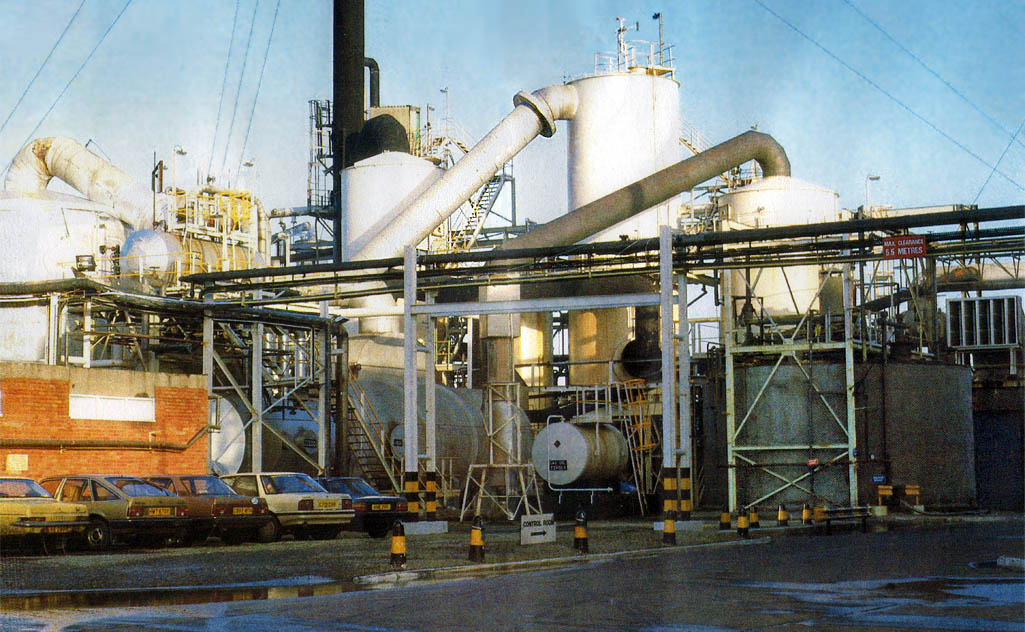
Water quality improvement was also helped in the 1990s by the rapid retraction of the chemical industry on the banks of the river with disposals by foreign owners and manufacturing movement overseas. Those plants that remained employed better technology, saving money and more often than not making environmental improvements as a result.
Strangely, Heseltine does not mention the river campaign in his autobiography but cites it repeatedly in interviews as his proudest achievement in Merseyside, if not politics. The recovery of the river is hailed as a great success. But how much of this would have happened anyway due to water privatisation or European pressures?
John Glester, part of Heseltine’s task force in the 1980s and now chairman of the New Heartlands housing market renewal pathfinder in Merseyside, says: “I don’t think we would be where we are today with everyone working together on the river without the start that Heseltine gave the campaign in the early days. He engaged partners who would have been at the back of the queue of volunteering if improvement had come about from legislation alone.”
Certainly, there would have been no inspirational element at all without Heseltine, and progress would have been much slower as a result. The campaign would not have been a recognisable entity and the relationships between assets could not have been seen as clearly.
The campaign’s success has been its pragmatism, Walton believes. “The campaign was never a blueprint, either in organisational terms or spend or programme. It consisted of the best efforts of the people available at the time.”
Maybe, just once, politics worked.

● Paul Unger started in journalism as a graduate trainee on the Liverpool Daily Post & Echo, rising to become business editor of the Daily Post. After moving into freelance business reporting, he spent six years as North West features writer for Property Week before creating the Place Media Group. This article was originally published as a chapter in Mersey: the River that Changed the World (Bluecoat Press, Liverpool, 2007).
FURTHER INFORMATION
Life in the Jungle: My Autobiography
Michael Heseltine
Hodder & Stoughton, 2000, ISBN 0-340-73915-0
Cleaning up the Mersey
Letter from Michael Heseltine and his proposal for the Mersey Basin Campaign, 1983
Mersey Basin Campaign
“New life for the North West”





0 Comments