Liverpool People’s History

Revisiting the 1970s and 1980s

Photographing football – with rollickings from Bill Shankly

2 comments

Stephen Shakeshaft spent four decades chronicling life on Merseyside with his camera. Joining the Daily Post and Echo as a messenger boy in 1962, he rose to become chief photographer and picture editor.
His work is much admired and has been the subject of four exhibitions at the Museum of Liverpool. In the article below he describes his experiences photographing football and encounters with Bill Shankly who for unexplained reasons always called Stephen “Peter”.
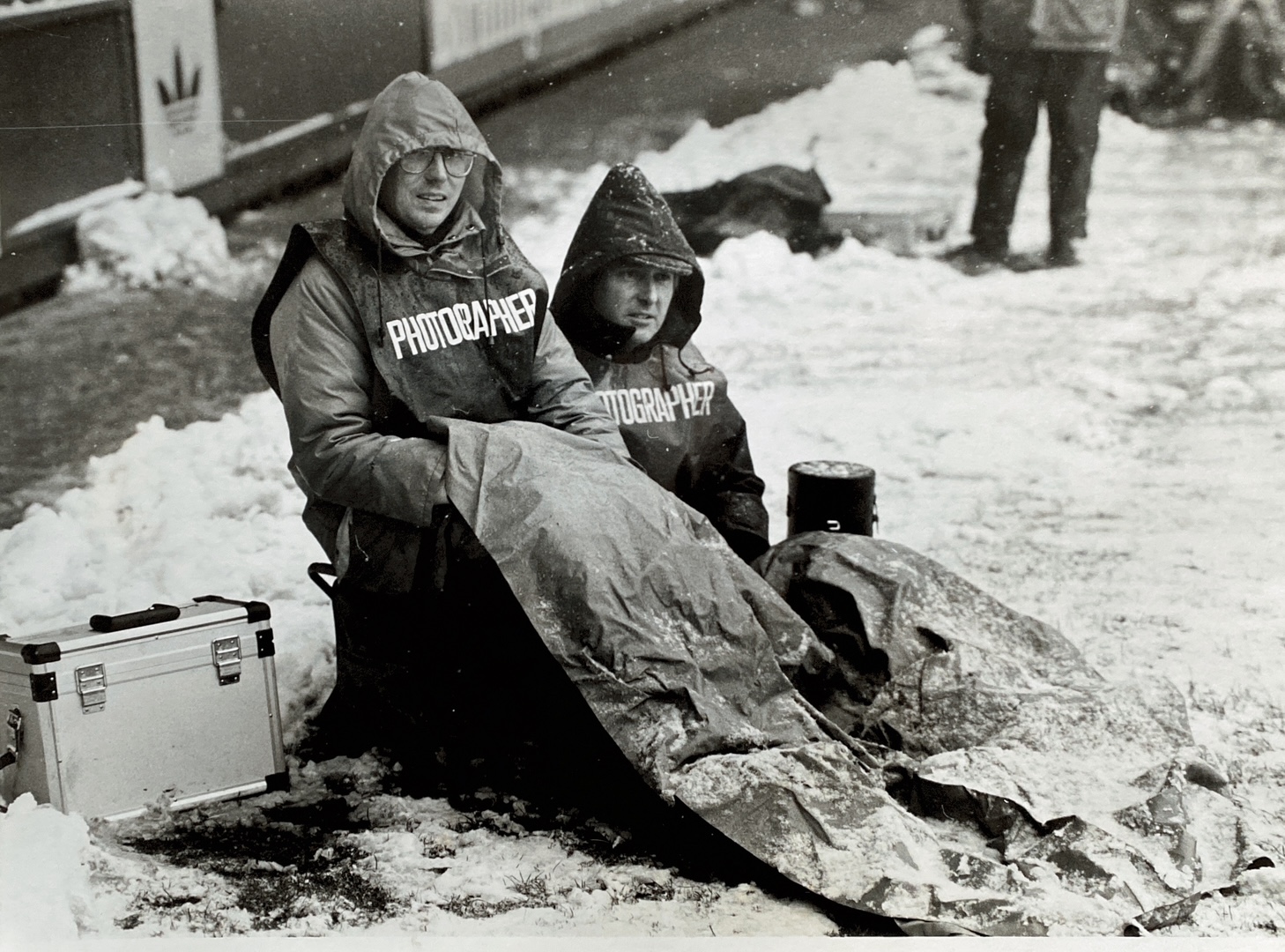
 

Sharing a groundsheet

Sharing a groundsheet with a freelance at the Anfield Road end. The luxury of being able to sit before the second half lying in front of the Kop.

.
I was 18 when the fiery Scottish breath of Bill Shankly hit the back of my neck. The Anfield pitch was covered in three inches of snow and burning hot braziers were alight every six feet of the hallowed turf. I was crouching to take a picture with the groundsman when the words echoed around the stadium: “Get off the grass son, you are going to ruin the pitch.”

The irony was lost on Bill as he escorted me down the tunnel and out. No-one was allowed on the Anfield pitch; certainly not a cheeky photographer. And that was the first of many future rollickings.

Foot in a bucket

Roger Hunt was the England international and Liverpool centre forward (Sir Roger, as he was christened by the fans, was a truly lovely man). He had been injured at Spurs and was arriving back in Liverpool that night. I set off to take a picture of him at home. Roger was sitting on a sofa in his lounge with a plastic bucket supporting his foot.

“Could you just put your foot in the bucket as if you were cooling the swollen ankle please Roger?” I suggested.

The picture made front page of the Post the next morning.

All was well until I arrived at Anfield on the Saturday for the next match. We entered the ground through the players’ entrance. There waiting for me was Mr Shankly.

“I want you, son.” He was angry and had his Jimmy Cagney swagger, tight suit and tight lips. “Come with me, Peter.”

“It’s Steve, Mr Shankly,” I stalled. He led me to a room where Bob Paisley was standing in a white medical coat.

“See this, Peter, it’s a machine to measure the muscles in the legs.”

Pointing to another machine he informed me it was a scanner to detect how serious an injury was. “You knew better and stuck his foot in a bloody bucket.”

He was not impressed with my picture at all.

Eye tests – Shankly style

The Anfield dressing room was a sacred place and I was privileged to be in there. Before the home game I had accompanied an American boxer called Roger Richer to take a promotional picture with the Liverpool players before his fight in Liverpool later that week. I had positioned him surrounded by the players and I had just taken my first picture using my flash. Bill arrived in the dressing room and exploded with rage.

“What are you doing son? You are going to blind all my players with that bloody light. They won’t be able to see the ball.”

With that he started to check their vision by waving his hands in front of all the players’ faces. I was on edge throughout the game in case they lost and it would all be my fault.

A strong kicker

I was standing at Melwood training ground to take a picture of new signing Larry Lloyd. It was snowing as I stood on the edge of the pitch. Suddenly a tap on my shoulder.

“What are you doing here, Peter?”

“I’ve come to take a picture of your new signing.”

“What do you think of him, Peter?”

I suggested he looked a strong player and tough.

“Tough? Son, he would kick his own mother.“

Giving the ref a lift to the station

I was never sure with Bill; was it a wacky sense of humour or not? But there was little humour on our return journey from the match at Southampton. Liverpool had lost and Bill was furious. I had hitched a lift back to Liverpool on the team coach bound for the train waiting at Euston. I was in the front seat in front of Bill and Bob Paisley.

“Stop the bus,” Shankly ordered.

Bill had seen the referee ahead walking to the station. He was offered a lift and sat down next to me. For the next 10 minutes he listened to the angry commentary re-run of the game, and how a wrong decision by the ref had lost them the match. On arrival at Euston the ref turned and thanked Mr Shankly for the lift and his educational comments. Bill was still seething and talking to himself as we arrived.

“I’m going for a pee,” Bill announced.

It was suggested that I should go with him. The station had introduced the “super loo” and we were headed straight for it and for trouble. We approached the entrance and a uniformed assistant held his hand out to Bill: “That’s a shilling please.”

Bill was firing on all cylinders. His shoulders back, he was ready for confrontation. “What do you mean a shilling for a pee?”

The Glaswegian anger combined with the body language startled the attendant … he was not prepared to take abuse from this little aggressive Scotsman who he didn’t know from Adam and he reached for the phone.

“It’s OK, he has had a bad day and he’s not himself.” I apologised and handed over five bob for the both of us. I soon caught up with Bill in the loo. He was still protesting and by now threatening to ring Harold Wilson the prime minister to complain.

This continued in the first class carriage all the way home as we ate our fish and rice pudding – Bill’s suggested menu for a perfect meal. The rest of the diners sharing the carriage, clearly not football supporters, were frequently interrupted by his shout to the players: “I’m ringing Mr Wilson up and telling him to take the shilling off the pee.”

Blue pyjamas

The fire bell was ringing and it was midnight. We were in an Ipswich hotel the night before the match. The players had been in bed for a few hours and I was on my way to my room.

The room next to mine was Bill’s. His door suddenly shot back on its hinges. “What the hell do you think you are doing, Peter?”

He wasn’t interested in my explanation that it was the fire bell. He stood there in blue pyjamas, leaving me speechless as he ranted on about the players being woken up in the middle of the night.

A book on boxing?

Waiting around hotels on a Saturday morning was part of the job and it was wonderful to observe life behind the scenes – my favourite part of being a press photographer.

It was after breakfast, the players were relaxing before the game in London. I was sitting in the lounge with a young reserve player who was breaking into the first team and he was reading Lord of the Rings. Bill was looking for company and he sat opposite us.

“Reading a book are you son?”

“Yes Boss.”

“Lord of the Rings?”

“Yes Boss.”

“Aye, is it about boxing, son?”

“No Boss.”

“A circus book?”

“No Boss, it’s about a world of wizards.“

“Aye son, well just make sure you run rings around them on the pitch later.”

Vulnerable at the end

Bill had just announced at a press conference that he was leaving the job. The press were staggered to hear the news. I had taken my pictures and was on the way out of Anfield to my car. On the stairs Bill joined me.

“Did you get all your pictures, Peter?”

I thanked him and said I was sorry he was going. He looked at me and hesitated, and said thank you, and amazed me by asking: “Do you think I have made the right decision Peter?”

I looked into his eyes and for the first time this bold and confident Scotsman, who at times scared the daylights out of me, looked so very vulnerable.

Tales from the touchline

Liverpool in another European final … Leicester win the premiership. Football is exciting and unpredictable. It got me thinking of some of the remarks thrown at me as I spent Saturday afternoons sharing the turf on football league grounds.

The wages of players didn’t compete with the huge salaries of today’s soccer “stars” and the lifestyle was much different to today’s showbiz style.

Players were tough, some had reputations to live up to. Tommy Smith was the Anfield iron. I can hear the words of Bill Shankly when a player complained of an injury: “They are not your legs son, they are Liverpool’s legs.”

Sitting on the touchline, sometimes so close my leg was on the byline, you could feel every crunch and tackle. But then there were the humorous moments. Jimmy Armfield on a warm afternoon leaning against the goalpost waiting for a corner kick, asked if I had a gin and tonic in my case. The West Brom goalie was a constant chatterer. I once had to warn him of an attack from the centre circle.

Bob Latchford the Everton centre forward landed in front of me at Old Trafford, splitting his eyebrow open. He was stitched up by the trainer next to me – and played on.

One Liverpool fullback was so frustrated by a missed tackle he kicked my camera bag along the pitch. Another, a keen amateur photographer, landed on top of me and kept his finger pressed on my camera shutter.

Likely lads from the crowd who had the cheek to jump over the fence would creep on to my groundsheet. “Don’t give me away mate!“ I didn’t need to – as soon as goalmouth action took place they would jump up and down.

The first time I approached a bulging Spion Kop at Anfield my knees rattled, the noise was so loud. Heat and steam from so many bodies felt like stepping into a mammoth hairdryer. The fans looked as if they were joined by Velcro. Swaying from side to side, some old, some very young, and girls too.

How did they know how to sing at the same time? Who was conducting this strange choir of people to make them word perfect? Louder and louder it grew as I approached along the touchline.

I was about to put a groundsheet in front of them and lie on it for the next two hours. To prepare me for this education in soccer etiquette the Liverpool Echo decided on my dress code. I was given a set of waterproofs. After putting on my wellies, the trousers made of non-flexible rubber were lifted over them and stretched to a pair of rubber braces around my shoulders. The rubber jacket two sizes too big for me completed the outfit. I was ready to go.
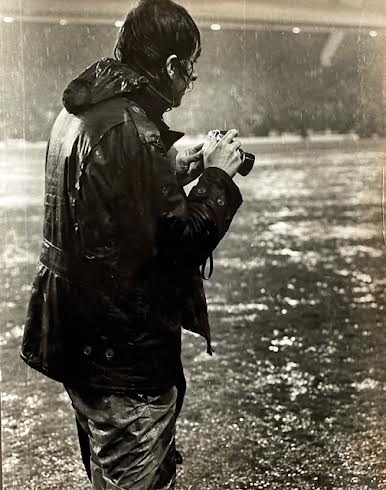
Soaked at full time.

Soaked at full time.

I squeaked as I walked and my legs didn’t meet in the middle. When I lay on the groundsheet I squelched like a beached sea lion.

“Hey mate, get your f – – – – – – head down,” came a shout, followed shortly after by the alarming call: “Hey mate, you’re on fire!“

Flat out on my tummy, my elbows as support for the camera, shoulder to shoulder with my colleagues, this was the nearest I ever got to camping.
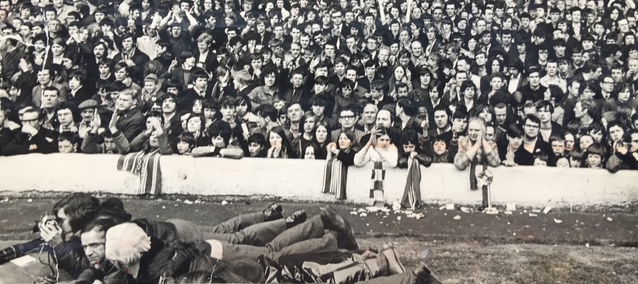
rain of coins

Photographers lying on the side of the pitch were struck by a rain of coins from the Kop.

We had an unwritten rule. The shout from the photographer nearest to the crowd – “Heads down lads” – was prompted by what was happening on the pitch. A controversial decision from the referee against the home team, or a foul in the goalmouth, or a penalty decision denied; any of these could ignite the fury of the fans. Then it started … the rain of coins. Pre-decimalisation the heaviest coin was the half crown, and it could travel the furthest, That silver weighty coin tingled your ears and bounced off your head.

The other disadvantage of being in this prostrate position was enduring the discarded flicked cigarette ends that ended on our backs, resulting in the shout of “You’re on fire mate”. If you were lucky – and if he heard – a passing policeman would put the “fag end” out by treading on your back.

The coin shower did have its reward. After one game I had collected enough cash to pay for a round of drinks. I often wondered why one freelance took longer to roll up his groundsheet. Perhaps he was just topping up his fee for the game? This position, chin at pitch level, made for exciting photographs but required great concentration and anticipation. We had to be prepared for the shot “out of the blue” that thundered past the goalkeeper and into the net.

On return to the office after a crucial match I was disappointed not to have captured the goal, missing the vital shot from the tricky winger, I had a picture of the goalie diving and then flat out. The charismatic sports editor glanced at my pics and shouted: “Where is the bloody goal? Call yourself a sports photographer?”

My reply was apt: “Well, Jack, the goalkeeper missed it too, and he is paid more than me.”

It is so difficult to anticipate a goal; that’s why we often had a photographer each side of the goal.

I was caught out when Tommy Smith climbed high over my blind side and headed into the net in Rome. All I managed to record was the diving goalie, followed by Tommy running back to his teammates. I was determined to capture Tommy’s delight on scoring, and at the end of the game I rushed round to the player bench where he was being held aloft by trainer Ronnie Moran. His face said it all as he looked straight into the lens, mouth wide open as he shouted to the fans.

I was in trouble. When he saw the published picture he told me why he had run to Ron. The trainer kept Tommy’s false teeth in his pocket and he’d wanted to put them in before his picture was taken.
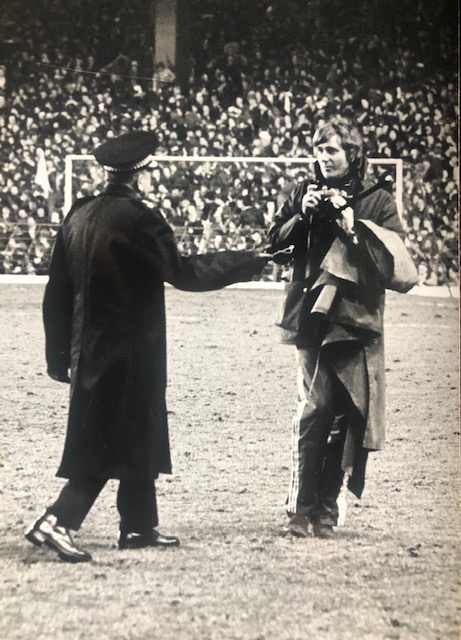
Yellow card from a police inspector

Yellow card from a police inspector while taking a short cut to the stand after a game.

I had a soccer map of the UK. The best grounds to work in (Chelsea was tops because they had a running track around the pitch). Never sit behind the goal at Manchester City. There, a middle aged woman rang a large school bell continually throughout the game. Never wear slip-on shoes at Wolves … mine were flicked off as I lay on the grass in front of the terrace. A policeman negotiated with a fan to return them to me.

I was left puzzled by referees. Why were so many bald, looked old and had bony knees? I have often had to shoot the goal action through their legs as they stood on the goal line in front of us.

Those soccer days of the 1960s and 1970s were special. How lucky I was to be part of it and to see so many players start off as unknowns and end up as heroes.
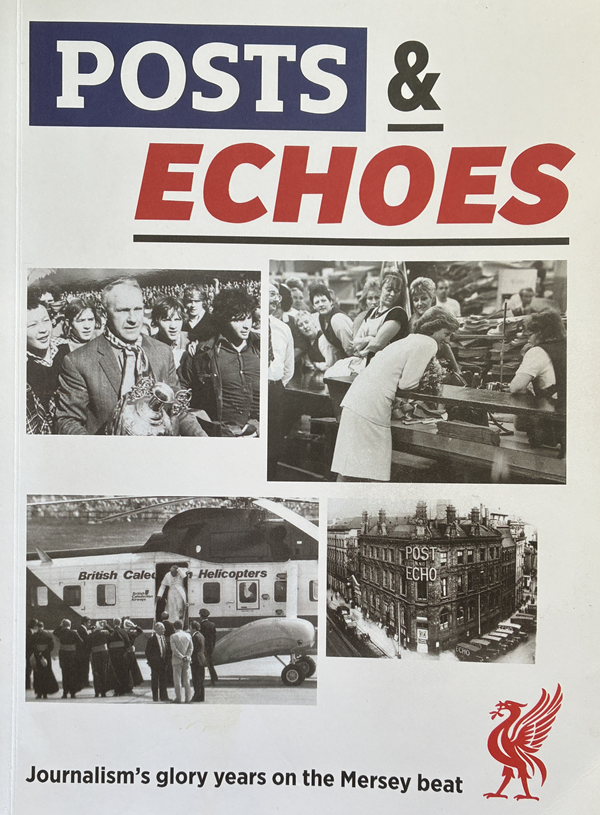
This article was originally published in the book “Posts & Echoes“,
a compilation of reminiscences by the papers’ former journalists.

Exhibitions of Stephen Shakeshaft’s work:

Soccer Shots
Museum of Liverpool, 2001–2002

Shooting Stars
Museum of Liverpool, 2003

Liverpool People
Museum of Liverpool, 2009–2010

By Jove! It’s Ken Dodd!
Museum of Liverpool, 2013–2014

2 Comments

  1. Charlie Lambert

    Great article and lovely memories from a top class photographer. Steve has done more than most to preserve a wonderful era of Merseyside sport.

    Reply
  2. Mick Ord

    A top photographer and a cracking guy. Highly respected +. Great to read his tails. Love Stephen’s photos of Doddy too!

    Reply

Submit a Comment

Your email address will not be published. Required fields are marked *

LATEST POSTS

Something nasty in the air: residents’ battles against noxious chemicals

Accidental emissions and hazardous waste from Merseyside’s chemical industries caused much alarm in the early 1970s. The government responded with two important pieces of legislation: the Control of Pollution Act and the Health & Safety at Work Act.

From riots to regeneration: Michael Heseltine and the great Mersey clean-up

How the Thatcher government’s environment minister inspired a campaign against pollution – and laid the foundations for Liverpool’s economic revival.

George Melly

George Melly was a multi-talented musician, writer and entertainer – a larger-than-life character noted for his exuberant sartorial style.

How working on ‘the Lump’ angered trade unions and caused a taxing problem for the government

The ‘Lump’ was a controversial practice in the construction industry where workers received a lump sum for each completed job, instead of a weekly wage. ‘Lump’ workers could earn more than regular employees but since they were supposedly self-employed they had no job security and were not covered by health and safety regulations.

Bob Dylan in Liverpool: 1966 and all that

When pop music came of age Liverpool was at its heart. Not only the Beatles and Merseybeat. Bob Dylan was part of it too. PHIL OATES explores the singer-poet’s connections with the city and how, on the sidelines of a controversial concert in 1966, it became a place of pilgrimage where he paid tribute to some of his literary and musical heroes.

How male prejudice toppled Britain’s highest-ranking police woman

In 1983 Alison Halford achieved what no woman had done before: she became an Assistant Chief Constable in Merseyside police – which also made her the highest-ranking officer anywhere in Britain. Nine years later, though, her police career lay in ruins. In an acrimonious legal battle she accused the police of sex discrimination and the police retaliated by accusing her of misconduct.

Mathew Street and the ‘Pool of Life’

The Beatles were gone but in the 1970s Mathew Street lived on as the epicentre of Liverpool creativity, drawing its energy from Eric’s Club, the Liverpool School of Language, Music, Dream and Pun, the Probe record shop and, according to some, the magical power of ley lines.

The acid factory that made St Helens fume

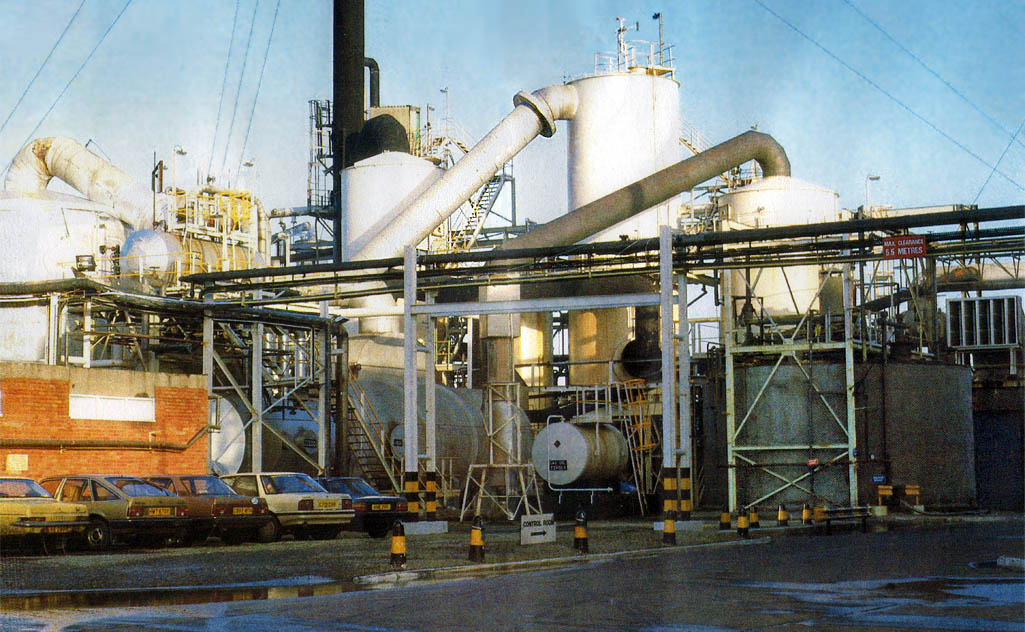
Leaks and emissions from a sulphuric acid factory brought constant complaints from local residents. Despite three public inquiries and several prosecutions, the problem continued for years and the council was powerless to stop it.

Pushing the boundaries of education

The City of Liverpool Community College aimed to provide qualifications for people who had left school without a certificate.
It also worked closely with local communities, providing literacy and numeracy classses for adults with poor basic skills. Later, though, the word “community” was dropped from its name.

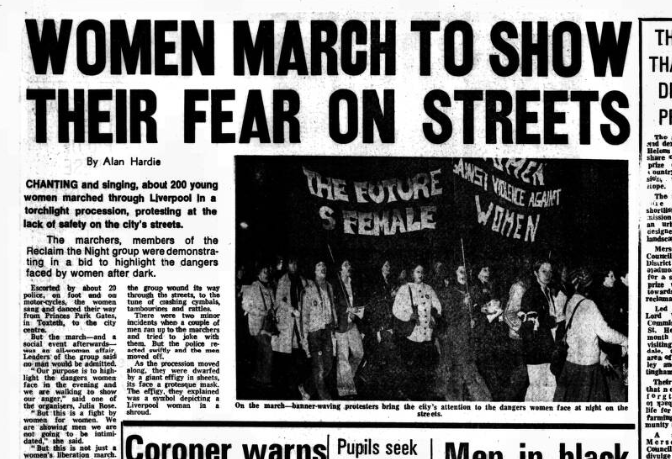
Reclaim the Night

Women’s campaign against male violence

Trouble in toytown

When the Meccano factory suddenly closed down in 1979, workers fought back by occupying the premises.

How the Campaign for Homosexual Equality brought gay Liverpool out of the shadows

Despite relaxation of the law against homosexuality in 1967, gay people faced a continuing struggle for social acceptance during the 1970s.

The ghost cinemas of Liverpool

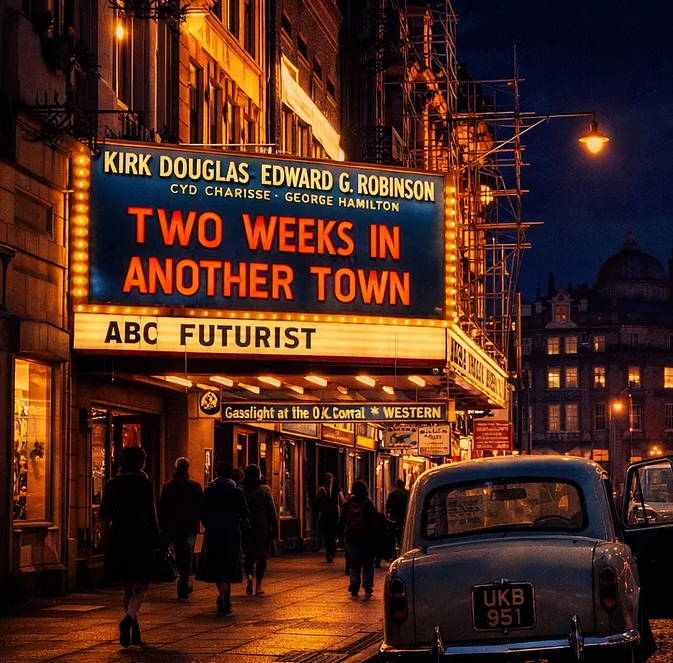
With the closure of cinemas Liverpool didn’t just lose buildings. It lost communal dreaming. Cinemas were places where you sat alongside strangers and felt the same fear, laughter, romance, and hope. In a city shaped by migration, war, poverty, and labour, cinemas offered shared narratives that crossed boundaries.

Creating jobs for the jobless

The Job Creation Programme was one of several government initiatives in the 1970s aimed at reducing unemployment, especially among school leavers. Local authorities, businesses and voluntary organisations were all urged to sponsor employment projects, with the government covering wages and other costs from a £75m fund. But what did it achieve?

The privatisation of intelligence gathering

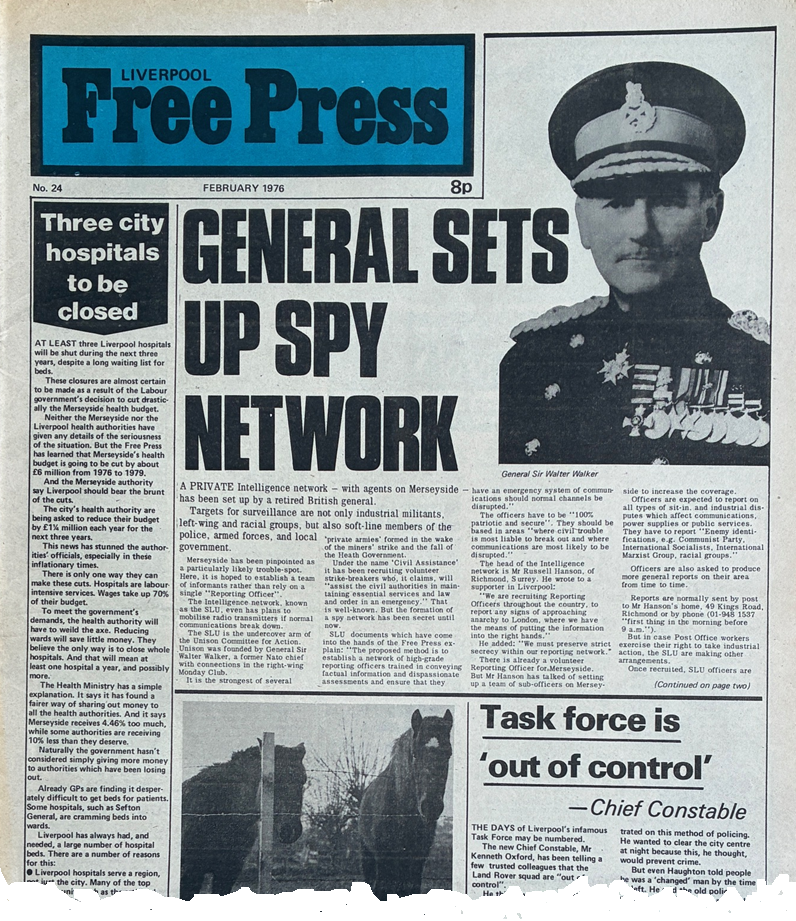
In the political and industrial turmoil of the 1970s, left-wing militants  –  especially among the trade unions  –  were treated as a threat to national security. Monitoring their activity was a task officially assigned to the police Special Branch but the police faced competition in the form of unofficial intelligence networks run by shadowy right-wing organisations. This article looks at the controversy generated by two of them: the Economic League and the Unison Committee for Action.

Rehousing Liverpool (1): From slum clearance to rehabilitation

Slum clearance in the 1960s and 1970s separated people from friends and neighbours they had known for years. Tens of thousands were “decanted” to new estates on the edges of Liverpool. But demolition and displacement weren’t the only options and in Toxteth the Shelter Neighbourhood Action Project initiated a new approach.

Rehousing Liverpool (2): Grassroots initiatives

Housing cooperatives began with the idealistic goal of giving residents control over their own homes. They were voluntary organisations that focused on rehabilitating run-down terraces (and, later, building new estates) with the aid of loans and government grants. Decision-making was in the hands of co-op members rather than the council or private landlords, but the members often had no previous experience working with architects and other professionals – which led to them making some surprising choices.

Rehousing Liverpool (3): Liberal compromises

The Liberals took charge of Liverpool City Council in 1973, though without an overall majority. They abandoned the construction of new council homes in favour of new-build co-ops. Thus what had started out as a radical and marginal movement for residents’ control was watered down as the new mainstream. However, the initial success of these co-ops created a demand for more that was impossible to meet because of government spending restrictions.

Rehousing Liverpool (4): Militant and ‘bourgeois’ housing

For several years in the 1980s Liverpool city council was dominated by members of Labour’s Militant Tendency which promised to build a thousand new council homes every year. Elsewhere in the country, municipal housebuilding was almost at a standstill and the cost of Liverpool’s ambitious plans brought a confrontation with the Thatcher government.

Militant also had ideological objections to housing co-ops which it saw as a backdoor form of privatisation benefiting the bourgeoisie rather than the working class.

Fun in the dismal days of Thatcherism: the story of ‘The End’ magazine

‘The End’ magazine was produced by the young and read by the young. It talked mainly about football, music, beer and made jokes about life without a job. The End had plenty of attitude and was often outrageous. It published witty poems that didn’t always scan and letters from readers who it then insulted in print. But that didn’t matter because it gave people a laugh – and built up a cult following.

Hounded out of town: the caravan dwellers with nowhere to stay

In the 1970s gypsies and other itinerant caravan dwellers faced constant battles with the authorities due to a lack of places where they could legally camp. After eviction from one patch of waste land they would move to another, where the process to evict them would begin again.

Neighbouring local authorities engaged in a sort of ping-pong game, batting the problem of unwelcome caravans back and forth across each other’s administrative boundaries.

A drink in the most dangerous pub … and a riotous night in Kirkby

The Eagle & Child pub in Huyton had a city-wide reputation as a clearing-house for stolen goods. Fights broke out almost every night and police officers who went to take a look would be pelted with eggs and beer. Former Post & Echo journalist John Toker recalls a visit.

Photographing football – with rollickings from Bill Shankly

Stephen Shakeshaft spent four decades chronicling life on Merseyside as a photographer and later as picture editor of the Daily Post & Echo. He describes his experiences photographing football during the Shankly era – and some strange encounters with the boss himself.

Queer-bashed in James Street: the story of a Scout leader who vanished

John Gick disappeared in 1969 during a weekend visit to Liverpool from the Isle of Man. Despite extensive searches and enquiries, the police found no trace of him, alive or dead. The reason for his disappearance is still unknown but delving into the mystery opens a window on the secretive lives of men who struggled with their sexuality in the 1960s and 1970s.

Policing Liverpool: the road to the riots

When Bert Balmer took over as Acting Chief Constable of Liverpool in 1964, tackling high levels of crime in the city centre was his top priority. Determined to take drastic action, he created a special task force with a glamorous-sounding name that was sure to cause a stir in the media and  –  he hoped  –  strike fear into would-be lawbreakers. He called it the Commando Squad.

What no one foresaw was that the battle against street crime initiated by Balmer would lead over time to a breakdown in police-community relations and ultimately to the riots of 1981.

Upping the rent: a landlord’s tricks of the trade

How private landlords drove out tenants whose rents were frozen by law and replaced them with new tenants at higher rents … and how they evaded the Rent Act by pretending tenants were “buyers” or simply “users” of the property.

A pioneer in the struggle for racial justice

The name is Bond … Comrade Bond

In 1984 Sampson Bond, a 26-year-old Londoner, became head of Liverpool city council’s new Race Relations Unit following a rigged selection process. Bond was the least qualified of six applicants for the post but he got the job because his views on race relations matched those of Militant, the Trotskyist group which dominated the city council at the time and believed racial problems would be solved by the defeat of capitalism. His appointment infuriated black and anti-racism groups in the city. They refused to cooperate with him and demanded his dismissal.

The bleak council estate of Netherley was nicknamed Alcatraz because people living there often felt like prisoners. In 1976, though, a group of women took the first step towards building a sense of community – and organised a carnival. Maria O’Reilly describes how they did it and what it achieved.

Colonialism in the classroom: books for children in the 1970s

Amid concern that Liverpool’s schools were not preparing youngsters for life in a multi-racial society, the Community Relations Council carried out a study of racist attitudes in books written for children.

The NHS watchdogs that were allowed to bark but not bite

In 1974 the government established Community Health Councils throughout the country to monitor NHS performance and represent the views of patients and the public. In Liverpool, Sylvia Hikins chaired one of them for nine years, but her hopes of improving health services were constantly battered by spending cuts and closures.

Scotland Road Free School: a devastating report from government inspectors
A highly confidential report by education inspectors in 1973 gave a blistering account of the Free School in its death throes, Liverpool People’s History has discovered.

News from Nowhere: the story of a radical bookshop 
An insider’s view of the shop’s history – by Mandy Vere who worked there for 45 years.

The early years of Women’s Liberation
How the movement evolved on Merseyside in the 1970s and 1980s.

The Bridewell and the Boys from the Blackstuff
Much of Alan Bleasdale’s acclaimed TV drama was filmed at a former police station on Prescot Street.

Police, drugs and ‘agriculture’ in Toxteth
In 1971 there were two notable court cases where black men accused of possessing cannabis were acquitted after claiming police had planted it.

The Liverpool Scene – and beyond
In the 1970s and 1980s Merseyside poets dared to be popular – challenging the idea poems can’t be ʽgood’ unless they are elitist.

International Garden Festival: a treat for ʽcomfortable Britain’
The Garden Festival in 1984 attracted more than three million visitors and helped to regenerate Liverpool. But what benefit did the visitors get from it?

Arthur Dooley, sculptor
The former shipyard welder who turned scrap metal into art.

Merseyside Unity Theatre
Drama and agitprop in the 1970s: an account by one of the theatre’s founders

From word games to Dial-a-Poem
How the Windows Project spread new forms of creativity among children and adults.

Concrete is beautiful: the Shankland master-plan
Graeme Shankland was a planner hired by the council. His vision for Liverpool was to tear down much of the centre and replace it with “robust and manly” new buildings encompassed by an inner motorway on stilts. His plan has since been described as “notorious” and “a nightmare”, and fortunately most of it was eventually abandoned.

The Civic Centre fiasco
In the 1960s Liverpool council embarked on a plan to bring all corporation offices under one roof in a massive city-centre building to be known as the Civic Centre. They spent years buying up properties that stood on the site but the new building became unaffordable and a public inquiry condemned its design as “oppressive” and “overpowering”.

Filming the community: Old Swan festival, 1976
Old Swan was a rather drab part of Liverpool but for a few days in 1976 it became an extraordinary place where residents held a community festival described as “an explosion of colour and noise”. In the midst of that, though, it wasn’t always clear where reality ended and the entertainment began — which in a way added to the fun.

Radio Free Liverpool
On Merseyside in the 1970s clandestine broadcasters played a cat-and-mouse game with the authorities who were seeking to confiscate their transmitters.

‘Seducing’ soldiers
Activists campaigning against Britain’s military presence in Northern Ireland faced surveillance and prosecution during the 1970s.

Liberty Hall
A club “for people who are interested in politics but don’t wish to belong to a political party”.

The battle to save Fisher Bendix
The Fisher Bendix factory in Kirkby had been built with government help to ease unemployment in the area. It wasn’t a success and in 1972 when the owners tried to shut it down workers occupied the factory in an effort to save their jobs. Three years later they began running it themselves.

Trade unions? No thanks! We’re Marks & Spencer
M&S, in its own estimation, was such a good employer that unions were unnecessary. In theory, staff were free to join one if they wished, but the company had ways of making sure that unions didn’t gain a foothold.

Where women ‘never had time to get bored’
Litttlewoods football pools once provided jobs for thousands of Liverpool women. Former employees describe what it was like to work there.

Revolting students: the Liverpool University sit-in, 1970
Students accused the university of ignoring its responsibilities by trying to isolate itself from the social and political consequences of its policy decisions. They occupied the university’s Senate House building for ten days and nights. One participant was expelled and nine others were suspended.

Democracy in the classroom: Scotland Road Free School
Come to school when you want and do what you like. An experiment in classroom democracy that didn’t work out.

GET INVOLVED
Since this is a “people’s history” website, it’s intended as a collaborative effort. Click here to find out the various ways you can take part.