Liverpool People’s History

Revisiting the 1970s and 1980s

Queer-bashed in James Street: the story of a Scout leader who vanished

0 comments

John Gick disappeared in 1969 during a weekend visit to Liverpool from the Isle of Man. Despite extensive searches and enquiries, the police found no trace of him, alive or dead. The reason for his disappearance is still unknown but delving into the mystery opens a window on the secretive lives of men who struggled with their sexuality in the 1960s and 1970s.
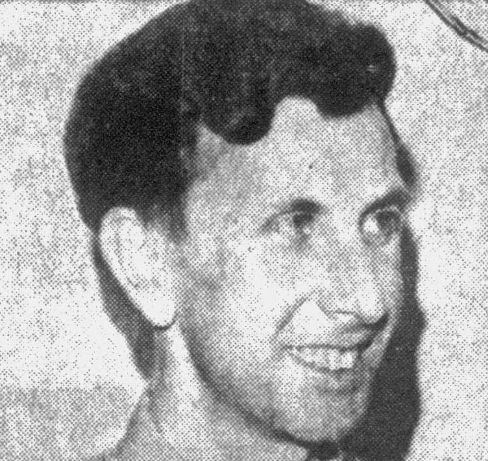


One Saturday in 1969 a group of Scouts travelled from the Isle of Man to see Birkenhead Scouts perform their annual Gang Show. Accompanying the twelve boys was the organiser of the visit:  John Gick, a senior figure in the island’s Scout movement who held the title of Commissioner for Cubs.

The ferry docked in Liverpool around 1pm and the group made their way to Scout headquarters in Birkenhead.

The boys had been looking forward to some sightseeing in Liverpool before the evening show but Gick surprised them by saying he had to “return a book” and would be going into the city alone. Promising to be back in time for the show, he left them in the Scout HQ with one of the older boys in charge.

That was the last that any of the Scouts saw of Commissioner Gick. As the start time for the show approached the boys became anxious — not least because he had gone off with their tickets — and eventually the police were called.

Gick’s mini-van, which he had brought with him on the ferry, was quickly found near the Pier Head — unlocked and with blood on the front passenger seat. There were also bloodstained handkerchiefs, tissues and a scarf in the door pocket.

Despite extensive searches and enquiries in the weeks and months that followed, the police found no trace of Gick, alive or dead: he had completely vanished. In the words of the Liverpool Echo, he was “the man who stepped into nowhere”.

Mugged in a public lavatory

Gick’s last confirmed location, around 5pm on the day he vanished, was in James Street, Liverpool, where he had been beaten and robbed on the steps of a public lavatory. Neither Gick nor anyone else had reported it to the police and the crime only came to light a few weeks later when a teenager was found in possession of Gick’s Post Office savings book. Three youths subsequently confessed to mugging him.

This brought a new dimension to the story, because the lavatory in question was a popular spot for men to go “cottaging” and was known in gay circles as the “Garden of Allah” — an obscure reference to verses in the Qur’an that describe Heaven as a garden where the faithful are plied with refreshments by beautiful young men.

The police, of course, knew perfectly well what sort of refreshments were on offer in the James Street “garden” but they didn’t talk about it in public. The local press undoubtedly knew too but didn’t mention it directly. They did, however, repeatedly note that Gick, in addition to being a Scout leader, was a “bachelor”.

Life in the closet

In the late 1960s it was rare for gay men to be “out and proud” about their sexuality: attitudes at the time made them fearful of the consequences. But there were degrees of “outness”. While some hid their sexuality completely, others tried to be discreet, some were “out” among like-minded friends and a few brave souls took delight in shocking people with their scandalous behaviour.

Opting to be in the closet gave no guarantee of staying there, however. Aside from the possibility of arrest, there was always a chance of being outed by accident — for example being spotted going into a gay bar.

First-hand accounts of gay life at the time can be found in a ninety-minute documentary — Pink: Past and Present — which traces the emergence of Merseyside’s LGBT community and its struggles for acceptance through the recollections of people who experienced it. The film begins with reminiscences of cottaging and its prevalence in the late 1960s and early 1970s. One of the men interviewed says it was “the only way you could meet gay people”, while another describes it as “the main scene” for most gay men.

In the absence of dating websites and apps like Grindr, public lavatories were the easiest place to find men looking for sex with other men, and for those who needed secrecy the anonymity was a bonus: no names, no chat-up — just a brief sexual encounter with someone they might never meet again. The James Street lavatory was one of the busiest. Close to the main bus station and the Mersey ferries at the Pier Head, it attracted a lot of passing trade.

Many of the “cottages” were no doubt squalid places but others, in the words of one man who patronised them, were “like ballrooms” — fine examples of antique plumbing and porcelain. The better-known ones had nicknames which gay men used in conversation in case someone overheard them. “Head Office” was code for Lime Street station — an “excellent” place according to one former user — while the “Wheel of Fortune” referred to a circular underground lavatory which was opposite the Playhouse theatre and frequented by actors.

Some of the lavatories were "like ballrooms"

Some of the lavatories were “like ballrooms”

There was a risk of being caught, though, and the film includes one account from a man who had been arrested when police raided a “cottage” in Victoria Street and bundled everyone into a van:

“This fella sitting next to me [in the police van] said ‘I’m actually married … I don’t know what my wife’s gonna say’, and I said ‘Well, you’ll have to come clean now, won’t you’.”

Besides the risk of arrest, men who went cottaging or cruising for sex were especially vulnerable to “queer-bashing” — muggings of the kind that befell John Gick. They were often reluctant to go to the police, either because the circumstances were embarrassing or because they didn’t expect the police to be sympathetic – and that increased the perpetrators’ chances of getting away with it.

While there’s no confirmation that Gick was illegally cottaging in James Street , the fact that he didn’t report the mugging suggests he hadn’t just gone there for a pee. The nature of his sexuality is far from clear, though. He had no obvious interest in women but whether he considered himself “gay” is another matter. Accounts of his time with the Manx Scouts do point to a man grappling with desires that society regarded as shameful but there’s no evidence that this translated into sexual acts involving Scouts.

A boy on the Isle of Man

Two years after Gick’s disappearance the body of a man was found in Staffordshire, buried on a secluded island on the River Trent. It was a gruesome discovery that attracted much publicity at the time: the man had been buried in a kneeling position with his wrists and ankles tied, and was naked apart from his socks and a gold wedding ring on his right hand.

The body has never been identified and in 2021 a man named Ken Davies decided to see if he could solve the mystery. He began working through a list of disappeared people in the hope of finding one that could be linked with the body and reported his progress in a series of podcasts which drew other would-be detectives into the project.

Not surprisingly, Gick’s name was on the checklist and while Davies’ investigation failed to solve the mystery of his disappearance, it did reveal new information about his life on the Isle of Man.

One of the people Davies spoke to was “Jim” (not his real name), a former Scout who said Gick had shown a particular interest in him from the age of ten or eleven and would give him a lift home after Scout meetings — a privilege not accorded to other boys.

When Jim was fifteen Gick took him to a Gang Show in London, with permission from the boy’s parents. The trip included an overnight stay where the pair shared a hotel bedroom, though nothing inappropriate happened: it appears to have been a platonic relationship.

When Jim left school after his O-Levels, Gick fixed him up at an insurance firm in Douglas, working as a clerk. He arranged it through a friend who worked there: Ken Dale, a man whose campness was likened to that of the actor John Inman.

Sometime later — about six months before his disappearance — Gick invited Jim to dinner with himself and Dale. They drove to a restaurant in the north of the island which was well away from Douglas — apparently to reduce the chances of being spotted. As with the earlier trip to London, there were no sexual advances but as the evening wore on Dale’s mannerisms became more and more effeminate — which made Jim uncomfortable.

Back in the insurance office next day, Jim told colleagues about the dinner — which resulted in Dale being summarily dismissed for inappropriate behaviour. Shortly afterwards, Jim left the island to take up a job with the Pilkington glass firm in St Helens.

That appeared to have severed the relationship but Gick hadn’t forgotten about Jim. Before setting off for Liverpool with the Scout group, he had sent a letter to Jim which arrived on February 1 — the day of Gick’s disappearance. The contents of the letter were never disclosed but in view of the timing it’s likely Gick was seeking to meet him.
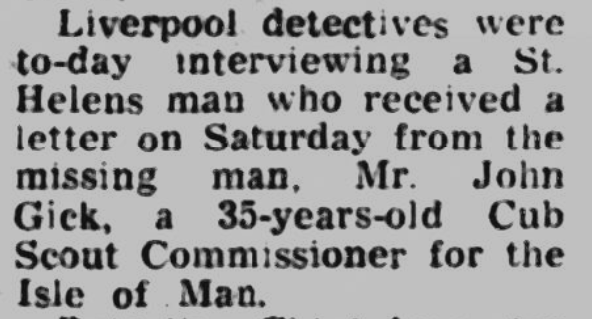
Liverpool Echo, 5 February 1969, p1

Liverpool Echo, 5 February 1969, p1

At that stage Jim was staying at the YMCA in St Helens on work days and spending weekends with his sister in Crosby. The letter appears to have arrived at his sister’s home, because that is where the police turned up four days later. Jim’s sister told them he was at work in St Helens and they hurried off to Pilkington’s to interview him about Gick. They left seven hours later and Jim never heard from them again.

Visits to Liverpool

Manx people who knew Gick described him as quiet, diligent, hardworking and unassuming. Aside from the Scouting he had spent more than 20 years as an accounts clerk at the Isle of Man Steamship Company which ran ferries between the island and Liverpool. It was a dull job but it came with a perk: employees could travel on the ferries free of charge.

The police were surprised to find how often Gick had made use of that facility for trips to Liverpool and it made them wonder what he had been doing there. They were reported to be checking with unspecified “clubs” and they also showed interest in a couple of hotels.

The purpose of Gick’s visits is unknown but, for a man struggling with his sexuality on the Isle of Man, Liverpool — with a few gay-orientated bars and an embryonic gay community — was clearly a more attractive place to be. The Isle of Man, in contrast, had a population of only 55,000 — too small to sustain much of a gay community — and it still clung to very traditional ideas about sex.

Another significant factor was the 1967 Sexual Offences Act which relaxed the law on homosexuality. Cottaging remained illegal but “private homosexual acts between men aged over 21” were no longer a crime. The Isle of Man is partly self-governing, however, and when the law changed in mainland Britain the Manx parliament held out against it. All kinds of gay sex remained illegal on the island until 1992.
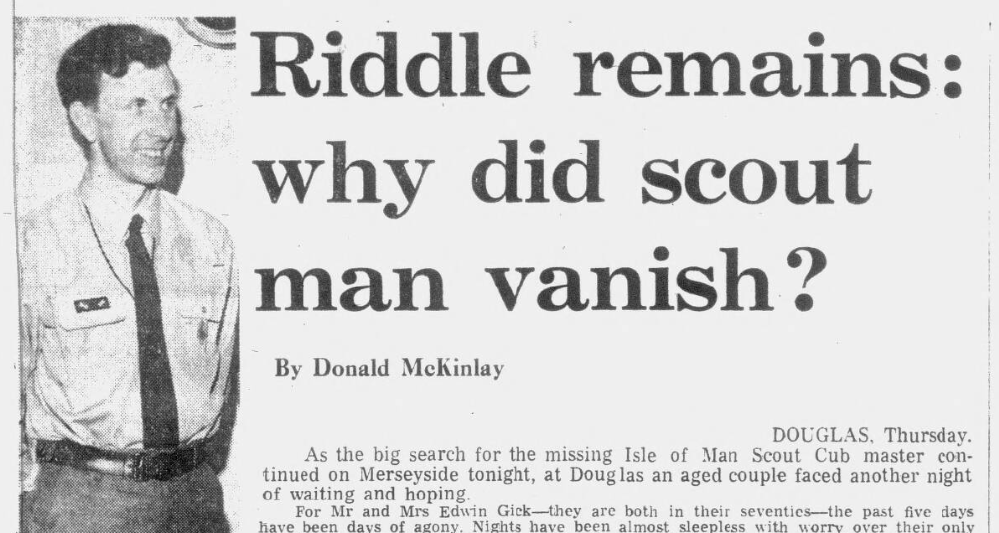
Liverpool Daily Post, 7 February 1969, p5

Liverpool Daily Post, 7 February 1969, p5

The mystery continues

There are several hypotheses regarding Gick’s fate. The story told at the trial of his teenage muggers was that they had punched him in the face, knocking him down, and then made off with his savings book, leaving him lying on the lavatory steps.

His injuries don’t appear to have been life-threatening, though. The supposition, based on the blood found in Gick’s mini-van, is that he returned to the vehicle after the attack and left again sometime later, without locking it.

Assuming he survived the mugging, could he have been murdered by someone else? To have been mugged and then murdered in a separate attack later on the same day would be an extraordinary misfortune. Conceivably it could have happened but there’s no supporting evidence – most crucially in the form of a dead body.

Another possibility is suicide. It’s not difficult to visualise Gick in a state of shock after the mugging, wiping blood from his face in the mini-van and desperately wondering what to do next. He clearly had no desire to tell the police, but what on earth was he to tell the Scouts anxiously awaiting him in Birkenhead? If the whole truth about his mugging ever got back to the Isle of Man his reputation would be ruined and his Scouting activities would be finished. To make matters worse, his attempt to renew contact with Jim, the young man he had doted on since childhood, appeared to have failed.

In that situation Gick could have felt his whole world was falling apart, so perhaps in a moment of panic he decided to end his troubles and (since he was at the Pier Head) threw himself into the Mersey. Again, though, the problem is a lack of supporting evidence. The bodies of people who drown in the river almost always turn up eventually, but it’s possible Gick was an exception.

The remaining hypothesis – a potentially happier one – is that he survived, having gone into hiding and started a new life elsewhere. That theory gained some support  when an employee of the ferry company later claimed to have spotted him, though the police were sceptical: false reports of sightings were not uncommon in such cases. There were also doubts about Gick’s ability to make a fresh start without access to money, since his Post Office savings book had been stolen in the mugging.

The long and short of it is that we can only guess at his fate and will probably never know what actually happened to him.

FURTHER INFORMATION

BACKGROUND

Pink Past and Present
An award-winning feature length documentary film which explores the rich, vibrant and often turbulent history of Liverpool’s lesbian, gay, bisexual and transgender community from the 1950s onwards. It was premiered at Homotopia and screened at FACT as part of Liverpool Pride 2012.

Queer Places
Website taking a historical look at Liverpool’s gay meeting places.

The Mysterious Case of Fred the Head
Podcasts by Ken Davies. Gick’s case is discussed in the following episodes:
Episode 41 – The Man who Stepped into Nowhere
Episode 43 – The Scout’s Story
Episode 45 – The Connection
Episode 47 – Man to Man
Episode 49 – Scouting for Boys

PRESS REPORTS ON THE DISAPPEARANCE OF JOHN GICK

Riddle of the missing scouter
Liverpool Echo, 4 February 1969, p1

Scouts may join hunt for missing leader
Liverpool Echo, 5 February 1969, p1

Riddle remains: why did scout man vanish?
Liverpool Daily Post, 7 February 1969, p5

Scoutmaster: Police step up search
Liverpool Echo, 3 March 1969, p1

Search for scouter widens
Liverpool Daily Post, 19 March 1969, p1

Scouter riddle remains unsolved
Liverpool Daily Post (Welsh edition), 24 April 1969, p13

Court story of attack on scout leader
Isle of Man Times, 25 April 1969, p7

Missing scoutmaster seen at Birkenhead docks – report
Liverpool Echo, 7 May 1969, p1

CID told: I’ve seen missing scouter
Liverpool Daily Post, 8 May 1969, p1

The man who stepped into nowhere
Liverpool Echo, 19 June 1969, p3

Scoutmaster left no tracks
Liverpool Echo, 2 September 1969, p6

Still no trace of the missing scoutmaster
Liverpool Daily Post, 17 November 1969, p7

Scoutmaster Gick: police have hunted for a year and the trail is going cold
Liverpool Daily Post, 29 January 1970, p5


 

0 Comments

Submit a Comment

Your email address will not be published. Required fields are marked *

LATEST POSTS

Friends of the Earth and the war against waste

In the 1970s, amid an ever-growing volume of rubbish dumped into landfill sites, environmental activists began a campaign to promote recycling.

Something nasty in the air: residents’ battles against noxious chemicals

Accidental emissions and hazardous waste from Merseyside’s chemical industries caused much alarm in the early 1970s. The government responded with two important pieces of legislation: the Control of Pollution Act and the Health & Safety at Work Act.

From riots to regeneration: Michael Heseltine and the great Mersey clean-up

How the Thatcher government’s environment minister inspired a campaign against pollution – and laid the foundations for Liverpool’s economic revival.

George Melly

George Melly was a multi-talented musician, writer and entertainer – a larger-than-life character noted for his exuberant sartorial style.

How working on ‘the Lump’ angered trade unions and caused a taxing problem for the government

The ‘Lump’ was a controversial practice in the construction industry where workers received a lump sum for each completed job, instead of a weekly wage. ‘Lump’ workers could earn more than regular employees but since they were supposedly self-employed they had no job security and were not covered by health and safety regulations.

Bob Dylan in Liverpool: 1966 and all that

When pop music came of age Liverpool was at its heart. Not only the Beatles and Merseybeat. Bob Dylan was part of it too. PHIL OATES explores the singer-poet’s connections with the city and how, on the sidelines of a controversial concert in 1966, it became a place of pilgrimage where he paid tribute to some of his literary and musical heroes.

How male prejudice toppled Britain’s highest-ranking police woman

In 1983 Alison Halford achieved what no woman had done before: she became an Assistant Chief Constable in Merseyside police – which also made her the highest-ranking officer anywhere in Britain. Nine years later, though, her police career lay in ruins. In an acrimonious legal battle she accused the police of sex discrimination and the police retaliated by accusing her of misconduct.

Mathew Street and the ‘Pool of Life’

The Beatles were gone but in the 1970s Mathew Street lived on as the epicentre of Liverpool creativity, drawing its energy from Eric’s Club, the Liverpool School of Language, Music, Dream and Pun, the Probe record shop and, according to some, the magical power of ley lines.

The acid factory that made St Helens fume

Leaks and emissions from a sulphuric acid factory brought constant complaints from local residents. Despite three public inquiries and several prosecutions, the problem continued for years and the council was powerless to stop it.

Pushing the boundaries of education

The City of Liverpool Community College aimed to provide qualifications for people who had left school without a certificate.
It also worked closely with local communities, providing literacy and numeracy classses for adults with poor basic skills. Later, though, the word “community” was dropped from its name.

Reclaim the Night

Women’s campaign against male violence

Trouble in toytown

When the Meccano factory suddenly closed down in 1979, workers fought back by occupying the premises.

How the Campaign for Homosexual Equality brought gay Liverpool out of the shadows

Despite relaxation of the law against homosexuality in 1967, gay people faced a continuing struggle for social acceptance during the 1970s.

The ghost cinemas of Liverpool

With the closure of cinemas Liverpool didn’t just lose buildings. It lost communal dreaming. Cinemas were places where you sat alongside strangers and felt the same fear, laughter, romance, and hope. In a city shaped by migration, war, poverty, and labour, cinemas offered shared narratives that crossed boundaries.

Creating jobs for the jobless

The Job Creation Programme was one of several government initiatives in the 1970s aimed at reducing unemployment, especially among school leavers. Local authorities, businesses and voluntary organisations were all urged to sponsor employment projects, with the government covering wages and other costs from a £75m fund. But what did it achieve?

The privatisation of intelligence gathering

In the political and industrial turmoil of the 1970s, left-wing militants  –  especially among the trade unions  –  were treated as a threat to national security. Monitoring their activity was a task officially assigned to the police Special Branch but the police faced competition in the form of unofficial intelligence networks run by shadowy right-wing organisations. This article looks at the controversy generated by two of them: the Economic League and the Unison Committee for Action.

Rehousing Liverpool (1): From slum clearance to rehabilitation

Slum clearance in the 1960s and 1970s separated people from friends and neighbours they had known for years. Tens of thousands were “decanted” to new estates on the edges of Liverpool. But demolition and displacement weren’t the only options and in Toxteth the Shelter Neighbourhood Action Project initiated a new approach.

Rehousing Liverpool (2): Grassroots initiatives

Housing cooperatives began with the idealistic goal of giving residents control over their own homes. They were voluntary organisations that focused on rehabilitating run-down terraces (and, later, building new estates) with the aid of loans and government grants. Decision-making was in the hands of co-op members rather than the council or private landlords, but the members often had no previous experience working with architects and other professionals – which led to them making some surprising choices.

Rehousing Liverpool (3): Liberal compromises

The Liberals took charge of Liverpool City Council in 1973, though without an overall majority. They abandoned the construction of new council homes in favour of new-build co-ops. Thus what had started out as a radical and marginal movement for residents’ control was watered down as the new mainstream. However, the initial success of these co-ops created a demand for more that was impossible to meet because of government spending restrictions.

Rehousing Liverpool (4): Militant and ‘bourgeois’ housing

For several years in the 1980s Liverpool city council was dominated by members of Labour’s Militant Tendency which promised to build a thousand new council homes every year. Elsewhere in the country, municipal housebuilding was almost at a standstill and the cost of Liverpool’s ambitious plans brought a confrontation with the Thatcher government.

Militant also had ideological objections to housing co-ops which it saw as a backdoor form of privatisation benefiting the bourgeoisie rather than the working class.

Fun in the dismal days of Thatcherism: the story of ‘The End’ magazine

‘The End’ magazine was produced by the young and read by the young. It talked mainly about football, music, beer and made jokes about life without a job. The End had plenty of attitude and was often outrageous. It published witty poems that didn’t always scan and letters from readers who it then insulted in print. But that didn’t matter because it gave people a laugh – and built up a cult following.

Hounded out of town: the caravan dwellers with nowhere to stay

In the 1970s gypsies and other itinerant caravan dwellers faced constant battles with the authorities due to a lack of places where they could legally camp. After eviction from one patch of waste land they would move to another, where the process to evict them would begin again.

Neighbouring local authorities engaged in a sort of ping-pong game, batting the problem of unwelcome caravans back and forth across each other’s administrative boundaries.

A drink in the most dangerous pub … and a riotous night in Kirkby

The Eagle & Child pub in Huyton had a city-wide reputation as a clearing-house for stolen goods. Fights broke out almost every night and police officers who went to take a look would be pelted with eggs and beer. Former Post & Echo journalist John Toker recalls a visit.

Photographing football – with rollickings from Bill Shankly

Stephen Shakeshaft spent four decades chronicling life on Merseyside as a photographer and later as picture editor of the Daily Post & Echo. He describes his experiences photographing football during the Shankly era – and some strange encounters with the boss himself.

Queer-bashed in James Street: the story of a Scout leader who vanished

John Gick disappeared in 1969 during a weekend visit to Liverpool from the Isle of Man. Despite extensive searches and enquiries, the police found no trace of him, alive or dead. The reason for his disappearance is still unknown but delving into the mystery opens a window on the secretive lives of men who struggled with their sexuality in the 1960s and 1970s.

Policing Liverpool: the road to the riots

When Bert Balmer took over as Acting Chief Constable of Liverpool in 1964, tackling high levels of crime in the city centre was his top priority. Determined to take drastic action, he created a special task force with a glamorous-sounding name that was sure to cause a stir in the media and  –  he hoped  –  strike fear into would-be lawbreakers. He called it the Commando Squad.

What no one foresaw was that the battle against street crime initiated by Balmer would lead over time to a breakdown in police-community relations and ultimately to the riots of 1981.

Upping the rent: a landlord’s tricks of the trade

How private landlords drove out tenants whose rents were frozen by law and replaced them with new tenants at higher rents … and how they evaded the Rent Act by pretending tenants were “buyers” or simply “users” of the property.

A pioneer in the struggle for racial justice

The name is Bond … Comrade Bond

In 1984 Sampson Bond, a 26-year-old Londoner, became head of Liverpool city council’s new Race Relations Unit following a rigged selection process. Bond was the least qualified of six applicants for the post but he got the job because his views on race relations matched those of Militant, the Trotskyist group which dominated the city council at the time and believed racial problems would be solved by the defeat of capitalism. His appointment infuriated black and anti-racism groups in the city. They refused to cooperate with him and demanded his dismissal.

The bleak council estate of Netherley was nicknamed Alcatraz because people living there often felt like prisoners. In 1976, though, a group of women took the first step towards building a sense of community – and organised a carnival. Maria O’Reilly describes how they did it and what it achieved.

Colonialism in the classroom: books for children in the 1970s

Amid concern that Liverpool’s schools were not preparing youngsters for life in a multi-racial society, the Community Relations Council carried out a study of racist attitudes in books written for children.

The NHS watchdogs that were allowed to bark but not bite

In 1974 the government established Community Health Councils throughout the country to monitor NHS performance and represent the views of patients and the public. In Liverpool, Sylvia Hikins chaired one of them for nine years, but her hopes of improving health services were constantly battered by spending cuts and closures.

Scotland Road Free School: a devastating report from government inspectors
A highly confidential report by education inspectors in 1973 gave a blistering account of the Free School in its death throes, Liverpool People’s History has discovered.

News from Nowhere: the story of a radical bookshop 
An insider’s view of the shop’s history – by Mandy Vere who worked there for 45 years.

The early years of Women’s Liberation
How the movement evolved on Merseyside in the 1970s and 1980s.

The Bridewell and the Boys from the Blackstuff
Much of Alan Bleasdale’s acclaimed TV drama was filmed at a former police station on Prescot Street.

Police, drugs and ‘agriculture’ in Toxteth
In 1971 there were two notable court cases where black men accused of possessing cannabis were acquitted after claiming police had planted it.

The Liverpool Scene – and beyond
In the 1970s and 1980s Merseyside poets dared to be popular – challenging the idea poems can’t be ʽgood’ unless they are elitist.

International Garden Festival: a treat for ʽcomfortable Britain’
The Garden Festival in 1984 attracted more than three million visitors and helped to regenerate Liverpool. But what benefit did the visitors get from it?

Arthur Dooley, sculptor
The former shipyard welder who turned scrap metal into art.

Merseyside Unity Theatre
Drama and agitprop in the 1970s: an account by one of the theatre’s founders

From word games to Dial-a-Poem
How the Windows Project spread new forms of creativity among children and adults.

Concrete is beautiful: the Shankland master-plan
Graeme Shankland was a planner hired by the council. His vision for Liverpool was to tear down much of the centre and replace it with “robust and manly” new buildings encompassed by an inner motorway on stilts. His plan has since been described as “notorious” and “a nightmare”, and fortunately most of it was eventually abandoned.

The Civic Centre fiasco
In the 1960s Liverpool council embarked on a plan to bring all corporation offices under one roof in a massive city-centre building to be known as the Civic Centre. They spent years buying up properties that stood on the site but the new building became unaffordable and a public inquiry condemned its design as “oppressive” and “overpowering”.

Filming the community: Old Swan festival, 1976
Old Swan was a rather drab part of Liverpool but for a few days in 1976 it became an extraordinary place where residents held a community festival described as “an explosion of colour and noise”. In the midst of that, though, it wasn’t always clear where reality ended and the entertainment began — which in a way added to the fun.

Radio Free Liverpool
On Merseyside in the 1970s clandestine broadcasters played a cat-and-mouse game with the authorities who were seeking to confiscate their transmitters.

‘Seducing’ soldiers
Activists campaigning against Britain’s military presence in Northern Ireland faced surveillance and prosecution during the 1970s.

Liberty Hall
A club “for people who are interested in politics but don’t wish to belong to a political party”.

The battle to save Fisher Bendix
The Fisher Bendix factory in Kirkby had been built with government help to ease unemployment in the area. It wasn’t a success and in 1972 when the owners tried to shut it down workers occupied the factory in an effort to save their jobs. Three years later they began running it themselves.

Trade unions? No thanks! We’re Marks & Spencer
M&S, in its own estimation, was such a good employer that unions were unnecessary. In theory, staff were free to join one if they wished, but the company had ways of making sure that unions didn’t gain a foothold.

Where women ‘never had time to get bored’
Litttlewoods football pools once provided jobs for thousands of Liverpool women. Former employees describe what it was like to work there.

Revolting students: the Liverpool University sit-in, 1970
Students accused the university of ignoring its responsibilities by trying to isolate itself from the social and political consequences of its policy decisions. They occupied the university’s Senate House building for ten days and nights. One participant was expelled and nine others were suspended.

Democracy in the classroom: Scotland Road Free School
Come to school when you want and do what you like. An experiment in classroom democracy that didn’t work out.

GET INVOLVED
Since this is a “people’s history” website, it’s intended as a collaborative effort. Click here to find out the various ways you can take part.