
In 1972 a man exercising his dog on open land in Halewood casually tossed a cigarette end into a pond. The pond burst into flames and six fire engines were needed to put out the blaze.
The startled smoker had thought it was just water but the pond also contained a highly flammable mixture of crude benzine and isopropyl acetate – chemical waste that two tanker drivers had collected from a factory in Speke a couple of days earlier … and dumped illegally. Their employer, Purle Waste Disposal, was fined £100 (the maximum penalty at the time) and the two drivers were fined £50 each.
A few months later Purle was fined a total of £500 after admitting five offences of polluting a stream that flowed into the River Tame and, ultimately, into the Mersey. The court heard that it had “secretly and furtively” poured sewage sludge and chemical waste containing propylene dichloride down a manhole on a farm, from where it had entered the stream.
Purle said the sewage had been intended to fertilise the farmland and suggested the chemical waste must have been left over in its tankers from a previous job.
Although pollution of the stream had reached 1,000 times the permitted level, Purle’s lawyer played down its significance and suggested the firm was a victim of environmentalism: “There is a tendency these days, having regard to the publicity on pollution, to rather jump on the bandwagon when any breach, however slight, is discovered.”
Illicit dumping was a tempting proposition for drivers hired to dispose of hazardous chemicals. It saved them effort and expense and, in the unlikely event of being caught, the penalties were too small to be much of a deterrent.
Factory emissions
Merseyside had more than its share of chemical-based industries and safely disposing of hazardous waste wasn’t the only problem. Emissions from accidents and mis-haps, often the result of malfunctioning equipment, brought complaints from people living or working nearby who objected to the nasty smells and feared for their health.
One especially notorious example in the 1970s was the Leathers Chemicals factory in St Helens which made sulphuric acid. Leaks and emissions led to constant complaints from local residents who often claimed the fumes were making them ill (see article). Meanwhile, the firm was routinely dumping sulphurous waste into Sutton Brook (known locally as Stinky Brook). Despite three public inquiries and several prosecutions, the problem continued for years and the council was powerless to stop it.
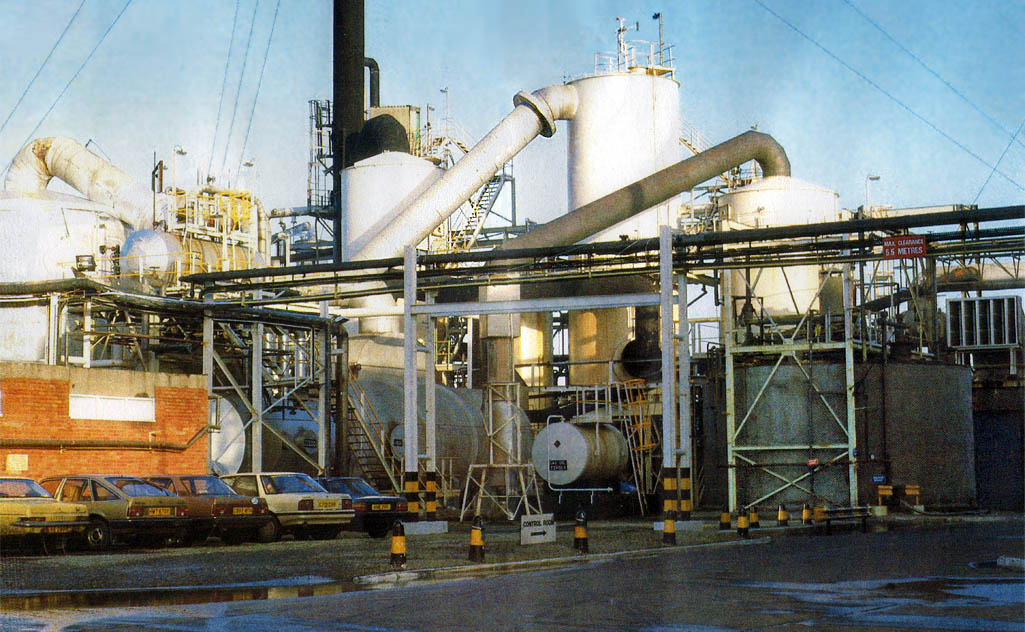
The sulphuric acid factory in the 1980s
‘Commercial secrecy’ – and a near-disaster in the Dingle
One frequent complaint was a lack of information about hazardous chemicals stored or in use near people’s homes. The companies refused to say, citing a need for commercial secrecy, which meant residents were unlikely to learn about them unless an accident brought them to the public’s attention.
In Liverpool, Esso had a storage facility next to the Dingle oil terminal. Locals knew about the oil but had no idea that it also had tanks capable of storing up to eight million gallons of naphtha – a volatile and highly flammable liquid. They found out about it one Sunday morning in June 1971 when police with loudspeakers toured the streets warning residents not to smoke or light gas stoves. Overnight, 600,000 gallons of naphtha had escaped from the Esso facility and he Dingle and Aigburth areas of the city were in the midst of a chemical emergency.
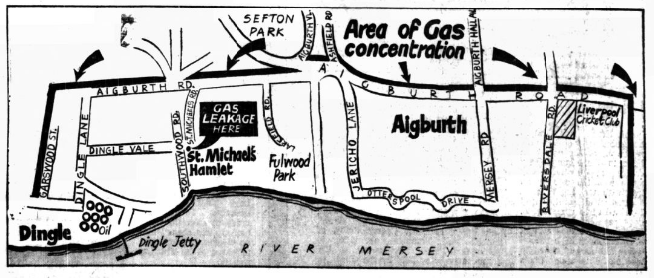
Some of the naphtha had leaked through a sewer pipe into the Mersey and some had turned into a vapour. With very little wind that day, the vapour was slow to disperse and, since it was heavier than air, clouds of it hung close to the ground. Amid fears that a small spark could cause a massive fire, . Otterspool promenade and gardens were evacuated and traffic was diverted from the area. The river and the Port of Liverpool were closed to shipping, with six vessels ordered to wait off the Mersey Bar. Services on the Seacombe and Woodside ferries operated for a while but were suspended when passengers ignored “no smoking” instructions.
In the words of the Liverpool Echo, the city faced its “gravest danger since the May blitz of 1941” but by 6pm the risk of a disaster had passed and life began returning to normal.
The leak occurred because someone had opened the valves on pipes which should have been closed, and the company blamed vandals. The valves were outdoors, just inside the perimeter fence, and had clearly not been adequately protected from interference.
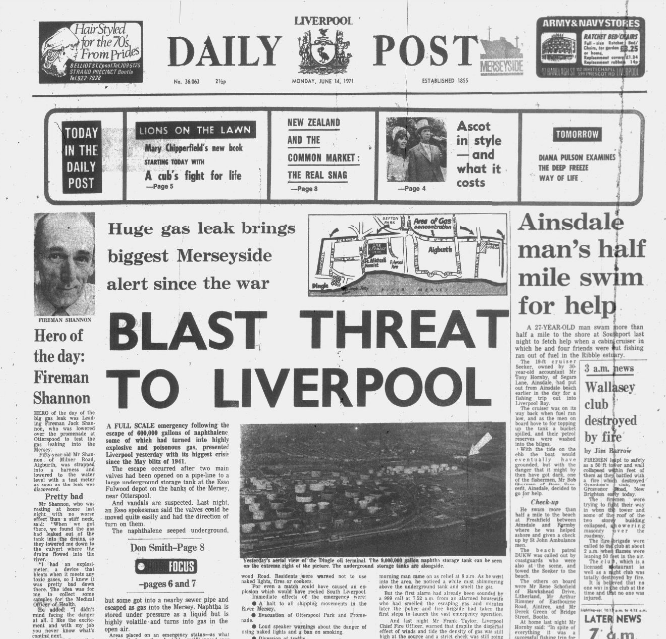
A residents’ meeting attended by 200 people a few days later called for tighter security arrangements, a public inquiry and removal of the Esso terminal — “but not on to someone else’s doorstep”. The manager of the Esso facility, who also attended, told them the company was implementing a five-point plan:
- 24-hour security patrols
- 9.5 miles of barbed wire
- Improved lighting
- Locks on all valves
- High-level alarms on all storage tanks
These were all obvious precautions that the company could have taken earlier but apparently it had not deemed them necessary. Safety was less of a priority at the time; regulations were lax or non-existent and safety devices didn’t always work.
When resin rained on Speke
On 4 June 1975 a blow-out occurred at Synthetic Resin, a Unilever company in Speke. It happened while the firm was producing resin for use in the manufacture of plywood — a process that involved heating three dangerous chemicals (phenol, formaldehyde and oxalic acid) in a 25-ft tall reactor.
Around 3am excess pressure built up in the reactor, triggering a safety valve which released the mixture into an escape pipe. The pipe was topped with a cowl intended to deflect emissions downwards into a relatively safe area but the cowl hadn’t been fixed properly and the force of the chemical eruption blew it away. Half a ton of resin mixture then shot into the air over Speke.
Fortunately, almost everyone was in bed at the time and there were no injuries but sticky blobs of resin mixture rained down on the Triumph factory’s car park nearby. Blobs that landed on cars changed the colour of their paintwork: a maroon car developed pinkish spots, a white car developed cream spots, and the plastic roof covering of at least one car shrivelled up.
Altogether, more than 100 cars — mostly belonging to workers on the Triumph night shift — were damaged and in need of re-spraying. The cost to Synthetic Resin’s insurers was estimated at almost £10,000.
Questions about workers’ safety
Incidents of this kind also raised questions about the protection of workers whose jobs involved handling dangerous chemicals, and Synthetic Resin was notable for its poor safety record.
The factory employed about 200 people and in the first six months of 1975 there had been 24 lost-time accidents, the Free Press reported. Extrapolating from those figures, the paper calculated that each employee had a one-in-four chance of being off work because of an accident during the course of a year.
It cited some examples from June 1975 when, in addition to seven lost-time accidents there had also been 46 minor accidents not involving a loss of work time:
R. Tellett… sustained caustic burns to four fingers and both forearms as he cleaned forklift engine with caustic solution. (He was wearing cotton gloves.)
J. Hughes… whilst drumming off hot material from No 6 kettle — material splashed over back of legs.
T. Strickland… whilst drumming off resin, valve bonnet gasket ‘blew’, causing resin to splash over face and eyes.
R. McQueen… chemical dripped down from floor above onto back of neck.
Feeling sick? Have a drink of milk
In addition to the chemical industries themselves, there were plenty of factories where workers handled hazardous substances — often with minimal protection. One example was Dickinson Brothers, also known as Dibro.
During the 1950s this non-union firm had specialised in making simple toys for sale in Woolworths. They included model cars made by pressing tinplate into shape then spray-painting them. Dibro cars were a cheap and cheerful alternative to Dinky Toys and several examples are preserved in the V&A museum.
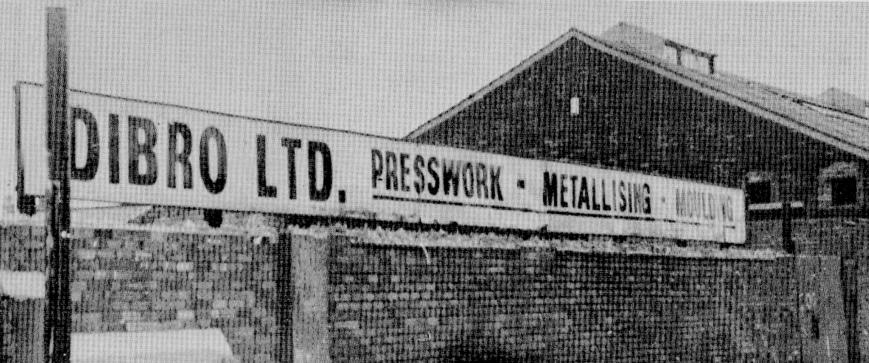
By the 1970s Dibro had been driven out of the toy market by imports from the Far East and the firm was now painting bottle tops for Fabergé and Brute perfumes, among other products. The tops had to be perfectly clean before painting — which meant dipping a tray of them into a bath containing ten gallons of chemicals.
A notice on the side of the bath warned: “Trichloroethylene and Perchloroethylene. If inhaled in small quantities can cause drowsiness which will pass off in fresh air. But large in large quantities may cause unconsciousness.”
The room where this was done did have an extractor fan but it made little difference to the fumes. One worker assigned to the dipping task left after complaining they made him vomit. The firm’s solution, for his 17-year-old replacement (earning £15.20 for a 40-hour week) was to provide a free pint of milk every day to settle his stomach.
The government steps in
In 1974, amid growing concern about the situation, parliament approved two important pieces of legislation: the Control of Pollution Act (COPA) and the Health and Safety at Work Act (HASAWA).
Up to that point workplace safety had been regulated through separate laws for specific sectors — shops, mines, railways, etc — but various accidents, including the deaths of 22 factory workers in a Glasgow fire, showed this fragmented approach was inadequate.
The Health and Safety at Work Act tackled the problem from a different angle by establishing a series of broad safety principles that would apply everywhere. The Act set out basic obligations for both employers and employees:
Employers must …
Maintain safe workplaces and equipment
Carry out regular risk assessments
Provide safe systems of work
Provide information, instruction, and training
Consult with employees or safety reps
Employees must …
Take reasonable care for their own health and safety
Follow health and safety training and procedures
Report hazards, defects, or unsafe practices
Use PPE and equipment properly
Avoid interfering with or misusing safety measures
In 1974, coincidentally the same year that HASAWA came into force, the Flixborough chemical plant explosion killed 28 people and injured 36.
Meanwhile, the Control of Pollution Act required local authorities to provide disposal facilities for noxious waste in their area and also to exercise tighter control over what was being dumped. Up to that point, many of them had made no provision, with the result that hazardous loads were often transported long distances by road – with the added risk of spillages in the event of an accident.
However, the Act wasn’t implemented immediately because the additional costs would have to be met by local authorities at a time when the government was trying to limit their spending.
Critics of the Act questioned how effective it was likely to be, pointing out that there were already other relevant laws, such as the 1936 Public Health Act, which were not being used to their full potential. Some MPs also felt the 1974 Act’s “Control of Pollution” title didn’t go far enough and sought – unsuccessfully – to change it to the “Prevention of Pollution Act”.
To comply with the Act, local authorities needed to know what chemicals were being dumped – which again raised questions of commercial secrecy. Chemical industries claimed that revealing the contents of their effluents could give away “trade secrets” about the processes they were using. To overcome that objection, the Act gave assurances that “trade secrets” disclosed to the authorities would remain in safe hands and it set heavy penalties for anyone who revealed them to the public.
This, of course, was the opposite of the transparency that many people had been demanding and their complaints were not seriously addressed until ten years later when the Control of Industrial Major Accident Hazards (CIMAH) regulations decreed that “persons liable to be affected by a major accident” must be given information about the nature of the hazard and the recommended steps to take if an accident occurred. “Persons liable to be affected” included the public as well as workers, so people living nearby also had to be advised what to do in the event of an accident.
One example of how CIMAH was applied in practice could be seen at the Leathers sulphuric acid factory (then operating under the name “Hays Chemicals”) in St Helens. The company held two open days where the public were invited to tour the plant and people living in the area were issued with this six-point “Action Card” …
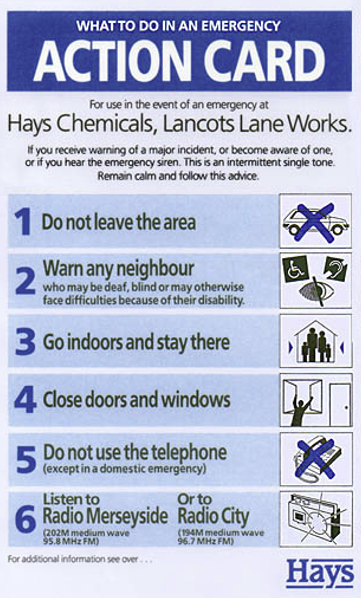
Another requirement of the CIMAH regulations was that manufacturers and local authorities must develop plans for dealing with emergencies, and in St Helens the result of this was Operation Cloudburst — a two-hour practice exercise in 1988 involving the fire brigade, the ambulance service and the police, based on an imaginary scenario where a drum of sulphur trioxide at Hays Chemicals had been punctured by a forklift truck.
The exercise was pronounced a success, though it started late and was ridiculed by some residents. Fortunately, the plans don’t seem to have been put to the test in a real emergency, though in 1989 there was a further oleum leak at the factory for which Hays was again fined £3,000.
FURTHER INFORMATION
Purle Waste Disposal:
Firm and drivers are fined for dumping
Liverpool Echo, 7 April 1972, p1
Halewood danger dumping: 2 fined
Daily Post, 8 April 1972, p7
Purle pour waste down a manhole
Liverpool Free Press, issue 9, p5
Leathers Chemicals:
The acid factory that made St Helens fume
Liverpool People’s History, April 2026
Naphtha leak in the Dingle:
Blast threat to Liverpool
Daily Post, 14 June 1971, p1. Also pages 6, 7 and 8.
Still on guard
Liverpool Echo, 14 June 1971, p1.
The day of the great gas alert
Liverpool Echo, 14 June 1971, p6.
Gun shots at naphtha base
Daily Post, 15 June 1971, p1
Residents fear new gas scare
Liverpool Echo, 19 June 1971, p8
Get rid of oil terminal, say 200 Dingle people
Liverpool Echo, 26 June 1971, p4
Gas leak area residents are satisfied
Liverpool Echo, 25 August 1971, p10
Blow-out at Synthetic resin:
The blobs fell like rain. Suddenly cars started changing colour
Liverpool Free Press, issue 20, p8
Dibro factory:
Dangerous fumes for expensive perfumes
Liverpool Free Press, issue 19, p3
Control of Pollution Act, 1974:
Old laws ‘are our best weapons’
Daily Post, 12 December 1974, p5











0 Comments