It was in the early 1970s that Paul O’Grady – later to become famous as a drag artist and comedian – first plucked up courage to phone the Liverpool branch of the Campaign for Homosexual Equality. He was just 17 at the time.
His call was answered by Robin Bloxsidge, one of the organisers, who chatted reassuringly and invited him to their next meeting. As the call came to an end Bloxsidge casually asked Paul his name.
“Simon,” Paul replied. “Simon King.”
“The day of the meeting I was beside myself with anticipation,” he wrote later – though he was also nervous and unsure what to expect. “Would it be an orgy of unbridled lust and passion … and if so, what would happen if I didn’t want to participate?”
His suspicions appeared to be confirmed when he arrived at Bloxsidge’s home for the meeting and Bloxsidge opened the door wearing only a towel. There was a simple explanation, though. “Simon King” had turned up 45 minutes early – while the host was taking a shower. Bloxsidge ushered him into the front room, gave him a copy of Gay News to read and went to get dressed.
“When everyone had finally arrived,” Paul wrote, “we were given tea and biscuits, not what I had expected at a Bacchanalial orgy – but then nor was the group. I was discouraged to find that they all seemed perfectly ordinary and unexciting … we could’ve been at a 1930s WI meeting in Tunbridge Wells.” He began to regret having given a false name.
As the meeting ended, though, a man who introduced himself as Steve offered Paul a lift home … stopping off for a drink at the Chelsea Reach club in New Brighton. That wasn’t all and, as Paul later discovered, Steve had a second stop in mind – for sex in the back of his van on Egremont promenade.
“I wasn’t agreeable to this suggestion at first,” Paul wrote, “but it’s amazing how a combination of cider and persistent persuasion can weaken the resistance of a lad who’s far too well brought up to say no.”
Seeking equality
With several thousand paid-up members and more than 100 local branches, the Campaign for Homosexual Equality (CHE) was the largest gay organisation in Britain during the 1970s. Formed in 1969, it evolved out of earlier campaigns to legalise sex between men. After the law was relaxed in 1967 the activists’ focus shifted towards gaining acceptance for gay people as the equals of straight people.
The Liverpool branch was established in 1970 and Bloxsidge, a young academic who later became head of Liverpool University Press, was one of its founders. Other key figures were Peter Norman, an architect in the council’s planning department; Alan Swerdlow, a businessman whose family firm sold catering equipment, and Ralph Hallett, a Welsh-born actor.
The following account of the group’s development and the issues it faced is drawn mainly from Peter Scott-Presland’s “official history” of CHE, which quotes many of the participants.
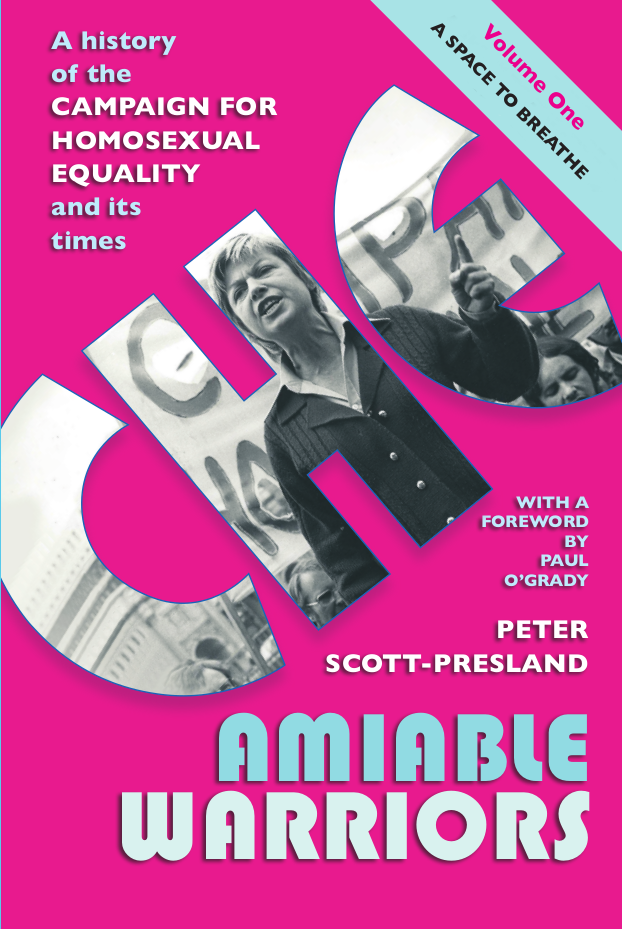
The first monthly meetings in Liverpool took place above a cake shop owned by Hallett’s family and, despite a series of small ads placed in the Echo, most of the people attending seemed to have heard about CHE on the grapevine. “In the first year or so, I would think we got more people by word of mouth than anything else,” Peter Norman recalled. “They were people really who were sort of hidden in the community. Nobody knew them, but they knew other people. It was like a hangover from gay life being a secret society.”
These were mostly not habitués of the gay pub and club scene – either because they had no interest or were too scared to take part – and the organisers saw a need to provide them with different ways to meet other gay people.
A while later, though, more people from the pub and club scene did begin attending. “They had found out about it and, although they might continue being pub and club people, they quite liked the social aspect, the fact that you can actually talk to people,” Norman said.
Scott-Presland explains:
Gay men themselves often had little experience of relating to other gay men apart from in a sexual context where contacts were largely wordless. When these early CHE members found themselves in their first meeting, their awkwardness was more than a self-consciousness about effectively ‘outing’ themselves … they literally did not know how to talk to each other.
The meetings often had guest speakers – among them Ray Gosling, the broadcaster and gay rights activist, Dick Crawshaw, the Labour MP for Toxteth, and representatives of the Albany Trust and the Gay Liberation Front. There were frequent talks given by clergy, and religion seems to have been a topic of particular interest – presumably because some members were struggling to reconcile their sexuality with religious teaching.
The visiting clergy appeared to benefit from these encounters too. Swerdlow commented: “Catholic priests came to talk to us and I think most of the ones who claimed they weren’t gay were gay, but they just came and talked, and I think it was as much as anything a support for them as an interesting evening for us.”
Objections to the Sexual Offences Act
The equality that CHE sought had two main strands. One was about equal treatment under the law and the other about gaining acceptance from society.
On the legal front, the 1967 Sexual Offences Act permitted homosexual acts between men so long as they were consensual, took place in private and the men were over 21. While this was an important step forward it left a number of anomalies:
● Setting the age of consent for gay male sex at 21 was discriminatory because heterosexual sex was legal at 16. Meanwhile, lesbian sex was legal at any age.
● The new law didn’t extend to Scotland or Northern Ireland and gay sex remained illegal in the armed forces and the Merchant Navy.
● There were also issues about the meaning of sex “in private” – for example, two participants were OK but a threesome would make it a “public” act.
Basically, CHE was demanding that sexual acts by gay men should not be a crime if comparable acts by straight people were legal.
In common with other CHE groups the Liverpool branch canvassed local MPs about further reforming the law but the replies were discouraging. Tim Fortescue, the Conservative MP for Liverpool Garston wrote:
There is almost no possibility of a new Bill on Homosexual Law Reform being introduced into the House of Commons this parliament and, if it were, even less possibility of it being carried. As you well know, the current Sexual Offences Act was bitterly contested on its passage through the House and, in the eyes of very many people, liberalised the law to excess … The time has not yet come to flout majority opinion again.
Scott-Presland comments: “It was, of course, a myth that majority opinion had been against law reform, inside or outside parliament, and CHE spent much energy trying to get this point accepted.” Fortescue was right about one thing, though: further reform of the law would be a long time coming.
Young members
Questions about the age of consent had practical implications for CHE because there were young gay men wanting to join the organisation who were not yet old enough to legally have sex. Local branches were autonomous to some extent and the Liverpool group had a rule which excluded those under 21 from joining. While this was in line with the legal position at the time, it conflicted with CHE’s campaign to reduce the minimum age to 16 – and it caused a bitter dispute.
In an attempt to compromise, Liverpool CHE initially set up a youth group, meeting separately from the main group. “For quite a long time it met in a gay club, on an early weekday when they weren’t getting any other customers,” Bloxsidge recalled. “The youth group was sixteen to twenty-one, but these people were drinking too, of course, and the police used to come to every meeting. All they did was say hello, and some of these kids would buy the policemen a drink, and then they’d go on their way.”
Bloxsidge was far from content, though, and he continued pressing for a rule change that would let people over 16 become full members. This was eventually approved – by a majority of two votes – at a long and acrimonious meeting in 1972.
“When it did go through, we actually lost quite a lot of members,” Bloxsidge recalled. “Maybe about twenty or twenty-something members went. Ironically some of the principal opponents of this were what you’d call ‘chicken hawks’, really, who thought it was alright to go hunting young people for sex, but you weren’t allowed to have them in this respectable organisation. But we did begin to get quite a lot of young people in after that.” Seventeen-year-old Paul O’Grady, aka “Simon King”, was one of those who joined at that point.
This is not to suggest that newcomers to CHE were necessarily young: there were others, too, from an older generation. Swerdlow remembers one man in particular who had lived quietly with his unmarried sister for many years. It was only when she died that he finally decided to develop the gay side of his restricted life.
Raising awareness
On the social front, initial efforts focused on raising awareness of CHE’s existence and developing contacts with relevant organisations or potential allies.
In the city centre a small group with badges saying “How dare you presume I’m heterosexual” handed out leaflets. They also wrote to various local groups – Women’s Institutes, Rotary clubs, trade unions, church groups, etc – offering to send a speaker and, on the whole, their talks were received with less hostility than they had expected.
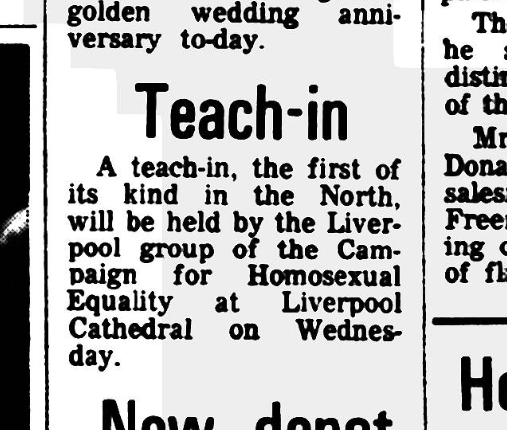
The announcement in the Liverpool Echo that sparked a protest
In 1972 they invited social workers, probation officers, magistrates and others to a teach-in about homosexuality. A one-paragraph news item in the Echo mentioned that it would be held at the Anglican cathedral – which resulted in the Christian Political Union demanding cancellation of the event and an inquiry by the diocesan authorities. “The use of the cathedral by this group is obnoxious in the extreme and totally unwarranted,” it said.
The cathedral stood firm, though. Dean Edward Patey, who had approved the booking, described the complainers as “somewhat hysterical” and “rather out of tune with Christian compassion”. He told the Daily Post: “I can’t see what all the fuss is about … The Wolfenden report changed the attitude to homosexuality and we are now in a situation to talk about this in a much more sensible and less emotional way.”
Countering stereotypes
In its efforts to gain public support, CHE sought to present gay people as ordinary members of society and “normal” apart from their sexuality: they could be one of your neighbours, the person sitting next to you on a bus, or a colleague at work and you wouldn’t necessarily be able to pick them out. While this offered a picture of gayness that straight people might feel comfortable with, it skirted over the existence of others who were more obviously gay – some of whom had no pretensions of being “normal”.
In 1971, apparently inspired by a Medical Research Council report suggesting “it may be as wrong to stigmatise the homosexual as it would to victimise the congenitally blind, the deaf or dumb”, the Liverpool Daily Post sent a reporter to interview “Albert”, a gay man who defied the usual stereotypes:
He is not effeminate. He is stocky, very broad, good-looking in a manish way and tough as they come. He does not walk with a mincing step and does not call people ‘darling’ with a fluff of the hand. He looks as though he would be extremely handy to have around in a brawl – and is, in fact, a club barman.
As the interview continued, though, it became clear that “Albert” had no time for men who were less masculine than himself and he didn’t regard them as “true homosexuals”. The paper quoted him as saying:
The true homosexual detests the flaunting, effeminate, brightly dressed, painted and long-haired type. They are in minority but get the majority a bad name. Lower down in the strata of homosexuals is the sort who deliberately antagonises the public … The lowest form of homosexual is the type who hang around public toilets and the like. They are, to us, revolting. They are male prostitutes and complete degenerates.
These incendiary remarks brought a riposte in the form of a letter from an anonymous “non-effeminate homosexual” published a few days later:
I was amazed that such a person as “Albert” should have been chosen to put forward the case for tolerance of homosexuals … It is ludicrous to plead for tolerance and in the same breath state that “the true homosexual detests the flaunting, effeminate, brightly dressed, painted and long-haired types”. These people are just as much homosexual and perhaps even more in need of understanding than the less overt types.
There were certainly some in CHE who, while not being as explicit as “Albert”, viewed flamboyant expressions of gayness as conflicting with the more bland image of homosexuality they were trying to present to straight people.
The Gay Liberation Front
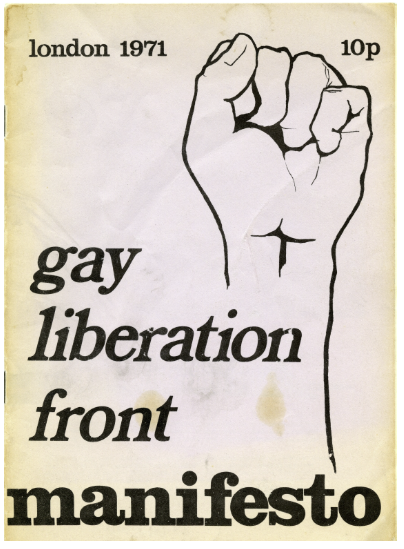
Around the same time, though, there was another organisation which made no claims of respectability. The Gay Liberation Front (GLF) courted controversy, made a point of being outrageously out and proud, and adopted a theatrical style of direct action that shocked some and amused others.
Ideologically, it was also far more radical than CHE. Its manifesto, issued in 1971, proclaimed boldly and unapologetically that “Gay shows the way” and continued:
In some ways we are already more advanced than straight people. We are already outside the family and we have already, in part at least, rejected the ‘masculine’ or ‘feminine’ roles society has designed for us. In a society dominated by the sexist culture it is very difficult, if not impossible, for heterosexual men and women to escape their rigid gender-role structuring and the roles of oppressor and oppressed. But gay men don’t need to oppress women in order to fulfil their own psycho-sexual needs, and gay women don’t have to relate sexually to the male oppressor, so that at this moment in time, the freest and most equal relationships are most likely to be between homosexuals.
Commenting on the tendency to “deny that homosexual men are effeminate or lesbians butch”, a GLF pamphlet acknowledged that talk of “gay people looking like anyone else” had served a useful purpose: “Inasmuch as this has made people realise that gays are more numerous than they had thought, and that homosexuality is a matter of emotional need quite unrelated to outward appearance, these protestations have been valuable; but the Gay Liberation movement demands a far more radical change than this.”
It continued:
We are not arguing about the assignment of gay people to one or another gender role, but questioning the validity of gender roles. We reject the concepts of masculinity and femininity, with their respective associations of dominance and submission … By attempting to gain acceptance within heterosexual society by dissociating themselves from the stigma of effeminacy, gay men only support the rigidity of gender roles … Gay men should attack the idea that there is something wrong with effeminacy instead of trying to off-load their oppression on to those who are usually disparagingly described as the stereotype.
It went on to remind readers of the role “stereotypical” gay people had played in the struggle:
Camp queens and diesel dykes came out and bore the brunt of heterosexual hatred long before law reform and the gay organisations gave their more discreet counterparts a platform from which to denounce them … To the discomfort of gay people who try to achieve a respectable image of men who behave like men and women who behave like women, the Gay Liberation Front has developed a strong section of opinion which claims that the only way for gay people to come out that will make any real impact on the gender role definitions which underlie gay oppression is by adopting a life-style and appearance that explicitly reject the masculine/feminine distinction and all that it implies.
Unlike CHE, the GLF favoured direct action and readily engaged in disruptive protests. Its most memorable exploit, in 1971, involved the Nationwide Festival of Light – a Christian-based organisation which campaigned against liberal attitudes to sex and what it saw as a decline in traditional family values. For the festival, numerous events had been arranged around the country, starting with a rally at the Central Hall in Westminster.
Veteran gay rights activist Peter Tatchell recalled: “Rather than protest outside we decided we would go inside the hall and cause maximum disruption.” One group of male protesters sneaked in disguised as nuns while another, in workmen’s clothes found the switch for the hall’s electricity supply and turned it off. Tatchell was on one of the balconies with the GLF youth group where their task was “to stand up and start same-sex kissing”. Most dramatic of all was the release of white mice. “It created panic among the mostly female audience,” Tatchell said. “Some climbed on their chairs screaming hysterically. Others ran out to get away from the mice. It was a festival of mayhem.“
The GLF survived for about four years, though other groups such as OutRage! later adopted similar tactics.
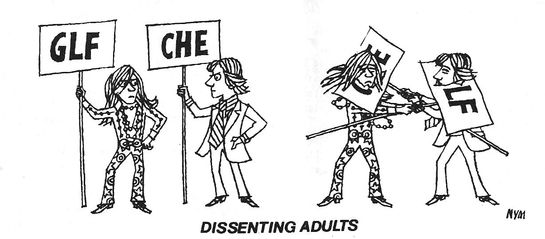
A cartoon in the CHE magazine, “Lunch”
Given the nature of the GLF’s exploits, it’s scarcely surprising that it got more media attention than CHE and, according to Scott-Presland, that has led a “scandalous” neglect of CHE in the existing annals of LGBT history. His book, Amiable Warriors – commissioned by CHE and funded through a legacy from a former member – is a gargatuan attempt to redress the balance. It runs to more than 600 pages and was originally intended as the first of three volumes. Explaining his reasons for writing at such length, he says in the preface:
Work on the period 1950-1990 has concentrated on the Gay Liberation Front, on the Homosexual Law Reform Society, AIDS activists, and Outrage; CHE is at best only mentioned in passing, or at worst ignored. The result is that it has acquired a reputation for being “middle aged and middle class” closeted white men with a cautious, even reactionary approach to societal change … Instead the glamorous GLF and its offshoots, with its street theatre and flair for publicity, has made all the running. To be fair, much of the history of GLF is vastly entertaining, the characters larger than life; its intellectual ‘clout’ was such that it created the most essential tools for analysing our oppression; but the upshot in popular gay mythology is that if GLF is a rainbow, CHE is beige.
Social activities
CHE’s work was far less glamorous but vitally important and in Rictor Norton’s view it succeeded in its main objective by creating opportunities for people with a shared sexual orientation to “come together in a broadly social space rather than a narrow subculture whose main aim was sex”. This, he adds, is not to say that sex was unimportant “but the real aim was a modus vivendi, a way of life, for homosexuals within society rather than a separate twilight world on the margins of society.”

The canal boat trip, 1972
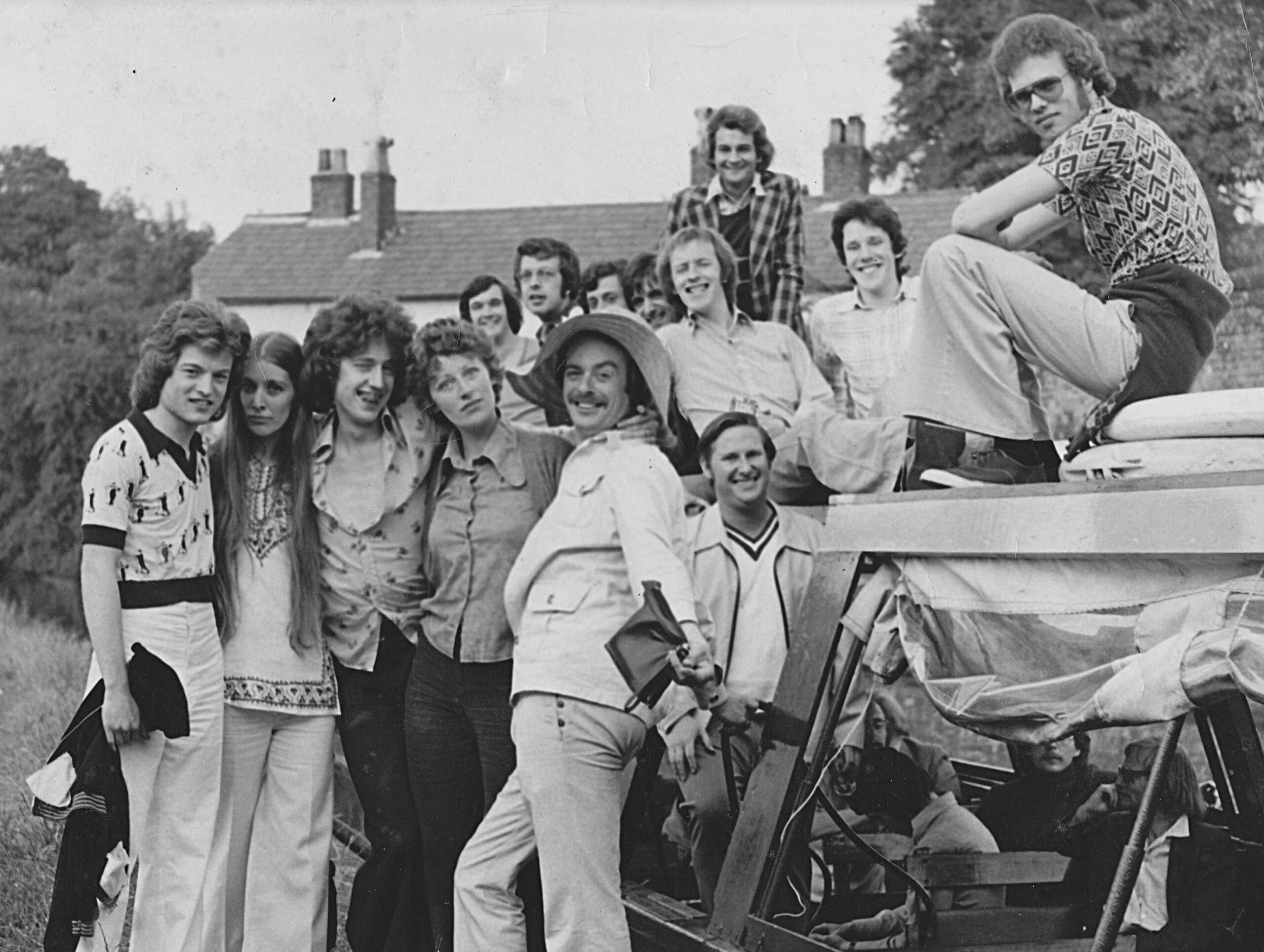
On the canal. Paul O’Grady is third from left
In Liverpool, Peter Norman had an idea for how this might be achieved . Having recently moved to the city to take up his job in the council’s Planning Department and looking for friends, he had joined a local group called the Octopus Club which held a varied range of social activities. Organisations of that kind were known as “singles” clubs. Ostensibly, they were about friendship but their basic purpose, Norman wrote in a memo, was “to provide single people, mostly young but some widows, divorced, etc, with [the] opportunity of finding a mate”.
Singles clubs existed primarily for straight people and Norman’s idea was to provide an equivalent for gay people. He explained:
The hetero equivalents work through putting people in a situation where they meet and socialise, and things develop from there if both parties wish it. And I thought the same thing would happen in CHE. I don’t think I would advocate that people should join specifically to pick people up, no. ‘Come to the meeting, go home with somebody that night’ — that wasn’t what I had in mind.
At first his proposal was greeted with some apprehension. While it was apparently OK for singles clubs to facilitate coupling among straight people, perceptions might be different where gay people were involved. One danger was that their purpose would be misconstrued. A column in the Daily Post by Ormskirk MP Harold Soref provided one example of how easily that could happen – even over something as basic as the funding of college gaysocs.
Soref — one of the most right-wing members of the Conservative party — attacked a decision by the National Union of Students to provide “thousands of pounds” in funding for gay societies in universities and colleges (as it did for many other student societies) and falsely claimed that the money would be used “to provide a national homosexual dating service to give free opportunity for uninhibited behaviour in public”.
Out in the open
Having overcome its initial hesitation the Liverpool group began supplementing its indoor gatherings with outdoor activities: a barbecue on Formby beach, a boat trip to Llandudno, and another on a canal barge.
And there was football. In 1971 Manchester Homophile Society announced that “in an attempt to free ourselves from a particular ‘gay’ image” they were forming a football team. Despite their claim to have no knowledge of the rules, this resulted a few months later in Britain’s first all-gay public football match between the Manchester group and Liverpool CHE. It took place in Heaton Park, Manchester, and the only goal was scored by Glenys Parry, the sole female player.
Spectators included the local police – hiding behind bushes, according to Bloxsidge. “I don’t know what they thought we were going to do on the football pitch,” he recalled, “but clearly they didn’t believe we were only going to play football”.
There was nothing earth-shattering about such activities but cumulatively they were a sign of gay people asserting themselves in everyday life and gaining visibility: they could be seen out and about, doing ordinary things – and it had an effect on attitudes among the public.
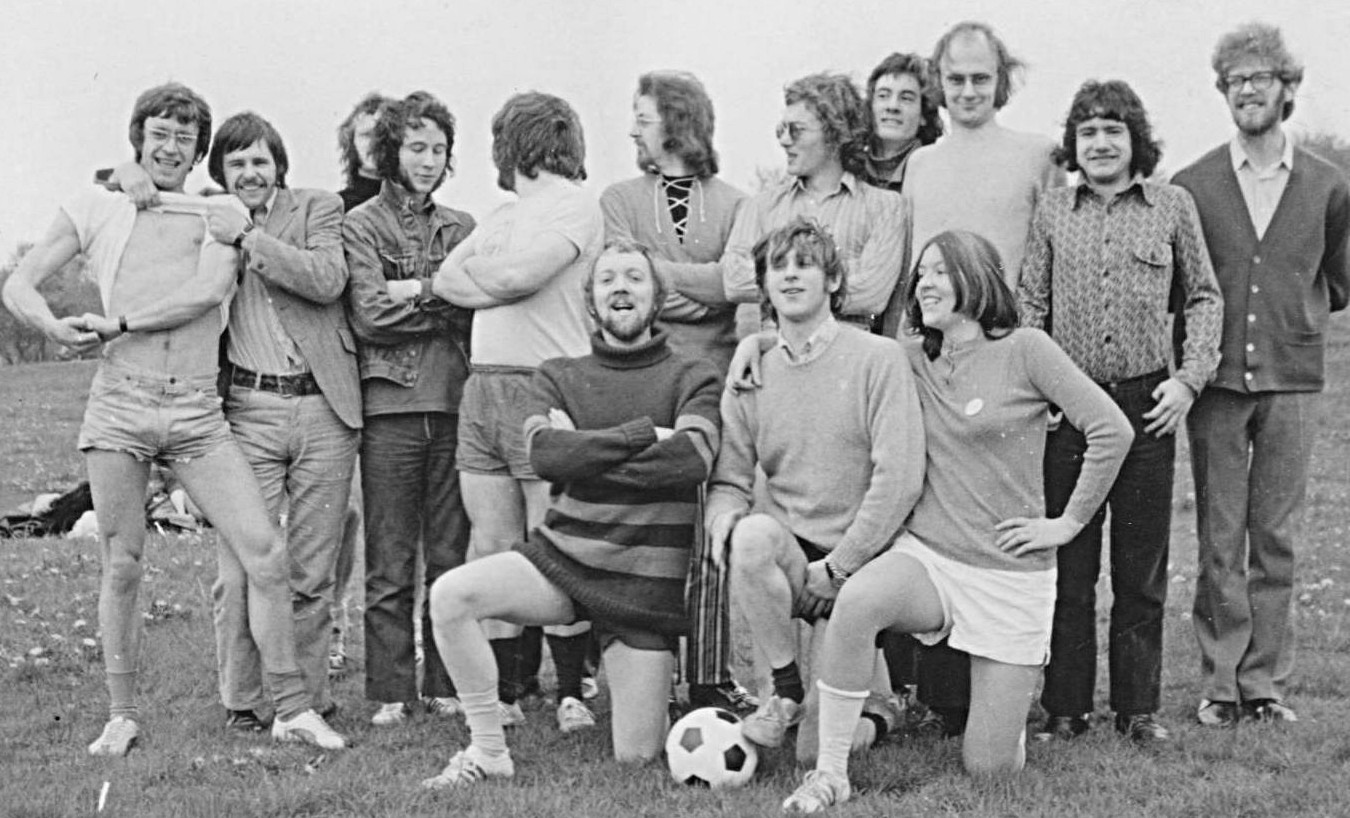
Line-up at Britain’s first all-gay public football match
Victory through small battles
CHE’s battles for social equality were mostly small ones, fought locally, and it’s easy to overlook their significance. But there were many of them and the effect was cumulative – which is one reason why Scott-Presland devotes 600 pages to documenting them in Amiable Warriors. He writes:
CHE largely worked through its local groups, often in areas where there was no other LGBT life at all. In the 1970s to try to get an advertisement into a local paper, even, was a political campaign. So the history of CHE on one level is the history of small things; and the courage of its members is the courage of small things … All through the 1970s and 1980s, hundreds, even thousands, of individual members of CHE all over the country were demonstrating bravery in small things.
In small communities they were writing letters to local papers, signed with their own name; teachers were telling their headmasters they were gay; lesbians and gay men were sharing their experiences in discussion groups and giving each other strength and a sense of identity; they were telling their families (or maybe just Mum); they were in dialogue with their MPs, talking to their local doctors and priests, and each time it was laying something of themselves on the line.
This constant pressure from “living and breathing un-stereotyped homosexuals” led to a sea-change in attitudes, Scott Presland says. “Put together enough small things and you end up with an accumulation which can be massive”.
FURTHER INFORMATION
At My Mother’s Knee … and other low joints
Paul O’Grady. Penguin Books, 2008
Pink Past and Present
An award-winning feature length documentary film which explores the rich, vibrant and often turbulent history of Liverpool’s lesbian, gay, bisexual and transgender community from the 1950s onwards. It was premiered at Homotopia and screened at FACT as part of Liverpool Pride 2012.
With Downcast Gays
GLF pamphlet by Andrew Hodges and David Hutter, 1974
GLF manifesto
1971, revised 1979
Queer Places
Website taking a historical look at Liverpool’s gay meeting places.
NEWSPAPER REPORTS
(with links to the British Newspaper Archive)
● The Daily Post’s interview with “Albert”
‘I feel the world is out of step, but I accept I’m a queer’
Daily Post, 21 April 1971, p8
Homosexuality and the need for tolerance
Letter from a “non-effeminate homosexual”
Daily Post, 28 April 1971, p8
● CHE teach-in at Liverpool cathedral
Teach-in
The one-paragraph mews item that announced the teach-in
Liverpool Echo, 18 September 1972, p7
Protest over teach-in at cathedral
Daily Post, 20 September 1972, p1
Group ‘not accepted by society’
Report on the teach-in
Daily Post, 21 September 1972, p11
● Harold Soref MP on “homosexual clubs”
Disturbing
Soref’s column
Daily Post, 10 April 1973, p6
Why the universities are forming gay societies
Letter from Robin Bloxsidge and John Greenman replying to Soref
Daily Post, 18 April 1973, p5
Outrageous?
Letter from London University Gaysoc replying to Soref
Daily Post, 7 May 1973, p5
● Other newspaper articles
City after dark
A five-part series on the seamy side of Liverpool’s night life included a short section on “haunts of homosexuals” – described as “the other side of the vice problem” by crime reporter Don Smith. “The main difficulty I found was that, with the current trend towards long hair and more flamboyant clothes, it was difficult to tell who was ‘queer’ and who was ‘normal’.”
Daily Post, 20 November 1973, p5
A race apart?
Series of four articles by reporter Bob Phillips giving a sympathetic view of CHE and including a visit to a gay disco where nothing untoward happened …
- Introduction
Liverpool Echo, 2 December 1974, p6 - At last the gay people feel it’s time to come out of hiding …
Liverpool Echo, 3 December 1974, p6 - The night I went to the disco with a difference …
Liverpool Echo, 4 December 1974, p10 - The fight for equality
Liverpool Echo, 5 December 1974, p10






0 Comments