The Liberals took charge of Liverpool City Council in 1973, though without an overall majority. They abandoned the construction of new council homes in favour of new-build co-ops. Thus what had started out as a radical and marginal movement for residents’ control was watered down as the new mainstream.
However, the initial success of these co-ops created a demand for more that was impossible to meet because of government spending restrictions.
This is the third in a series of four articles on housing by Matt Thompson:
.
- From slum clearance to rehabilitation
- Grassroots initiatives
- Liberal compromises
- Militant and ‘bourgeois’ housing
.
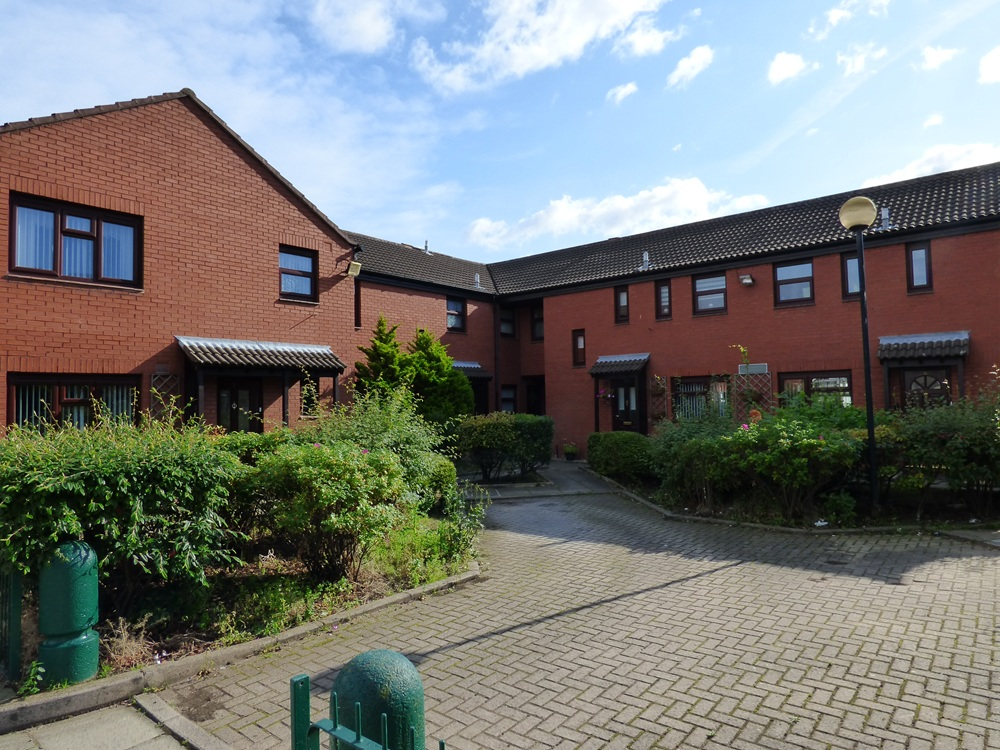
New-build homes in the Weller Street co-op
.
Between 1973 and 1983 no party had overall control of Liverpool’s city council, and the result was a period of political inertia which became known as the “lost decade”.
In the 1973 local elections the Liberals made spectacular gains and for the next 10 years alternated with Labour as the largest party, with the Conservatives trailing some way behind. However, neither Labour nor the Liberals managed to secure an overall majority.
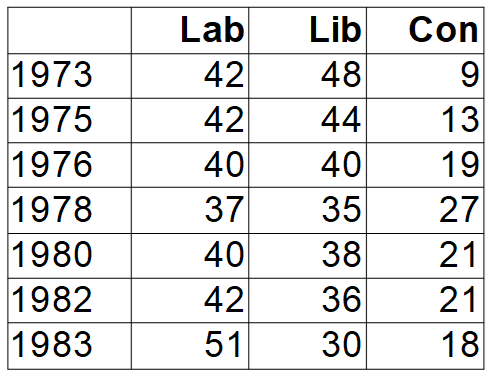
Composition of the council, 1973-1983
For the Liberals, this meant forming a minority administration in alliance with the Conservatives. During the four years when Labour was the largest party, though, it chose to remain in opposition, forcing the Lib-Con alliance to stay in power but without sufficiently shared politics or coherent an agenda to push through necessary reforms; conflict between parties over budgets meant that plans could not be made. Particularly controversial was the Liberals’ 1975-76 budget, which used some of an extra £21 million allocation from central government to hold down the rates (council tax) rather than supporting services like council housing.
By 1979, new council house building had been completely halted by the Liberals – despite 12,000 people on council waiting lists, 10,000 awaiting transfer and with around 25,000 increasingly dilapidated dwellings, a third of the stock, classified as hard to let.
Resources were consequently directed into a private sector renewal strategy complemented by housing co-ops, diverting limited funds away from existing public sector housing to do so. The Liberals opposed the notion of having a single bureaucratic authority – i.e. the council – in charge of all the city’s social housing. They also opposed allowing its Direct Works Department to have a monopoly on housing maintenance services – believing this to be costly, inefficient, paternalistic and damaging to citizens’ capabilities to manage their own lives.
Liberals such as Richard Kemp, who was chair of the Housing Committee from 1979 to 1981, and Chris Davies, Kemp’s deputy who succeeded him as chair, laid the housing crisis at the door of a bloated bureaucracy which was held to be too unwieldy and distant to effectively manage the 90,000 or so properties owned by the council.
Specifically, they located the problem in the heavily unionised and politically powerful Direct Works Department which had a backlog of repairs and was failing to deliver decent services for tenants. Kemp admits that “repairs cost us a fortune, we didn’t manage our stock properly”, and that such a state of affairs contributed to the Liberals’ refusal to build more council housing:
“I used to go to public meetings and say, ‘We’re such a bad landlord I’m not going to build any more except special needs and specific ones,’ and that’s what we did for three years … Everything that we then put in new was housing cooperatives.”
For a city substantially housed by the council and relying on in-house services for the upkeep of their homes, the Works Department enjoyed a surprisingly powerful position. This was at a time when public sector employment had become a crucial counterweight to Liverpool’s evaporating port economy. Over a third of the city’s working population was employed by the public sector; a third of these in turn employed directly by the council. “Every hundredth person in Liverpool,” Kemp says, “was employed in the Works Department.”
The Works Department was understandably opposed to the transfer of council-owned housing to co-ops, since it meant a loss of future work. Tenants of the rehab co-ops would no longer be tied into maintenance jobs with the Works Department – they could choose their own contractors.
The Liverpool Labour Party – alongside the labour movement – opposed co-ops precisely for this reason: their potential power to weaken the trade unions and expose what was once guaranteed work for the public sector to open competition with the private and voluntary sectors. Thus the Works Department, according to Davies, “threatened to go on strike immediately if we did this [diverted council budgets towards rehab co-op housing] because it would be a chink in their armour”.
This made rehabilitation politically difficult – and it may have been a factor in the policy shift away from rehab co-ops towards new-build.
Liberals’ housing policies
The Liberals had come to power on the back of Labour losing working-class voters opposed to the slum clearance programme and frustrated by the poor service of council house maintenance. Their policy thus came to be geared around circumventing problems associated with council management of housing and followed a three-pronged approach.
First, they promoted the development of private houses for sale on council-owned land around the city centre, for the first time since the 1920s, in a bid to end the council’s century-long obsession with tenement-building. Aiming to instil a new social mix, this was augmented by a policy of selling off council homes to tenants, presaging Thatcher’s Right to Buy and New Labour’s Mixed Communities agenda.
Second, they shifted from demolition to rehabilitation. Building on the work of SNAP and utilising the 1969 and 1974 Housing Acts, the Liberals rehabilitated over 30,000 terraced homes through the largest Housing Action Area and Housing Association sector outside London.
Third, as part of this strategy, housing co-operatives were, in the words of Chris Davies, “Public Sector 2.0 – a Liberal approach to public sector housing in the inner city”.
However, the Liberals’ policy approach was by no means a coherent or systematic programme and it has been criticised for its overemphasis on developing the private sector at the expense – neglect even – of municipal ownership. On the other hand, it was passionately informed by liberal ideals for dweller control, choice and self-government. But such a lucid ideology was strangely distorted by a lopsided housing strategy. Kemp acknowledges their motivations were an incongruous mix of “a high blown Liberal viewpoint that people can and should be able to run their own lives”, and a “response to the practicalities”. He adds: “We didn’t want to throw good money after bad; we knew that if we provided more council housing it would be useful, but it wouldn’t be as cost effective or as good as finding other ways of doing it”.
In this way, the Liberals gradually abandoned council house building, switching the “tenement rehousing programme” towards new-build co-ops. Their inability to reform the Works Department further fuelled the physical deterioration of the tenements. An increased demand for rehousing coincided with a diminution of options to just one, with perverse consequences. By presenting co-ops as the only route for council tenants to be rehoused, the Liberals inadvertently created a surge in demand that slammed up against tight fiscal limits. Davies describes the impact:
“It started to snowball … more and more groups started to come to us in the course of this period, saying ‘We’d like a new house please, we know that if we form a co-op, we can get one’. OK that goes so far, but there’s also a limited amount of money.”
Money was limited for a number of reasons. First, new-build co-ops were much more expensive than rehab, owing to greater costs incurred in demolition, design, land assembly, construction and development. Second, the Housing Corporation’s budget was cut and the Cooperative Housing Agency – the subsidiary agency set up to support co-op growth nationally – was closed down in 1979. Third, this meant money for the co-ops had to come increasingly from the council, with only Weller and Hesketh Street getting through the Housing Corporation funding process before an expenditure moratorium was imposed in 1980 by the new Conservative government in Westminster.
Hesketh Street found itself caught up in the uncertainty, with development put on hold while replacement funding streams were secured from the council. From then on, all co-ops were funded predominantly by Liverpool City Council, but its housing budget was tightly constricted.
Despite the principle of choice underpinning the Liberal overhaul of public housing, their policies had the paradoxical effect of reducing choice to just one underfunded alternative: co-op housing was now almost the only way council tenants of crumbling tenements could get rehoused. What had started out as a radical – and marginal – movement for cooperative dweller control was watered down as the new mainstream. Ironically, the success of the new-build model had a bandwagon effect that created a groundswell for undiscerning co-op development. A manager at Co-operative Development Services (CDS) recalls that people who had seen a friend rehoused used to phone and say “I want to form one of these co-op things”.
Ideological differences
Popularity diluted the original principles of dweller control, reducing co-ops to little more than glorified housing associations, and splintering the movement into factions. On the one side was Weller Street, whose members were vehemently political and thought of themselves as the pioneers. In his first-hand account of the co-op, Alan McDonald notes that they were “high on an idea – the idea of a fight, a mission, a mini-revolution, not merely a way of getting decent housing for themselves”. Such ambitions were not limited to internal debate but often publicly stated: “The intention of the Cooperative is that we should eventually become a completely autonomous organisation, responsible for running our own affairs.”
These aspirations for radical self-government distinguished Weller Street from most of the co-ops that followed, inflating their sense of ideological righteousness and collective confidence to go it alone. They eventually severed ties with CDS and set up their own independent secondary co-op as “an anti-professional alternative to the likes of CDS”.
Without the professional expertise of CDS, however, Weller Street’s secondary experiment failed within a matter of months. This brought them into repeated conflict with their professional partners, culminating in a feud with CDS – an organisation for which Weller Street residents had always harboured a sceptical distrust.
CDS did indeed have financial interests in the scheme, asking for 90 per cent of the co-op’s administrative allowances provided as part of Housing Corporation funding. Yet the organisation relied on such income for survival as a business – and they certainly earned their fees. Almost all the administrative work was done by CDS and it is likely that without CDS neither the co-op nor the wider movement would have developed.
Despite these debts to their “mother” agency Weller Street was quick to sever the umbilical cord. The split culminated in residents storming CDS offices to recover all “their” files, provoking a prolonged legal battle. Weller Street promoted their new secondary to other co-ops but were regarded as “oddballs, the socialists, the sometimes rather arrogant pioneers”. What set Weller Street apart from the rest were their belligerently political motivations, expressed by a committee member as being about “mainly the fight, mainly the idea: let’s take them on, let’s see who they are – ’cause your life had been fucking dominated by people you never knew … Let’s have a go at them”.
Such a fighting spirit earned them a reputation. Weller Street got drunk on their own story of success, reflected in the common belief that they were the “only real co-op”. Their aggressive and uncompromising style of campaigning and political lobbying unsurprisingly alienated potential allies. In November 1980 they invaded a private dinner party hosted by Hugh Cubitt, then chairman of the Housing Corporation, to protest at possible cuts to housing co-operative schemes. One of the members stuck a finger into Cubitt’s soup saying, “you won’t eat that will you? It’s contaminated. That’s what our places are – contaminated”.
Ironically, Weller Street’s single-minded defence of cooperative principles undermined cooperation with outsiders. Weller Street’s gripe was not with new co-ops per se – they were all for expanding the movement through their own secondary. What Weller Street opposed, rather, was CDS’s idea of forming co-ops among council tenants, which, according to a leading member, was “assisting the Corpy to manage their fucking shite”.
They saw council tenants as less deserving, having not earned their right to form a co-op, and whose “‘housing need’ was less urgent than the need of the Weller Streets members living in clearance”. Thus a division was cut between, on the one hand, the politically principled Weller Street – joined by close cousins, Hesketh, Thirlmere and Leta-Claudia – and, on the other, those that followed in their wake, forming co-ops with council support and funding as a means to get better housing.
Avocado-coloured baths?
Co-op design outcomes reflected distinctions between factions. Weller Street’s design was for ten identical courts of six houses each wrapped around a communal landscaped area. Architect-academic Rob MacDonald, who once worked with the community as a student, explained the layout:
“A series of L-shaped courtyards, very different from all the other co-ops … Each cluster was supposed to be responsible for their own courtyard, and then at the back you had the private gardens.”
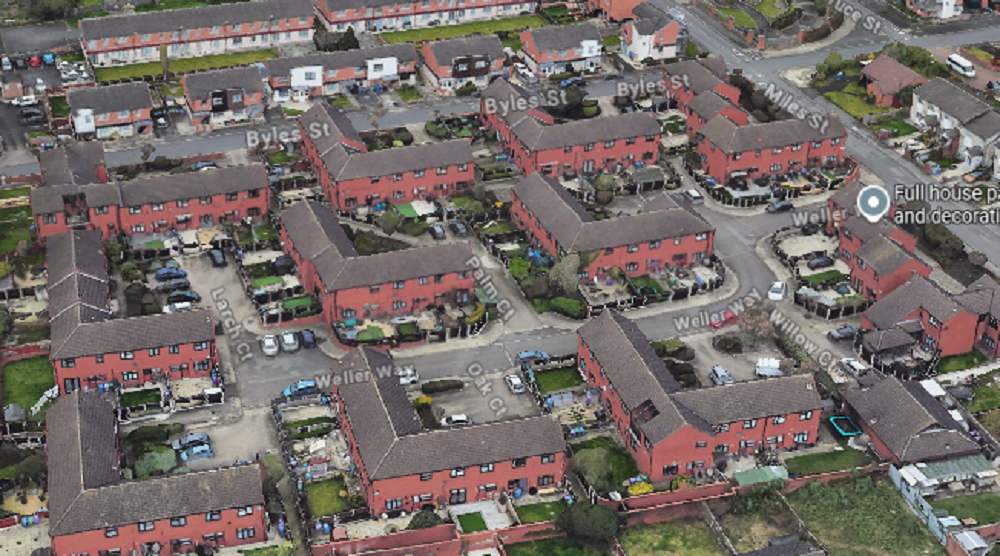
Strictly egalitarian: aerial view of the Weller Street co-op with its regimented L-shaped housing blocks
The cell-like layout of identical courtyards was the material expression of a uniquely egalitarian political philosophy. Bill Halsall, the co-op’s architect, remembers the internal debates between residents arguing for individual design choices set against the more puritanical committee:
“One of the co-op members dared to say, ‘Could people have different coloured baths?’ which was debated round and round and round, and stamped on firmly, on the basis that this was like a bourgeois tendency coming out – to have an avocado bath. So the answer to him at the end was ‘You can have white with a grey ring around it like everybody else’.”
Such an ideological commitment to egalitarianism produced what some observers describe as Stalinist tendencies. Members coined a new word – “utalitarian” – for Weller Street’s distinctive blend of totalitarianism and utilitarianism.
“Utalitarian” design was intended to ensure that everybody had exactly the same housing allocated according to need regardless of who they knew or how much effort they put in. This principle was taken to its extreme, with uniformity across almost all aspects, from bricks to letterboxes to internal fittings. “Everybody had to have the same share of sunlight,” Halsall says. “It’s like what socialist housing might have looked like”.

“Utalitarian” design in the Weller Street housing co-op
Hesketh Street was different. Residents chose a variety of individualised designs, with a resulting 25 or so different porch choices in a scheme of some 40 houses. It was derided by architectural critics for being “cluttered” and incorporating many of the vernacular themes popular at the end of the 1970s: “Like other ‘landscaped’ schemes of this sort, it blends awkwardly with its urban surroundings and its design is somewhat inappropriate to an urban infill site.”
This reflected the striking incongruity of the Liverpool co-ops in general between their political radicalism and the ordinary, conservative, suburban design outcomes. The same critics, however, also acknowledge that “to be revolutionary doesn’t mean that you have to lose sight of common sense.” The common sense of co-op members was for warm, dry, clean, spacious houses, arranged to promote social interaction among neighbours, where their children could play safely in secluded streets sheltered from encroaching dereliction.
Anti-urbanism
Having lived for so long in a state of neglect, amidst decay, dereliction, vandalism and crime, communities were determined to shut themselves off from the rest of the city. This defensive instinct was combined with aspirations for something better than council housing – something more akin to a wealthy suburban housing estate.
Weller Street initially toyed with the idea of creating a village green as the focal point – the rural idyll of English village life – and this anti-urbanism was taken to its extreme by one of community architecture’s highest-profile supporters, notably Prince Charles, who advocated turning the derelict sites of “crushed tower blocks” in inner-city Liverpool “back into countryside”.
However, due to the physical constraints of their site, requiring a dense design in which to fit the entire community, Weller Street took on a more urban quality, of courtyard squares. Most of the other co-ops, by contrast, were typically cul-de-sacs which Bill Taylor, formerly of CDS, likens to “a sort of wagon train when they’re stopped for the night”, arranged in a tight, inward-facing circle. But without a masterplan connecting these wagon trains at a higher scale they are “like oases in a desert of dereliction”.
This was not for want of city planners trying to assert their professional expertise in the face of residents’ desires. One participant recalled a showdown between planners and Thirlmere co-op, whose chairman, Reg Cummings, a generally “quiet, peaceful man”, spoke up against professional aversions to their cul-de-sac design of inward-facing houses:
“I tell you what mate, you either change your fucking mind right now or I’ll get on that phone … There’s a bus load of people down on the dock road, they’re going to fucking come in here and sit in this fucking office until you fucking change your mind, all right?!”
And the planner said, “Well, what do you mean? Mine is a professional decision”.
He said, “Stick your profession, I have to live here, and I come from here, and I’m telling you, we’re going to sit in this office until you change your mind and see it from our perspective!”
Ironically, it was planning decisions that first created the urban conditions against which residents turned. Understandably not wanting to “look out onto an empty derelict site”, co-ops literally turned their backs on the city, preferring, in the words of one co-op development worker, the “security of looking inwards so we can keep an eye on each other”. In being given a voice for the first time, residents felt empowered to challenge professional decision-makers and contest their knowledge claims.
While the new-build co-op model produced many benefits for those residents lucky enough to be a part of it, in the constrained political circumstances of the “lost decade” it failed to grow beyond a marginal sector for a privileged minority. But what gave those fortunate few residents the right to reap the rewards of new co-op housing when most other council tenants had to put up with deteriorating conditions? Was it their ability and opportunity to organise proactively as a community and vocally express their demands for better housing to the right organisation at the right time coupled with a capacity to carry their campaign through to the bitter end? Should adequate shelter not be a social right granted to everyone regardless of their inclination to be entrepreneurial?
These were questions that the Labour Party, led by certain key figures associated with the radical left Militant Tendency, was asking when it regained control of the council in 1983, largely on the back of campaign promises to fix the housing crisis, left to spiral out of control through the 1970s.
The next article explores that battle of ideas, and its consequences for the co-op movement.
* * *
Matt Thompson is Lecturer in Urban Studies at the Bartlett School of Planning, University College London. This article is an edited extract from his book, Reconstructing Public Housing: Liverpool’s Hidden History of Collective Alternatives, published by Liverpool University Press in 2020.
FURTHER INFORMATION
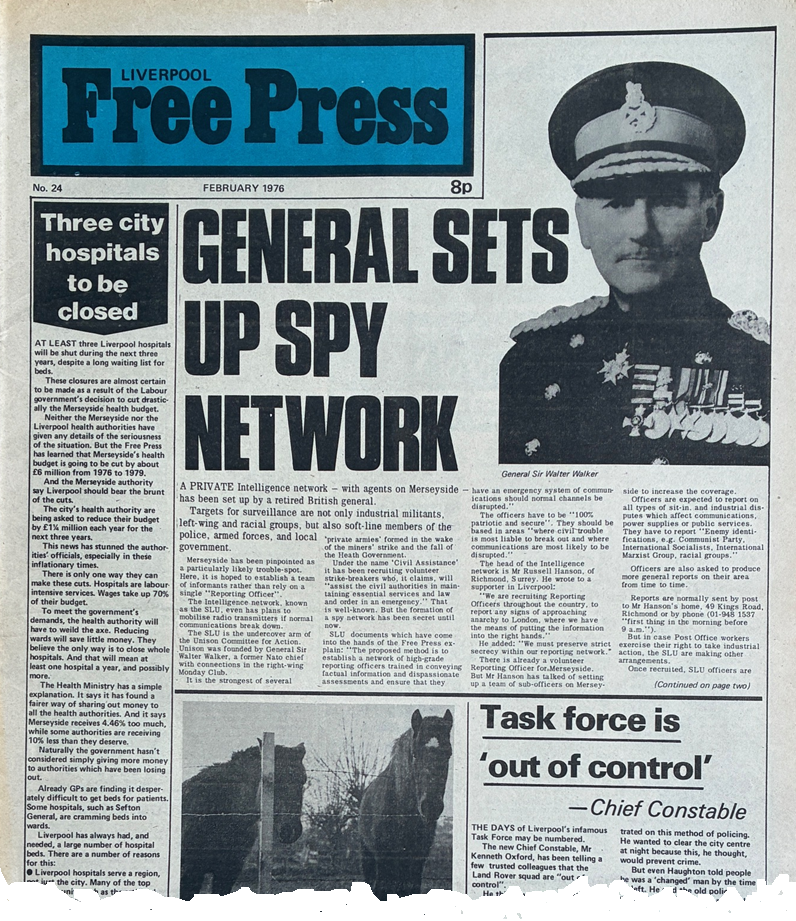
Repair depots face axe
Liverpool Free Press, March 1976, p3
Man behind the plan to axe direct works …
Liverpool Free Press, April 1976, p 12
Just who really benefits from Housing co-ops?
An opinion article by Joe Gorton
Liverpool Free Press, March 1976
The Weller Way: The Story of the Weller Street Housing Cooperative
Alan McDonald, Faber & Faber, 1986.
Vauxhall Victors: Eldonians Special Issue
The Architects’ Journal, March 23, 1988, pages 37-66.
The Rebirth of Liverpool: The Eldonian Way
Jack McBane. Liverpool University Press, 2008.














0 Comments