Slum clearance in the 1960s and 1970s separated people from friends and neighbours they had known for years. Tens of thousands were “decanted” to new estates on the edges of Liverpool.
But demolition and displacement weren’t the only options and in Toxteth the Shelter Neighbourhood Action Project initiated a new approach.
This is the first in a series of four articles on housing by Matt Thompson:
.
- From slum clearance to rehabilitation
- Grassroots initiatives
- Liberal compromises
- Militant and ‘bourgeois’ housing
.

Credit: SNAP
.
The municipal elections of 1955 brought the Labour Party to power in Liverpool for the first time. Under the leadership of Jack and Bessie Braddock, the city council embarked on a systematic and large-scale plan of comprehensive redevelopment, decanting large numbers of inner-city residents to overspill estates and new towns on the periphery.
The Daily Post reported that about 125,000 people would be affected: 48,000 would go to Skelmersdale, 30,000 to Kirkby, 19,350 to Halewood, 18,000 to Widnes, 6,000 to Cantril Farm and 3,500 to Formby. Collective outrage and resistance to these forced relocations expressed itself through various cultural mediums at the time. “Back Buchanan Street”, a popular folk song written by Harry and Gordon Dison in the mid-1960s, was melancholic and nostalgic:
A fella from the Corpy, just out of Planning School
Has told us that we’re being moved right out of Liverpool
They’re sending us to Kirkby, or Skelmersdale or Speke
Don’t want to go from all we know in Back Buchanan Street.From Walton to the Dingle, you’ll hear the same old cry
Stop messin’ round with Liverpool at least until we die
Don’t want to go to Kirkby, or Skelmersdale or Speke
Don’t want to go from all we know in Back Buchanan Street.
It was generally agreed across the 57 clearance areas that the houses were too small, insanitary and lacking most basic amenities but the council’s approach to slum clearance caused much resentment by breaking up long-established communities.
Despite popular tendencies to romanticise life in the old terraces, though, there was a real need for state intervention to upgrade such housing, as one interviewee recalls:
“People’s memories are with tinted glasses, some of those properties that they demolished needed demolishing … People remember playing ball in the street and they don’t remember playing with the rats in the street.”
The search for alternatives
The threat of displacement and the breaking up of communities was one of the main drivers behind campaigns for cooperative alternatives. Another was the terrible condition of existing housing within the inner city. The nineteenth-century two-up two-down terraced houses were insanitary by modern standards, often ‘back-to-back’ – with windowless internal back walls built against the houses behind to save on construction costs – or else separated by a narrow alley.
Part of the slum clearance involved replacing old terraces with new tenement blocks which soon deteriorated. By far the most notorious of these were the trio of tower blocks in Everton colloquially known as the Piggeries or the Ugly Sisters. They had been built in 1965 but, as a council officer recalled, they were so badly built that five years later “the tenants had gone on rent strike and therefore the council, in direct retaliation, had gone on a repairs strike” … Within another five or six years the blocks had been demolished.
Such experiences, coupled with growing collective anger over the slum clearance programme, eventually led to a fall in support for the local Labour Party. Following the 1973 local election, the Liberals became the largest party in the council, promising a new kind of “pavement politics” in place of Labour’s boss politics or the Tories’ paternalism. The Liberals took advantage of various policy changes at the national level to install a new public housing programme locally – one which turned its back on council housing and focused on private and cooperative alternatives, in a bid to diversify and decentralise what many now saw as moribund municipal housing.
Before exploring these changes in more detail, we must first turn our attention towards a little-known policy experiment in Liverpool which did a great deal to pave the way for the Liberals’ housing policy and the development of the co-op movement.
By the 1960s, emerging social movements composed of urban communities and idealistic professionals were beginning to resist top-down comprehensive redevelopment and propose rehabilitation instead. In response, the government passed the 1969 Housing Act, which put the onus on local authorities to consider rehabilitation through the establishment of General Improvement Areas.
This new ‘rehab’ approach to regeneration was profoundly influenced by a policy experiment in the deprived inner-city area of Granby. The Shelter Neighbourhood Action Project (SNAP) was one of the first action-research programmes in Britain to deliver rehabilitation rather than demolition of inner-city terraced neighbourhoods. Founded in 1966 as a charity campaigning for the homeless, Shelter had turned its attention to resolving the broader urban issues at the root of homelessness – and SNAP aimed to do just that.
At the same time, the 1969 Housing Act opened up the space for local authorities to engage with voluntary associations in ameliorating housing problems. Following the 1969 Act, the council set up Granby Planning Action Area and invited Shelter to investigate local demand for rehabilitation of a section of this area.
A holistic approach
SNAP was forward-thinking in conceptualising Granby as a “twilight area” stuck in a “twilight trap” – a vicious cycle of poverty compounded by societal discrimination. This invited a more holistic approach and SNAP’s director, Des McConaghy, proclaimed that “to deal with such areas in isolation would be to treat local sores without administering any systemic medicine”.
SNAP also helped to flesh out in practice the General Improvement Area (GIA) approach established by the 1969 Housing Act. It was the “flagship” project for General Improvement Areas and would later influence the development of Housing Action Areas – both of which were important for the development of housing associations and, later, housing cooperatives in Liverpool.
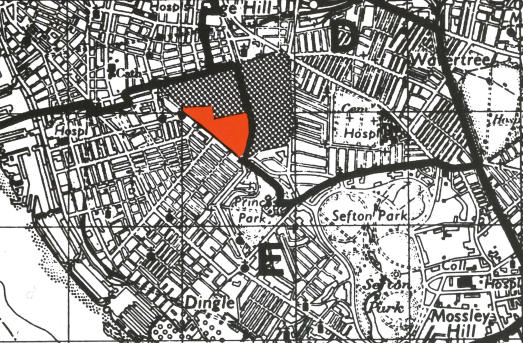
SNAP’s General Improvement Area (in red), with the Granby Action Area (black with white dots)
Communications between Granby residents and the council were made difficult partly by hostility towards the post-war slum clearance programme but also because most of the houses were privately rented from small-time absentee landlords. SNAP was to provide the vital link with residents, articulating their needs to the council and offering free advice on health, welfare and housing issues.
Its main task was to deliver environmental improvements: reducing housing densities, repairing existing properties, reorganising internal space and installing inside toilets, bathrooms and kitchens. Generally, no such amenities were available in the nineteenth-century slum terraces. This became the blueprint for the General Improvement Area rehab approach. Yet the idea was to go deeper than mere physical upgrading: to work closely with existing residents to understand their complex needs and deliver lasting improvements in health, welfare, environment and employment.
A local office for the SNAP team – comprising architects, housing managers and even a sociologist – was opened in Granby, allowing direct contact with residents. Street committees were elected by residents at SNAP meetings and task forces organised on each topic of local concern, such as housing, health and crime. Their findings were incorporated in the SNAP report to the council: an early experiment in community participation in regeneration and the ‘co-production’ of public services.
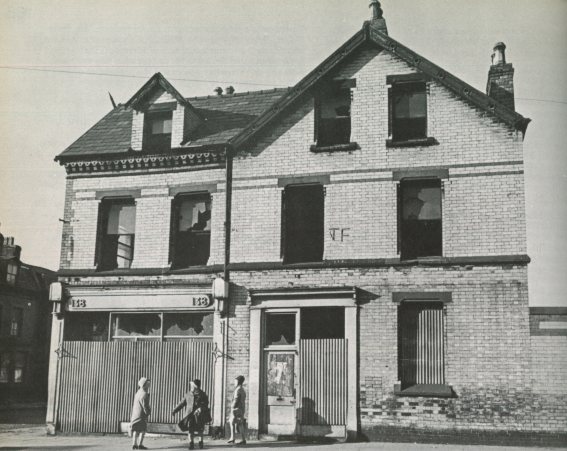
SNAP’s Granby office when acquired in 1970. Credit: SNAP
Yet the SNAP project revealed a complex knot of place-based problems that presented too many complications to be loosened by a participatory rehab approach alone. The principal problem was the scattered distribution of housing ownership and the large number of multi-tenanted privately rented dwellings. Absentee landlords were not incentivised to invest voluntarily in rehabilitation, owing to low and unreliable rents. Of the 740 terraced dwellings in the Granby General Improvement Area, only 17 per cent were owner-occupied; almost all the rest owned by private landlords; with 566 in need of improvement.
The SNAP final report revealed a convoluted bureaucratic process of 71 separate procedures required to obtain a single council grant. Liverpool’s urban governance was marked by too many competing agencies, regulations and contractors resulting in “welfare chaos”, as McConaghy put it. Alternatively, SNAP recommended wholesale restructuring into development corporations coordinating local service agencies and strategically directed at the national level through a central urban task force.
The problem of rehabilitating multi-tenanted private rented terraces split between small-time landlords was partly resolved by their consolidation into co-operative and housing association ownership.
One flank of the holistic SNAP strategy was to build tenant buy-in and find a common regeneration solution through participatory mechanisms. The other was to persuade absentee landlords to endorse the scheme despite their disinclination, before resorting to Compulsory Purchase Orders (CPO). However, blanket municipal ownership was too expensive in the context of large numbers of individual owners needing to be bought out.
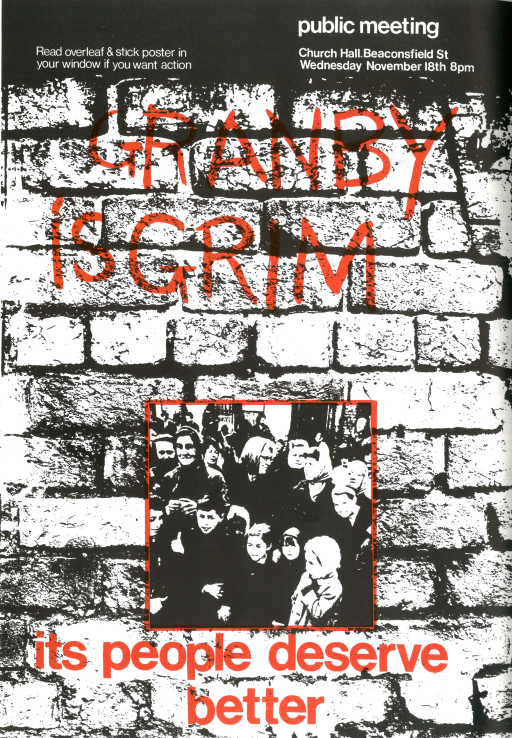
“Granby is grim” poster
Housing associations
Local housing associations were therefore encouraged to buy stock from landlords and owner-occupiers. Shelter had supported the development of two key local associations: Liverpool Housing Trust (LHT), established in 1965 as a church-based initiative; and Merseyside Improved Houses (MIH), established in 1928 as Liverpool Improved Homes, becoming one of the first Shelter-supported associations, and later morphing into Riverside, one of the biggest associations in the UK.
Both LHT and MIH were geared towards inner-city neighbourhood improvement using fundraising from Shelter, council improvement grants and mortgages. The SNAP approach innovated by Shelter was a major inspiration for the housing association and co-op movements, as a former LHT officer attests:
“LHT’s whole ethos came out of the SNAP project. The SNAP project in Granby had shown, at least for a while, how much good it could do to one small area – not just on the housing but on housing, shops, all of the public services, and work intensively with the community in that area and turn it around.
“And so that became our idea and that’s why we always had small teams in local offices wherever we then went to work … It’s how everybody works now, but at the time it was really quite revolutionary.”
* * *
Matt Thompson is Lecturer in Urban Studies at the Bartlett School of Planning, University College London. This article is an edited extract from his book, Reconstructing Public Housing: Liverpool’s Hidden History of Collective Alternatives, published by Liverpool University Press in 2020.












0 Comments