Liverpool’s International Garden Festival in 1984 was part of a government initiative to regenerate the city in the wake of the Toxteth riots.
The chosen spot was a heavily polluted landfill site between the Dingle and Otterspool which since 1945 had served as the municipal refuse dump. Before construction work could begin a venting system had to be installed to prevent fires or explosions from methane in the underlying rubbish.
Queen Elizabeth opened it on 2 May and by the time it closed in mid-October there had been more than 3.4 million visitors.
In many ways it was a success, though there were also calls for “jobs before trees” and in the article below ROGER HILL wonders what benefit the visitors actually got out of it. His article was originally published in the fortnightly magazine Next 14 as the festival was about to close and begins with a fantasy vision of how it might be dismantled …
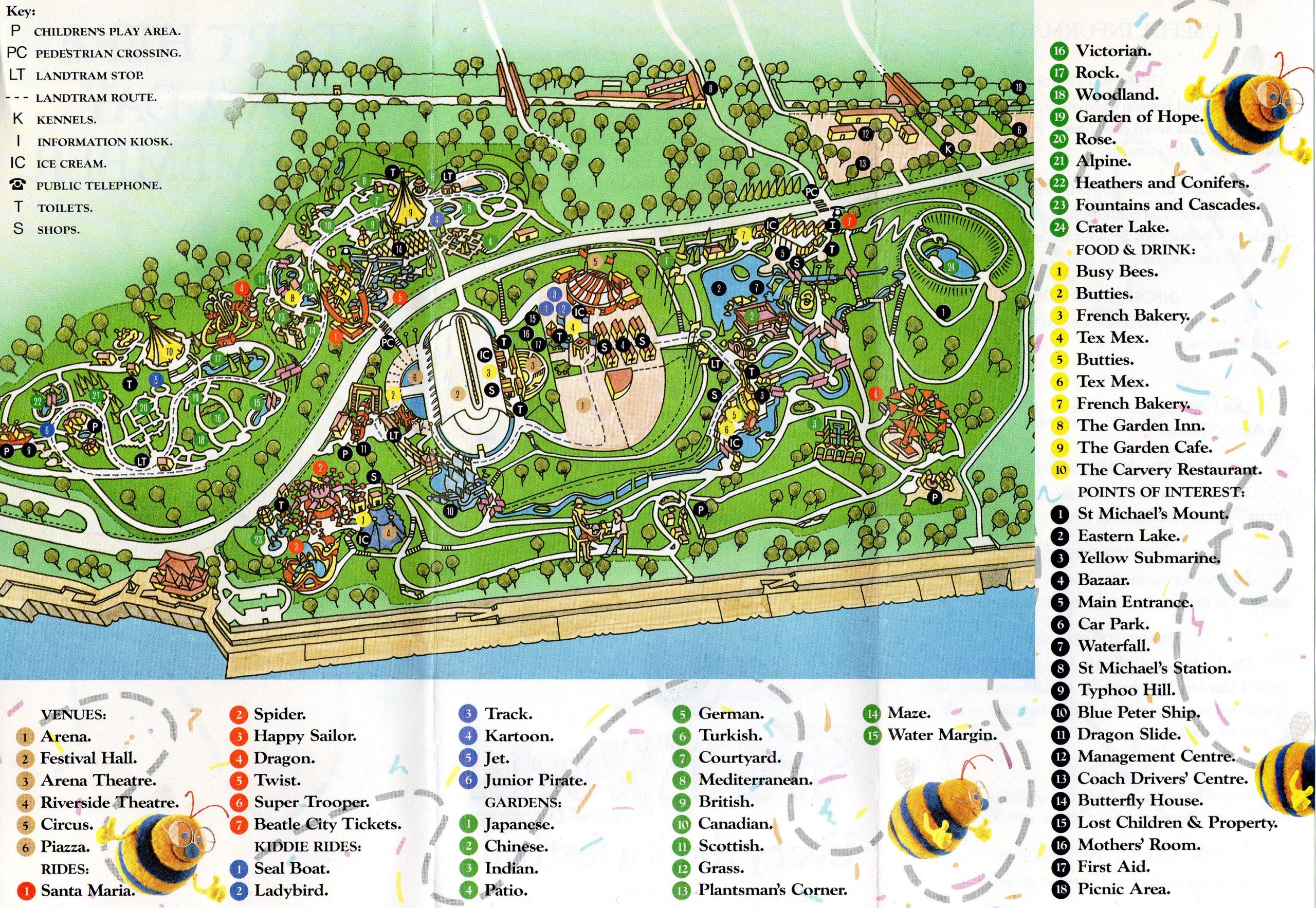
A plan of the Garden Festival. Open image in new tab for a larger view.
by ROGER HILL
Somehow I imagine a bugle call, its clear, high and rather mournful notes rising, falling, rising again and hanging silvery in the light pellucid mist before dropping slowly far out over the wide expanse of the Mersey, at its final cadence young men in grey tracksuit bottoms, the lemon yellow fluorescent flashes now worn and dull, poised each with a gleaming axe, kept in storage for this very moment, held high in the air waiting for the last note to die away — strike downwards severing at a blow each of the securing cables, until the green and yellow roofs of the cafes, of the shops and booths, begin to lift, tremulously at first, then rise, then drift upwards towards the sky rocking gently as they go — and the tractors positioned round its edge move to dislodge the concrete blocks restraining the Festival Hall, which — first nothing, then… with a great shudder, begins to emerge from the ground pushing up chunks and tatters of refuse and gravel as it pulls free, shakes itself clear, and the Dutch windmill, slowly, ever so cleanly, topples, down, down smack into the shining upturned boats of the British pavilion, and the Carillion cascades musically into the rubble, the Arena roof folds suddenly, extravagantly, like a frightened jellyfish, the Laser Dome pops, the Pilkington glass-house shatters into a million infinitesimal fragments, as the Festival Hall breaks skywards scattering railway sleepers and pine branches and unidentifiable shards of sculpture, for so long its great gleaming body buried below the surface, at last airship-like, a colossal silver cylinder, now clear, now grey, now a fine white as it sails majestically upwards away from the site of its birth, the methane sponge from which it grew, the shining dream now on a long voyage across the stratosphere to another future. And the workers doff their grey sweat-stained caps and gaze at its mighty bulk drifting towards the city skyline…
It wasn’t like that. The International Garden Festival ended with prayers and furled flags and a distant rumble of bulldozers. Pity, really.
Well, you either went or you didn’t. And if you did you belong with an almost knife-edge certainty to what David Sheppard has memorably called “Comfortable Britain”. Even though the coaches ferried in to that windy car park the marginally poor, the old, the handicapped, the tiny, the hard-to-teach, to swell the family crowds poised on the threshold of a promise — momentary freedom from the many kinds of poverty which imprison the spirit — they could thank the support-systems which had rallied round them, while that Other Britain of the really poor, the absolutely disadvantaged, those too preoccupied with survival to even focus the Festival, carried its lives on, a world’s distance away, untouched by the promise.
I’d best declare myself now — I never paid to get in. I did work at the site on and off during the summer, as a Radio Merseyside DJ and on the Youth Theatres Festival which took place in the Amphitheatre. I was there often and saw much — not everything, but enough to know the potency of that promise. The Festival was an oasis of stable values in a troubled and chaotic world, a place where trains always ran on time, litter was picked up as soon as it was dropped, flowers were cared for, water was clean, railings safe, staff polite, policemen few and far between, toilets convenient, signposts everywhere — such a contrast with that other world where They vent their problems on the rest of Us!
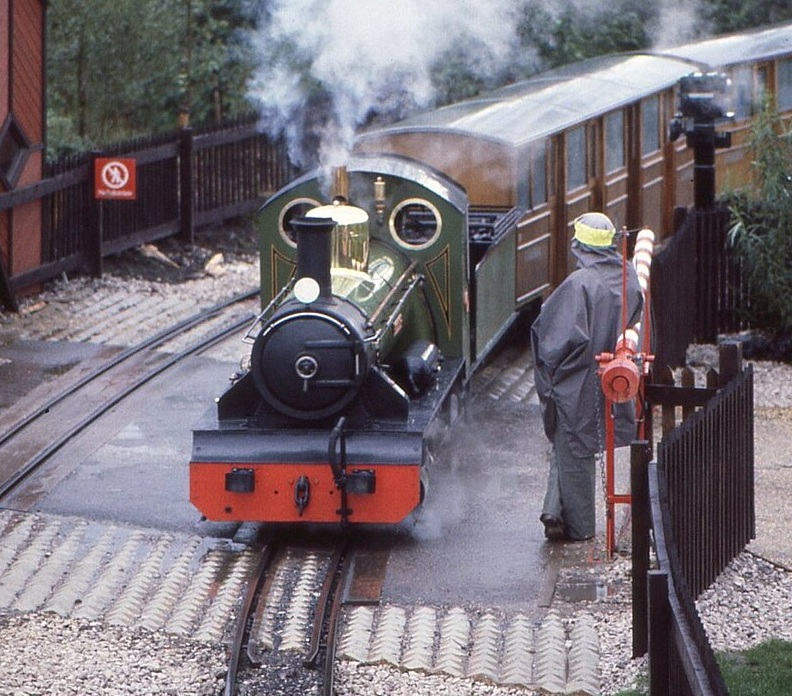
Miniature steam trains transported visitors around the festival. Photo: Richard Sutcliffe (CC-BY-SA-2.0)
And the price paid for this Garden where we felt Secure? Absolute control, no less — chain fences and barbed wire buried in the grass, coercive bonus systems for the litter-pickers, no unions but the threat of dismissal into the jobless world if targets were not met, a hefty entrance-fee, of course, fixed franchises and prices, strict regulation of access, the guard dogs corralled up by the Dingle entrance and lots of distractions to keep your mind off such matters.
I went on record beforehand in the Yorkshire Post as saying that there was a tragedy built into the whole project — if it was magnificent the people who most needed it would have to break in to get at it, and, if it wasn’t — what a let down we would all suffer. The truth as usual was a halfway house between these dramatic possibilities. There were violations of the system of course — kids providing free access at weak points in the fence, the paths people wore across the grass to save themselves the rigours of the picturesque route, the occasional misdemeanour, and compromises, like the introduction of mobile chip shops in August, and accidents, and the strain to maintain control was terrific, tempers fraying, zombie-like indifference fading gradually from the faces of the litter-pickers at sunset as they headed up the hill to clock off — but in the end it was not quite absolutely magnificent, it didn’t quite generate a mega-feeling, it was as subtly blighted as the leaves with their tell-tale black edges and the brown slopes bare of real foliage.
Perhaps it was unfair to expect otherwise given the time-scale, nature’s slow agenda. It was the structures anyway which excited, the architecture of fun and play. If the gardeners had to grit their teeth at the fickle weather, the architects and sculptors had a field day, with tents and roofs and cabins and temples and glass and wood and curves and peaks and points. A lot of the space was redeemed by funny moments you could sit in, on, hide under, behind, swing on, run down, pose by — those figures on the Esplanade, kites in the Hall roof, the red cow, yellow submarine, blue trains, odd objects to give a second’s focus then move on.
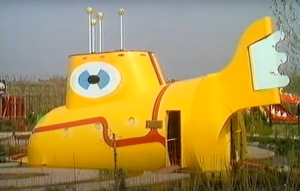
The yellow submarine
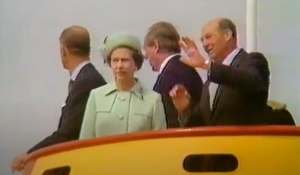
The Queen surveys the festival from the submarine’s conning tower
The moving events sometimes achieved as well: Queen Victoria, the Robot, knife-juggler, Worzel Gummidge on the back of a LandRover looking down at the upturned moon-faces of a first-year primary class in plastic macs standing in a puddle. Sitting down for a break was more pot-luck. Apart from the spectaculars, like Chinese opera and big-name jazz-men, you might rest your feet in front of a Norwegian school orchestra, Indian dancers, one of our Youth Theatre plays, a Canadian rock band, Chinese mime — it was hard to foretell, or perhaps care that much.
Season-ticket holders had the chance to tell a different story but on a one-day visit it was true that if you chased the events you missed the landscape, and vice versa.
The quality of involvement was anyway generally low and the most characteristic expression I saw on visitors’ faces was bemusement, a sort of “Oh, that’s it, is it?” look, whether “it” was Greece, Scotland, or hydrangeas or the rare Alsatian bee-orchid — there was too much of it, and too much else to see. So much of it was plants anyway — I envied the gardeners who knew one leaf from the next in the shallow sea of greens and browns while I hankered after the swings and roundabouts of Southport and New Brighton.
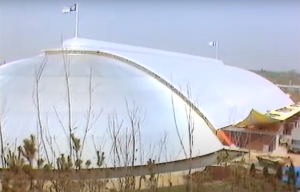
The gigantic Festival Hall
Something was unreal about the place and its scale. It felt large but it wasn’t, and the Festival Hall was massive or, seen another way, just so big. Nothing stayed in focus for long. I guess it was a Strawberry Field, that’s all — if not forever.
It gave the lie in the end to its internationalism. The globe as trotted Garden-Festival style merged all its differences into similar spaces, flower beds and a maze of paths, Cheshire a rounder kind of India, Spain as a cul-de-sac on the way to Vienna, American about the same as the Victorian age only with a lake in the middle. No wonder we have difficulty grasping the plight of the Third World — it’s just the same as anywhere else, isn’t it? Nor should we pass without comment the neglect of internationalism in the permanent workforce. Where were our local ethnic communities when it came to handing out the jobs? Internationalism begins at home.
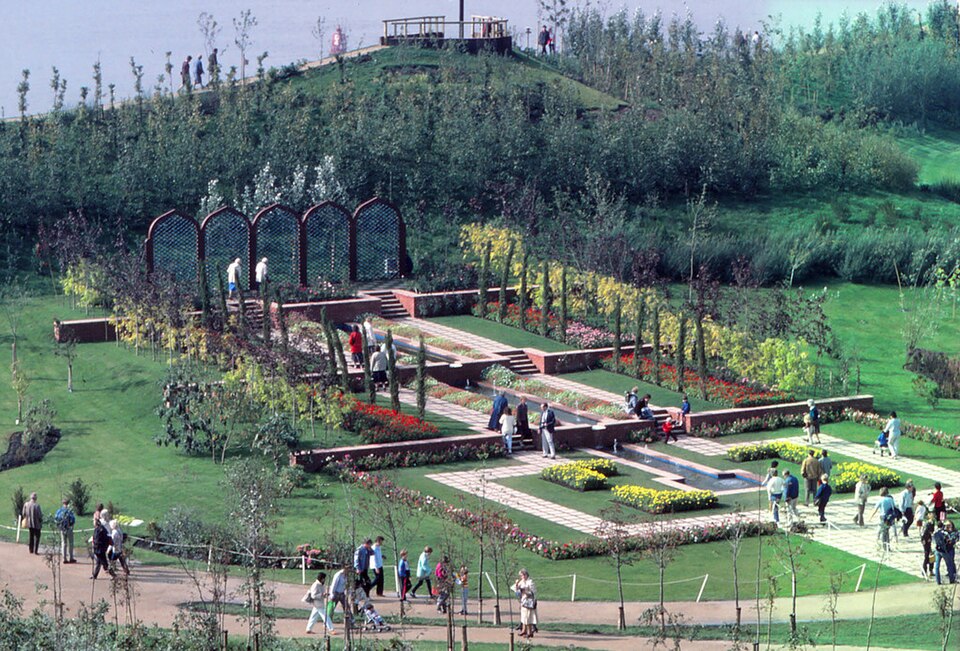
The Indian Garden. Photo: Chris Denny (CC-BY-SA-2.0)
In any lucid moment the Garden Festival appears as it was, a test-bed for leisure in the Thatcherist state — and it was a success! Here in Liverpool, where people buck the system, kick over the traces, pride themselves on their independence and cunning and scallydom — do it their way or not at all — three million people came, a lot of locals amongst them, and took it all lying down, the absolute control, the prices! Pretty much we caved in, and in the International Garden Festival this summer Comfortable Britain found its Deckchair.
So who’s being negative? The real benefits were something else. We established that sculpture can be sat on and messed about with; we got in the Festival Hall the best new building of 1984. We had witches and mazes and Chinese temples and Muffin Mule and great views from high places and, God bless it, the Garden Festival gave us back our River! If water was the constant true sight of the Festival, splashing streams, spurting geysers, calm pools, cascades, trickles, smooth falls, shores and spray, then the River Mersey achieved the apotheosis, wide direct and majestic, the real action the great thing which the city has to itself, everyday a different mood, light, reflection, high as the ferry came berthing in, low and stinky, full of sails or a brave passage of working boats saluting with spray, the River returned to us the perspective we had lost. For that new and exhilarating access to the Mersey I can forgive the Garden Festival almost everything.
The newspaper reports to come of vandalism on site? The budget-. battles over policing and servicing it? The wrangles over usage? The blurred future beyond the great years of ours when morale sags into talk of abolition and economies and first-division score-draws? Can I forgive it for bequeathing us that prospect?
For many people who lived and worked it thoroughly, on hot days and hazy days of release and relief the IGF was Summer ’84, the unforgettable one, the first and once-only, and I’m glad. People can redeem anything with good faith. But on Bank Holiday Monday I walked from the controlled consumer frenzy of the Festival up Lark Lane to Sefton Park where Larks in the Park was generating relaxation and a great atmosphere virtually for free. And I know that at the end of 1984 (the book not the year) Winston Smith is sitting in the Chestnut Tree cafe nursing his gin and his moral collapse in front of a telescreen which cries “Victory, victory, victory!” and if I have ever in my life been in the Chestnut Tree cafe it was on the Esplanade of the Garden Festival site.
If I bear the place no lasting ill-will it’s because I had this notion that when we’d all gone each day at dusk nature took a deep breath and the birds fucked and the plants grew and something reasserted itself in readiness for the next day. But now we’re all gone from the place for good, and the place itself has gone, what can nature do?
* * *
NOTE: We have a selection of videos about the Garden Festival here.










0 Comments