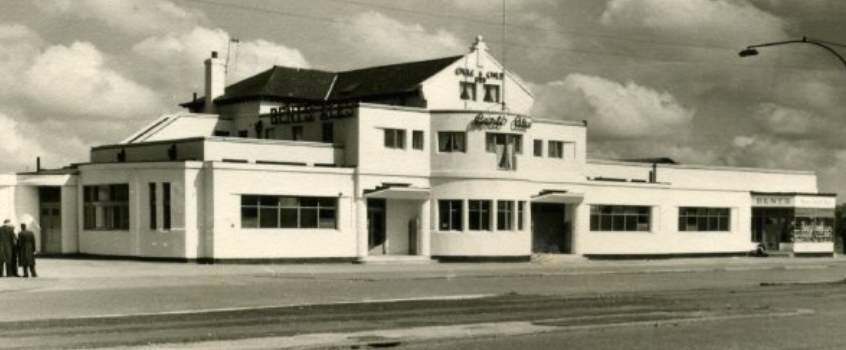
Danger zone: the Eagle and Child pub in Huyton. It was demolished in the 1990s. Photo: Facebook/HuytonPast
by JOHN TOKER
I’ve drunk in some rough places in my time as a journalist, all in the line of duty of course. The bombed-out windowless Holiday Inn in Sarajevo at the peak of the Bosnian war and the Clover Leaf on the Falls Road, Belfast (where you entered through a turnstile), still remain vivid in my memory. But without doubt the most violent and dangerous bar I ever entered was just a few hundred yards from the Echo’s district office in Huyton: the Eagle & Child in Liverpool Road.
If a pub could smell of aggravation then the Eagle reeked of it. The bar area wouldn’t have looked out of place in Hogarth’s Gin Lane. The walls were bare, the floors were never carpeted and the tables and chairs were made of iron – a deliberate choice by the brewery to make it harder for them to be picked up during the violence which broke out so regularly.
The Eagle had a city-wide reputation as a clearing house for the local criminals. All low level stuff: meat from the Stanley Market a couple of miles down the road, clothing from the local industrial estates and bits of jewellery from burglaries in Knowsley village and posher parts of Prescot. If you wanted a telly, or new piece of electrical equipment you could even place an order in advance … for a birthday or anniversary.
None of that made the Eagle stand out from many other pubs on my patch. But the violence did. There was a fight almost every night and on Saturday you could guarantee that there would be a “settler” between a couple of hard cases, always after closing time and always watched by a crowd of at least a hundred.
To give you an idea of how tough it was, the owners once appointed Peter Stockley as the Eagle’s landlord. I had known him in a previous life when he owned a club in Manesty’s Lane in the city centre. He was a hard, hard man who lived permanently on the edge of violence and had previously been convicted of manslaughter in connection with a clubland shooting.
I was researching a story about club bouncers and the notorious Bennett family in particular. They ran a team of doormen (nearly all related to each other) and were trying to muscle in on Stockley.
Three Bennett brothers had gone looking for him one night and had broken down the front door. Peter told me he had switched off all the lights in the club and in the confusion one of the Bennetts had been shot in the leg and another had been severely slashed in the back with a docker’s hook.
A ‘special’ coat for visiting the Eagle
So when I went for a drink at the Eagle in connection with the story I was happy to tag along with one of the ‘Jacks’ from CID who was paying a visit.
And that’s how I first came across the ‘detective’s coat’ as it was called. The coat had hung on the back of the CID office door for as long as anyone could remember. It may have been white to start off but it had never been cleaned. It was used solely for visits to the Eagle.
By the time I first walked into the Eagle, beside Detective Constable Frank Owens, the coat would have shamed Columbo. But Frank wore it with pride.
He was a former Welsh miner and stood well over six feet. The coat was short on his arms and reached only his mid-thigh but no-one laughed when he walked into the Eagle. They just went very quiet and bided their time.
The first objective of the visit was to show that no licensed premises were a no-go area for the police. The second was to check who was in that night. The third was to make sure no-one touched your drink (which meant Frank and I would spend the whole time with our hands on our pints) watching over each other’s shoulder.
Inspection done, we reached the final objective: getting out in a dignified manner. “No running” was Frank’s order. No-one dared to confront DC Owens face to face, so the attacks came from the back. Bitter, mild and a couple of eggs splattered on the back of the coat. Routine for the night. And what a football fan would call a score draw.
For me it was the chance to tick a box on my experience as the Echo’s district man in Huyton and Kirkby.
The Eagle and Child was demolished in the 1990s. I don’t know what happened to the coat … it might still be hanging on a peg in the CID office. After all, some things don’t change.
Saturday night entertainment in Kirkby
Throwing-out time in Kirkby on a Saturday in the early 1970s was like a scene from the Wild West. Pubs on the three council estates – Northwood, Southdene and Westvale – all disgorged their customers at precisely the same time.
Full of drink and with nowhere to go, many were happy to entertain themselves rather than go home. In the rush to build the town and relieve the awful housing conditions in the Bullring and Scottie Road in the centre of Liverpool, the planners had omitted to build any recreational facilities.
Kirkby, with a population of 60,000, had no cinema, no night clubs, a poor bus service into the city and few taxi drivers who were willing to risk their cars to the end product of an overfull stomach.
There were fights aplenty though most of the locals were too far gone to do much harm to each other. So the police officers on duty would usually hang back until things had gone quiet before trying to move the crowds on their way home.
The last places to stay open were the chippies (every estate had four or five, inevitably located next to the pub). The menu could have been written on the back of a fag packet; fish, chips and mushy peas were the staple. The hundred-or-so different offerings of Chinese takeaways had yet to reach beyond the city limits at Croxteth.
So it was one Saturday night in the summer of 1968 at about 11.30 pm outside the Roughwood pub that Constable Paul Cook, a Prestonian, fresh out of Lancashire Constabulary training school at Hutton, chose to make a momentous entry. (I should declare an interest here. Paul and I have been close friends since the day we met more than 45 years ago. He is godfather to my eldest son and me to his eldest daughter.)
At Hutton, Paul had been trained to disperse groups of people in the belief that they would be co-operative, polite and possibly sober. And that most citizens would be willing to follow his advice willingly and “move along now”.
But this was Kirkby on a Saturday night.
Just a gentle shove
To this day Paul swears that he pushed the young man gently and just once in the back. And from where he stood behind the young man how could he know the lad was carrying at least six chip suppers under his chin? As the suppers splattered on to the pub forecourt, the reaction was instant.
First, the demand for an explanation (justified) then a demand for compensation (unlikely) and threats of dire consequences (very likely).
Paul was decked by the first punch and wasn’t conscious to see the consequences of that single push. But the call “officer down” went out from one of his colleagues and within minutes the famous Z-cars were heading to the melee.
To this day Paul Cook cannot understand how a simple argument developed into one of the biggest disturbances in the history of Lancashire Police. Initially Force Control thought they could handle matters by using back-up from police stations in Skelmersdale and Huyton. But word spread in the town and back-up from protesters was also coming from the Peacock, the Railway, the Carters Arms and the Labour Club.
Rumours spread on both sides. The general belief amongst the police and the public was that one of their own had suffered a brutal beating. Meanwhile PC Cook had been moved to the safety of the control room in Kirkby nick where he watched with amazement as officers arrived from Wigan, Bolton and even Lancaster.
Though the evening never got worse than a pushing and shoving match, there was a real concern that (according to PC Cook) with at least a thousand civilians on the streets after midnight things could deteriorate. So officers from all over Lancashire were put on patrol until the early hours when things subsided.
No-one was charged with any disorder offences and PC Cook had no idea who had hit him – so there was no prosecution for assault.
His embarrassment was somewhat eased by the fact that most of his colleagues wanted to buy him a pint because of the overtime they had earned. And an event that today would have been feasted on by Twitter and YouTube made barely a mention in the Echo. It exists as one of many stories about the ‘Wild West’ town which produced a headline almost every day for me as the district reporter in the 1970s.
And PC Paul Cook? He suffered no long-term effects on his career from that single push and retired at the rank of chief superintendent more than 30 years later.
- John Toker was the Kirkby district reporter for the Daily Post & Echo. He later held senior posts at ITN and served as director of communications for security and intelligence in the Cabinet Office.






0 Comments